
Delivery Rescue 101: Why Are Your Projects Failing?
Your roadmap is six months behind. Your CTO just quit. Your biggest customer is threatening to churn. Sound familiar?
If you’re reading this at 2 AM with a knot in your stomach, you’re not alone. I’ve spent 30 years helping B2B SaaS founders deal with exactly this kind of situation. The good news? Most delivery failures follow predictable patterns. The better news? You can diagnose them yourself in 48 hours. But you must learn to recognize the signs.
Let’s talk about what’s really going wrong—and what you can actually do about it.
Why Delivery Crises Feel Like They Come Out of Nowhere
Here’s the dirty secret about failing projects: they don’t fail overnight. They fail one missed milestone at a time, one dodged standup at a time, one “we’ll circle back on that” at a time.
By the time you notice something’s seriously wrong, you’re already looking at months of accumulated damage. Your engineering team is demoralized. Your customers are frustrated. Your investors are asking pointed questions.
You did see the signs. The problem is that you didn’t realize they were warning signs.
The 5 Diagnostic Questions Every Founder Should Ask
When delivery stalls, most founders panic and start throwing solutions at symptoms. Bad idea. You need diagnosis first, treatment second.
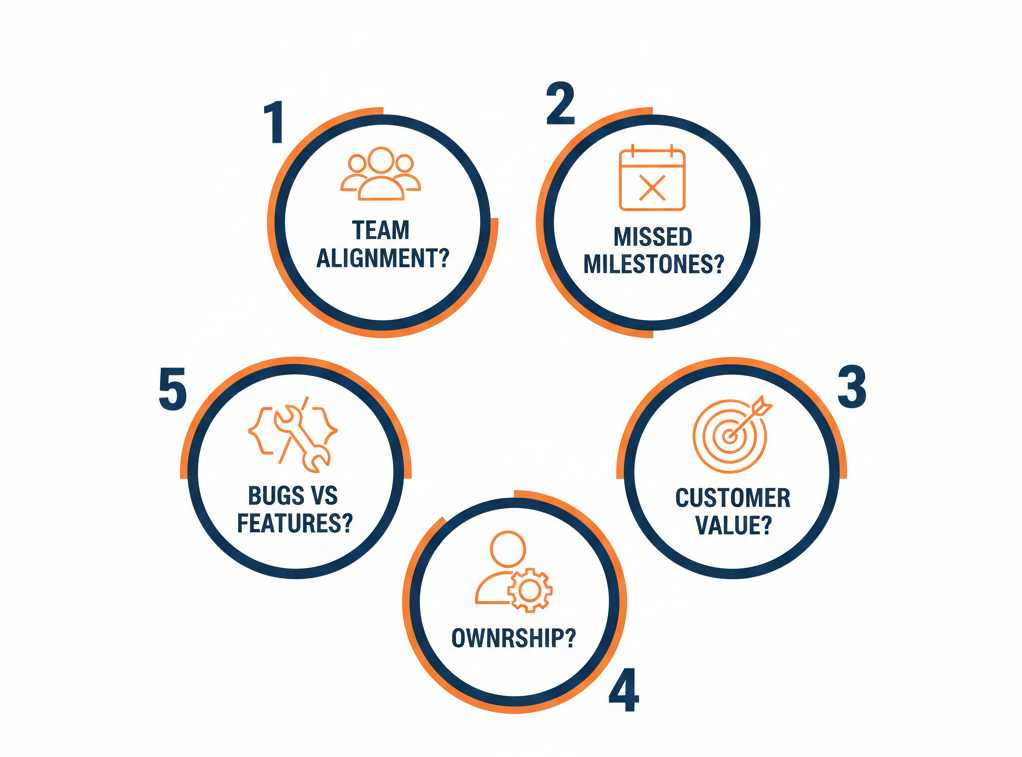
Ask yourself these five questions. Answer them honestly. Your answers will tell you exactly where the breakdown is happening.
1. “Can everyone on the team clearly articulate what we’re building and why?”
If you ask three different people what the product roadmap is, do you get three different answers? That’s not a communication problem. That’s a strategic alignment problem.
What’s really happening: Your team is building features, not solving problems. Nobody understands the “why” behind the work, so they can’t make smart trade-off decisions when things get complicated.
The fix: Stop work for 24 hours. Get the whole team in a room (or Zoom). Have each person write down the top three priorities. If they don’t match, you found your problem. Create a one-page strategy document that everyone can recite in their sleep.
DIY or Expert? You can fix this yourself if you’re willing to be brutally honest about the misalignment. Bring in an expert if the politics are too tangled or if you’ve tried this before and it didn’t stick. A fractional COO can facilitate this conversation without the baggage of internal relationships.
2. “Have we missed the same milestone three times in a row?”
One missed deadline is a hiccup. Two is a pattern. Three is a red flag waving directly in your face.
What’s really happening: This isn’t about working harder. This is about either terrible estimation, invisible blockers, or people afraid to tell you the truth about scope.
The fix: Find out which one it is. Pull the team leads into a private room. Ask them: “What’s actually stopping us?” Not what they think you want to hear. What’s actually true. Then fix that thing, not the symptom.
DIY or Expert? If your team trusts you and you suspect it’s a technical or process issue, you can tackle this internally. If you suspect politics or fear is driving the misses, bring in an outside voice. People tell consultants things they won’t tell their boss. A fractional CTO can assess technical bottlenecks without the emotional baggage.
3. “When was the last time we shipped something customers actually wanted?”
Not what was on the roadmap. Not what investors asked for. What customers actually needed and used.
What’s really happening: You’ve lost touch with your market. You’re building in a vacuum. Your product team is optimizing for internal stakeholders instead of external value.
Or someone influential on the board is pushing through their own favourite features! And everyone knows this person cannot be opposed. So they quietly get to work, knowing full well this is wasted effort.
The fix: Pick three customers. Call them yourself. Don’t send a survey. Get on the phone. Ask them what’s working, what’s broken, and what they wish existed. Then compare those answers to your current roadmap. The delta is your problem.
DIY or Expert? Founders can absolutely do customer discovery themselves. But if you’re six months behind and customers are churning. Now you need someone who can run discovery fast and translate findings into actionable priorities. A fractional CPO or embedded partner can reset your product direction in weeks, not quarters.
4. “Is there a single person who actually owns delivery end-to-end?”
If the answer is “well, the CTO handles tech and the COO handles ops and the CPO handles product and they all coordinate…” then the answer is no. Nobody owns it.
What’s really happening: Ownership is diffused. When everyone is responsible, nobody is responsible. Decisions take weeks instead of hours because three people need to weigh in on everything.
Or Nobody takes the really tough decisions. Everyone is in CYA mode. Everyone fears the axe if the decision taken turns out to be wrong down the line. This happens more often than you think because building a product is a highly dynamic process.
The fix: Pick one human being. Make them the delivery owner. Give them authority to make calls on scope, timeline, and resources. Hold them accountable for shipped work, not meetings attended.
DIY or Expert? If you have someone internally who can step up, empower them today. If your org chart is a mess of dotted lines and “collaborative decision-making,” you need outside help to untangle it. This is exactly when fractional leadership makes sense—someone who can own delivery without disrupting your existing team.
5. “Are we building new features while known bugs pile up in production?”
Check your issue tracker right now. How many critical bugs have been sitting there for more than two sprints? If the answer is “more than five,” you have a priority problem disguised as a delivery problem.
What’s really happening: Your team is afraid to tell stakeholders “no” to new features, so they keep piling on scope while the foundation crumbles. Customers are experiencing pain you already know about, but you’re too busy chasing the next shiny thing.
The fix: Declare a feature freeze. Spend one full sprint fixing what’s broken. Watch what happens to customer satisfaction when you actually solve their existing problems instead of promising future ones.
DIY or Expert? This is a discipline problem, and discipline comes from the top. You can enforce a bug bash internally. But if you’ve tried this before and people keep sneaking features back into the sprint, you need an external enforcer who doesn’t have emotional attachment to anyone’s pet projects.
Red Flags vs. Yellow Flags: What’s Urgent vs. What’s Important
Not every problem requires immediate panic. Here’s how to tell the difference between “we need help this week” and “we should address this next month.”
Red Flags (Drop Everything and Fix This)
Three missed milestones in a row
As I said earlier, this is THE red flag. If you’ve missed the same delivery commitment three times, you’re not dealing with bad luck or one-time issues. You have structural problems that will compound until something breaks catastrophically.
Your CTO, COO, or CPO just quit
Losing c-level technical or operational leadership during active delivery is a crisis, full stop. The knowledge walking out the door, the team morale impact, and the investor confidence hit will cascade fast. You have about 30 days before this becomes catastrophic.
Your largest customer is actively threatening to churn
When your biggest revenue source tells you they’re evaluating competitors, you’re looking at a potential death spiral. Lost revenue, damaged references, team morale crash, and investor panic all hit at once.
Your burn rate just jumped 40% without corresponding revenue growth
If your costs are accelerating while delivery stays flat or slows, you’re on a treadmill to nowhere. This usually means you’re throwing bodies at a problem that bodies can’t solve.
Your team has stopped talking to each other honestly
When standups become theater, when nobody admits blockers, when everyone says “it’s fine” but nothing ships—you’re watching organizational trust collapse in real-time.
Yellow Flags (Address Soon, But Don’t Panic)
Delivery is slowing, but milestones are still being hit
This is normal as teams scale. You might need process improvements or better tooling, but you’re not in crisis mode yet. Monitor it. Track the trend. But don’t throw money at it prematurely.
One key person quit, but you have coverage
Turnover happens. If someone leaves but you have cross-training and documentation in place, this is manageable. Use it as a forcing function to improve your knowledge transfer processes.
Customer complaints are rising, but churn is stable
Complaints are early warning signals. They give you time to fix things before customers leave. Take them seriously, but you’re not in firefighting mode yet.
Tech debt is accumulating, but core systems still work
Every codebase accumulates debt. If your system is still reliable and you have a plan to address debt in the next two quarters, you’re probably okay. Just don’t let it become a red flag by ignoring it completely.
Your team is working long hours, but morale is still positive
Crunch happens during launches. If people are tired but still energized about the mission, you can sustain this short-term. Just make sure “short-term” doesn’t become six months.
The 48-Hour Assessment Framework
Here’s how I diagnose delivery problems in two days. You can run this yourself or bring someone in to do it. Either way, 48 hours gives you brutal clarity.
Hour 1-8: Stakeholder Interviews
Talk to your CTO (if you still have one), your head of product, your head of ops, your biggest customer, and your most vocal team lead. Ask them the same questions:
- What’s actually blocking delivery right now?
- If you could fix one thing this week, what would it be?
- What’s the thing everyone knows but nobody’s saying out loud?
Write down everything. Don’t defend. Don’t explain. Just listen and document.
Hour 9-16: Systems and Metrics Review
Pull up your project management tool, your git activity, your customer support tickets, and your revenue dashboard. Look for patterns:
- Where are commits slowing down?
- What features are getting rewritten multiple times?
- Which customer complaints keep repeating?
- Where is money being spent vs. where value is being created?
The data doesn’t lie. If your gut says one thing and the metrics say another, trust the metrics.
Hour 17-24: Code and Process Audit
Actually look at the codebase. Check test coverage. Review the last ten pull requests. Sit in on a standup. Watch how decisions get made.
You’re looking for:
- Technical debt that’s invisible to management
- Process bottlenecks that slow down simple changes
- Cultural issues that show up in code reviews and meeting dynamics
Hour 25-40: Pattern Identification and Root Cause Analysis
Now you synthesize. What are the themes? Is this a people problem, a process problem, or a technical problem? Is it strategic misalignment or execution dysfunction?
Most delivery failures are multi-causal, but there’s usually one primary driver. Find it.
Hour 41-48: Recovery Plan Draft
You don’t need a perfect 50-page plan. You need a one-pager that answers:
- What’s the core problem?
- What needs to change this week?
- What needs to change this month?
- Who owns each change?
- How will we know if it’s working?
That’s your roadmap out of the crisis.
When to Bring in Outside Help vs. Fix It Internally
This is the question that keeps founders up at night. “Can we fix this ourselves, or do we need to bring in a consultant?”
Here’s my brutally honest take after watching hundreds of companies make this call.
Fix It Yourself If:
You have the right skills internally
If your CTO actually understands delivery management (not just technology), if your COO has run ops before (not just “figured it out”), if your CPO has shipped successful products (not just managed backlogs)—you might have what you need.
The problem is clear and you just need execution discipline
Sometimes you know exactly what’s wrong. You just haven’t made the hard calls. If that’s you, outside help won’t tell you anything new. You need internal courage, not external expertise.
You have time to learn and iterate
If you have 12-18 months of runway and stable revenue, you can afford to try, fail, and adjust. Learning by doing is valuable if you can survive the tuition.
Your team trusts the internal person leading the fix
If you have someone who can rally the team, make hard calls, and maintain morale through change—and people actually respect them—internal is often better than external.
Bring in an Expert If:
The problem is outside your core competence
If you’re brilliant technologists who’ve never managed a 20-person delivery org, guessing at operational fixes will cost you more than paying someone who’s done it before. I’ve watched founders burn six months “figuring out” what an experienced fractional COO could have fixed in six weeks.
You’ve tried to fix it before and failed
If this is your second or third attempt at the same problem, you’re missing something fundamental. An outside perspective breaks you out of your own patterns. Insanity is trying the same thing and expecting different results.
Speed matters more than cost
Bringing in a fractional CTO, COO, or embedded partner is expensive. But losing your biggest customer or missing a funding milestone is catastrophically expensive. If you need results in 30-60 days, not 6-9 months, pay for experience.
You need a truth-teller who doesn’t have political baggage
Sometimes the problem is visible to everyone except leadership. Your team knows what’s wrong but won’t say it because of org politics, fear, or loyalty. External advisors can say what your team can’t.
The cost of getting it wrong exceeds the cost of expert help
Do the math. What’s six more months of delivery delays worth? Lost revenue from churned customers? Missed fundraising window? Damaged team morale? If that number is bigger than the cost of fractional leadership for 3-6 months, the ROI is obvious.
The Hidden Cost of Doing Nothing
Here’s what nobody talks about: the cost of delay compounds faster than you think.
Every month your project stays broken:
- Your best engineers start looking elsewhere
- Your customers tell their friends to avoid you
- Your competitors ship the features you promised
- Your investors lose confidence in your execution
- Your personal stress level makes you less effective at everything else
I’ve seen founders save $50K by not hiring help, then lose $500K in missed revenue because the problem got worse instead of better. That’s not frugal. That’s expensive.
How I Help B2B SaaS Founders Get Out of Business Problems
I’ve spent three decades in the trenches with B2B SaaS companies. I’ve been the CTO who had to rebuild a broken roadmap. The COO who had to stabilize a chaotic delivery org. The embedded partner who stepped in when a C-level leader quit at the worst possible moment.
I know what delivery rescue looks like because I’ve lived it from every angle.
When you work with Cerebral Ops, here’s what actually happens:
First 48 hours: I run the diagnostic framework above. We talk to your team, review your systems, audit your processes, and identify the core problem—not just the symptoms you’re seeing.
Week 1: You get a one-page recovery plan that’s specific to your situation. Not generic advice. Not best practices pulled from a blog. Actual actionable fixes based on what’s broken in your business.
Weeks 2-12: I work embedded with your team. I’m not a consultant who writes a report and disappears. I’m in your standups, reviewing your roadmaps, making calls on priorities, coaching your team leads, and shipping actual work.
Months 3-6: We stabilize delivery, rebuild team confidence, restore customer trust, and get you back on a growth trajectory. Then I transition ownership to your internal team and step back.
This isn’t theory. It’s what I’ve done for dozens of B2B SaaS companies in the US, UK, EU, Australia, and India. Companies with $5M-$50M in revenue who were stuck, scared, and unsure how to fix delivery without blowing everything up.
If your project is failing, your CTO just quit, or your biggest customer is about to churn—you don’t have to figure this out alone.
Let’s talk. Contact us at https://cerebralops.in/contact/ or send us a direct message via WhatsApp at +91-877 995 2916.
About Cerebral Ops
Cerebral Ops helps B2B SaaS founders rescue failing delivery, stabilize operations, and accelerate growth.
We provide Fractional CTO/COO/CPO/CMO services, Delivery Rescue, and Embedded Partner support for companies with $5M-$50M in revenue across the US, UK, EU, ANZ, and India. Learn More About Us.
Unlike traditional consultants who write reports and leave, we work embedded with your team—fixing problems in real-time, making hard calls when needed, and transferring knowledge so your team can sustain the improvements after we step back.
Founder: Deepkumar Janardhanan brings 30 years of experience in Technology, Startup Operations, and Marketing. He’s been the CTO who rebuilt broken roadmaps, the COO who stabilized chaotic delivery orgs, and the embedded partner who stepped in during leadership transitions.
What we fix:
- Delivery crises (roadmaps 6+ months behind schedule)
- Leadership gaps (CTO/COO/CPO transitions)
- Customer churn risks (implementation delays, broken promises)
- Operational chaos (cross-functional dysfunction)
- Growth bottlenecks (team scaling, process breakdowns)
Where we work: We operate through local offices in the US and EU, serving clients globally.
How we’re different: We don’t just diagnose—we deliver. We’re in your standups, making calls, shipping work, and building internal capability. You get senior executive experience without the full-time cost or long-term commitment.
If your delivery is broken, your team is stuck, or your customers are threatening to leave—we can help.
Contact: https://cerebralops.in/contact/ | WhatsApp: +91-877 995 2916
Twitter/X Card Tags
html