
Generalists vs. Specialists: Building Your Early-Stage Engineering Team
You’ve just closed your seed round. Your two founding engineers are cranking out features. Product-market fit is tantalizingly close. Everything’s humming along.
Then your CTO walks into your office with a problem: “We need to hire our third engineer. Should we get another generalist who can do everything, or is it time for a specialist?”
This decision will define your next 18 months. Get it right, and you’ll accelerate toward Series A with momentum. Get it wrong, and you’ll spend the better part of a year untangling technical debt, rebuilding trust with customers, and explaining to your board why your engineering velocity dropped by 60%.
I’ve watched this play out dozens of times over three decades of building and rescuing B2B SaaS companies. The pattern is always the same: founders who nail this decision scale smoothly. Those who don’t? They call me 12 months later when everything’s on fire.
Let me show you exactly what they got wrong—and more importantly, how you can get it right.
The Third Engineer Decision That Defines Your Next 18 Months
Why This Hire Is Different
Your first two engineering hires were straightforward. You needed people who could build fast, wear multiple hats, and thrive in chaos. You probably hired generalists—full-stack developers who could touch frontend, backend, infrastructure, and everything in between.
That made perfect sense. When you’re pre-product-market fit, you need velocity above all else. You need engineers who can ship a feature on Monday, fix a database issue on Tuesday, and deploy a customer-requested integration on Wednesday. Specialists would slow you down.
But here’s what changes with hire number three: you’re no longer just building. You’re starting to scale. The difference is enormous, and most founders miss it entirely.
When you’re building, every line of code is new. When you’re scaling, you’re maintaining what you built while adding new features. The ratio starts at 100% new code and shifts toward 70% maintenance, 30% new within your first year of growth.
Your generalists excelled at building. But maintenance and scaling? That’s where the cracks start showing. And your third hire either patches those cracks or makes them worse.
The T-Shaped Engineer Myth for Early-Stage SaaS
What T-Shaped Really Means (And Why It Rarely Exists)
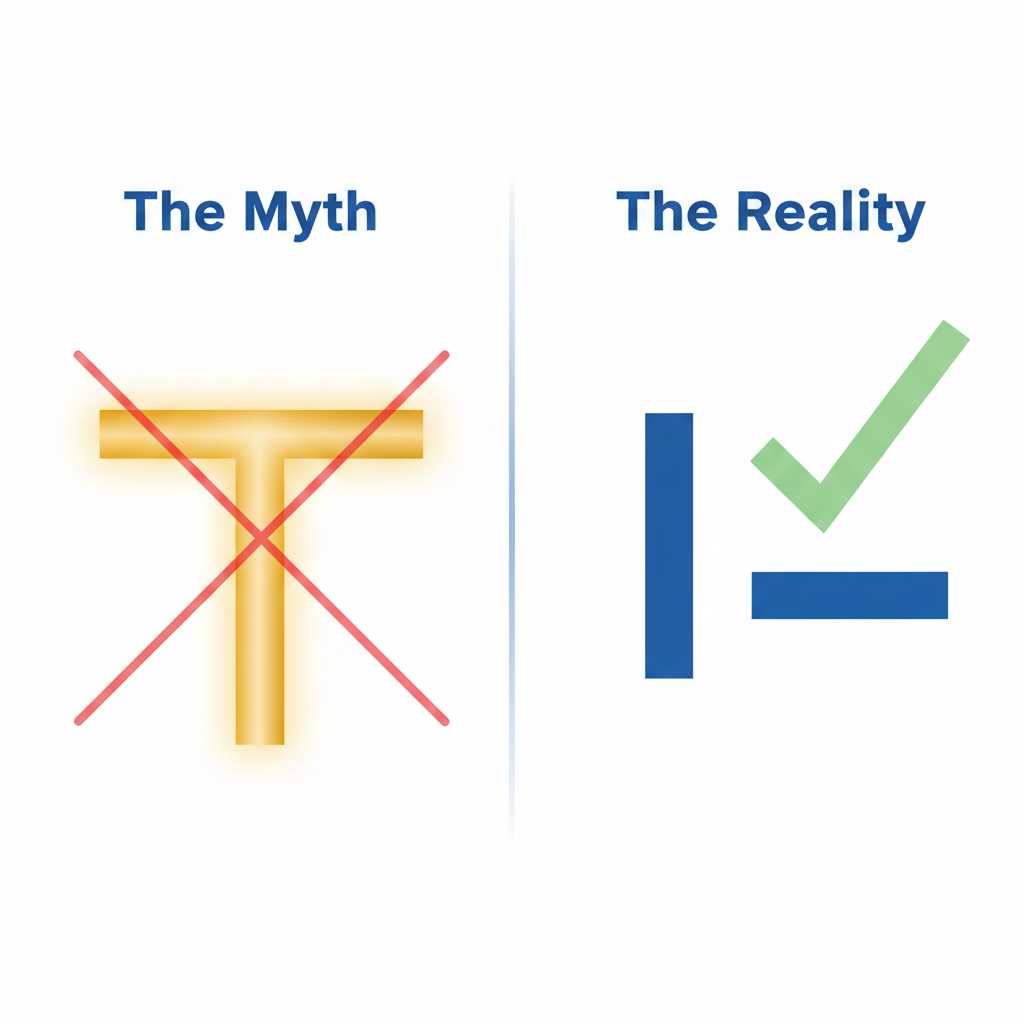
You’ve probably heard the advice: hire T-shaped engineers. They have broad knowledge across many areas (the horizontal bar) plus deep expertise in one specific domain (the vertical bar). Sounds perfect for early-stage companies, right?
Wrong. Here’s the uncomfortable truth: T-shaped engineers at the early stage are mostly a myth. Or more precisely, they’re so rare and expensive that your seed-stage budget can’t afford them.
What actually exists in the market are two types:
I-shaped engineers (specialists): Deep expertise in one area, limited breadth. Your DevOps engineer who’s brilliant at Kubernetes but hasn’t touched frontend code in three years. Your backend developer who can optimize database queries in their sleep but couldn’t center a div if their life depended on it.
Dash-shaped engineers (generalists): Broad but shallow knowledge across many domains. They can touch everything but aren’t expert at anything. They’ll get your feature shipped, but you’ll pay for it later in technical debt.
The T-shaped unicorns—engineers with genuine depth AND breadth—are getting hired by Google, or they’re founding their own companies, or they’re senior enough that their compensation packages make your CFO weep.
The Reality: You’re Hiring I-Shaped or Dash-Shaped
Once you accept this reality, the decision becomes clearer. The question isn’t “Should I hire a T-shaped engineer?” The question is: “Given my current team composition and upcoming challenges, do I need an I or a dash?”
For most early-stage B2B SaaS companies, here’s the pattern that works:
- Engineers 1-2: Dash-shaped generalists (build velocity)
- Engineer 3: Usually still dash-shaped (maintain flexibility)
- Engineers 4-5: This is where it gets interesting (we’ll come back to this)
- Engineers 6+: Increasingly I-shaped specialists (manage complexity)
But this pattern has massive exceptions based on your product, market, and technical architecture. And those exceptions are where founders make expensive mistakes.
When Generalists Accelerate (And When They Become Bottlenecks)
The Generalist Sweet Spot: 0-5 Engineers
In your first few engineering hires, generalists are your secret weapon. Here’s why:
Speed trumps perfection. When you’re racing to product-market fit, shipping matters more than pristine architecture. A generalist who can close the entire loop—frontend change, API update, database migration, deploy—will move faster than coordinating three specialists.
Context switching is minimal. With a tiny team, there aren’t that many contexts to switch between. Your two engineers know the entire codebase. They can hold the full system architecture in their heads. Adding a third generalist maintains this advantage.
Hiring is faster. Finding quality generalists is easier than finding specialists. The talent pool is larger, compensation expectations are more standardized, and you can assess capabilities more quickly in interviews.
Flexibility is maximum. When priorities shift (and they will), generalists can pivot without friction. Your frontend-focused generalist can jump to backend work if that’s where the bottleneck appears.
This is why YC and most startup advisors push generalists hard for early hires. For teams of 2-5 engineers working on a single product, it’s usually the right call.
The Warning Signs Your Generalist Is Drowning
But here’s where founders get blindsided. The same strengths that made your generalists perfect at the start become weaknesses as you scale. Watch for these warning signs:
Production incidents are increasing. When your generalist-heavy team ships features fast but breaks things often, it’s a red flag. Specialists with deep infrastructure or architecture knowledge would have caught those issues before deployment.
Code review backlog is growing. If pull requests sit for days because nobody has time to properly review them, your team is stretched too thin across too many domains. They’re context-switching so much they can’t maintain quality gates.
The same person is the single point of failure everywhere. You have one engineer who’s the only person who understands your authentication system, your payment processing, your deployment pipeline, and your database architecture. When they take vacation, velocity drops to zero. That’s a generalist who needed specialist backup six months ago.
Engineers are working on too many tickets simultaneously. If your dashboard shows each engineer touching 5-7 different parts of the system in a single sprint, they’re not going deep anywhere. They’re spreading themselves thin, and technical debt is accumulating in their wake.
Time-to-resolution for bugs is increasing. When it takes progressively longer to fix issues, it often means the codebase has grown beyond what generalists can reasonably navigate. Specialists would maintain mental models of their domain that keep resolution times stable.
The pattern I’ve seen repeatedly: these warning signs appear around engineer #5-7. Founders ignore them because “we’ve always worked this way.” By engineer #10-12, they’re in crisis mode.
The Dangerous Transition Point: 5-15 Engineers
Why This Range Breaks Most Engineering Teams
The 5-15 engineer range is where most B2B SaaS companies stumble. Here’s why it’s so dangerous:
At 5 engineers, you’re too big for pure generalist chaos. Everyone can’t know everything anymore. The codebase has grown beyond what any single person can hold in their head. You need some structure, some specialization, some domain ownership.
But at 15 engineers, you’re too small for rigid specialist silos. You can’t afford dedicated engineers for every domain. Your iOS engineer can’t sit idle while everyone else is swamped with backend work. You need flexibility that specialists don’t naturally provide.
You’re stuck in the messy middle. Not small enough for full generalist agility. Not large enough for full specialist structure. Most founders try to solve this by:
- Hiring more generalists and hoping for the best. This delays the pain but makes it worse. By engineer #12, you have a dozen people who can touch anything but aren’t expert at anything. Technical debt is compounding. Customer-facing bugs are increasing. Engineering morale is dropping because nobody can go deep enough to do truly satisfying work.
- Hiring specialists too early and creating silos. The opposite mistake: bringing in specialists at engineer #6-7, before you have enough work to keep them busy in their specialty. They get bored. They either leave or start touching other parts of the system, creating territorial conflicts with your generalists. Team dynamics deteriorate.
- Ignoring the problem entirely. Founders get busy with sales, fundraising, or product strategy. They assume their CTO or tech lead will figure it out. By the time they look up, they’re at 12 engineers with no clear team structure, overlapping responsibilities, and political infighting about who owns what.
The Hidden Costs of Getting It Wrong
When you mishandle the 5-15 engineer transition, you pay in ways that don’t show up immediately on your P&L:
Velocity collapse happens at 9-12 months. Initially, your growing team ships faster. More hands, more code. But around the 9-month mark, coordination costs start exceeding individual productivity gains. Features that took 2 weeks now take 6 weeks. Your board notices. Your customers notice. Your team notices and starts getting frustrated.
Technical debt becomes technical bankruptcy. Every shortcut your generalists took during the “move fast” phase comes due. But now you have 10 people stepping on each other’s code, so fixes take 3x longer. You’ll spend 6-12 months in “infrastructure quarter” mode, barely shipping features while you pay down debt. Your competitors ship circles around you.
Top performers leave. Your best generalists get frustrated that they can’t go deep. Your best specialists get frustrated that they can’t stay in their lane. By month 15, you’ve lost 2-3 of your strongest engineers. Recruiting costs spike. Ramp time for replacements kills another 3-4 months of productivity.
Fundraising gets harder. When investors dig into your metrics and see declining engineering velocity, increasing bug rates, and high engineer churn, they worry. Series A becomes Series A-minus. Your valuation takes a hit. You raise less capital on worse terms.
I’ve watched companies lose 12-18 months of momentum because they hired engineer #5-10 without a clear generalist-to-specialist transition strategy. The companies that get it right? They deliberately plan the transition starting at engineer #5.
How to Recognize When You Need Your First Specialist
The Four Signals That Demand Specialist Attention
Stop guessing. Here are the four concrete signals that tell you it’s time to hire your first specialist:
Signal #1: You’re spending more than 15% of engineering time on a specific domain. Track where your team’s time actually goes for 2-3 sprints. If DevOps/infrastructure consistently consumes 15%+ of total engineering hours, you need a DevOps specialist. If API performance and database optimization is a recurring theme, you need a backend specialist. The math is simple: if you’re spending 15% of 5 engineers’ time on infrastructure (0.75 FTE), hiring a dedicated DevOps engineer (1.0 FTE) who can do that work 50% faster while improving quality is an obvious win.
Signal #2: You’re repeatedly facing the same class of problems. Do production incidents always trace back to infrastructure issues? That’s a DevOps specialist signal. Are frontend bugs and user experience inconsistencies your constant pain point? Frontend specialist. Having the same category of problem recur means your generalists lack the depth to permanently solve it. They’re patching symptoms, not curing root causes.
Signal #3: Your generalists are explicitly asking for help. When your engineers start saying “We need someone who really knows X,” listen to them. They’re telling you they’ve hit the ceiling of their expertise. This usually happens with infrastructure first (Kubernetes, AWS architecture, deployment pipelines), then backend performance (database optimization, caching, API design), then frontend complexity (state management, performance, accessibility).
Signal #4: Customer-facing issues in a specific domain are increasing. Look at your support tickets and incident reports. If 40% trace back to API performance, or deployment reliability, or frontend bugs, you have a domain that’s suffering from lack of specialist attention. Your generalists are stretched too thin to maintain quality in that area.
When you see 2+ of these signals pointing at the same domain, it’s time. Don’t wait for all four. By then you’re already bleeding customers and engineer morale.
Which Specialist to Hire First
For B2B SaaS companies, the pattern is remarkably consistent:
First specialist (usually around engineer #6-8): DevOps/Infrastructure. Why? Because infrastructure problems multiply exponentially. One deployment pipeline failure affects everyone. One security vulnerability threatens the entire business. One scaling bottleneck blocks every feature. And infrastructure is the domain where generalists are most likely to cut corners that come back to haunt you.
Your DevOps specialist immediately delivers value by: reducing deployment time (so everyone ships faster), improving reliability (so everyone spends less time firefighting), implementing security best practices (so you can sell to enterprise customers), and setting up observability (so problems get caught earlier).
Second specialist (usually around engineer #10-12): Senior Backend or Platform Engineer. As your product matures, backend complexity grows faster than frontend. Your data models get more sophisticated. Your API surface area expands. Your performance requirements tighten as you land larger customers. A backend specialist owns this complexity and prevents the architectural decay that kills velocity.
Third specialist (usually around engineer #14-18): Frontend or Product Engineer. Once infrastructure and backend are stabilized, frontend becomes the differentiator. Your specialist frontend engineer makes your product feel more polished, more performant, more intuitive than competitors. They implement the design system that makes new features ship faster with consistent UX.
This is the pattern I’ve seen work for dozens of B2B SaaS companies. But it’s not universal. If you’re building a heavy data product, your first specialist might be a data engineer. If you’re building mobile-first, your first specialist might be iOS or Android. Match the specialist to your biggest pain point, not to a generic playbook.
Five Hidden Problems (And Their Solutions)
Most founders think they understand the generalist vs specialist tradeoff. But they miss these five problems that only become obvious when you’re drowning in them.
Problem 1: The “Full-Stack” Fallacy
The Problem: You hired “full-stack engineers” thinking they’d give you T-shaped flexibility. Instead, you have a team of dash-shaped generalists who do mediocre work across the entire stack. Your frontend is clunky. Your backend is slow. Your infrastructure is fragile. Nothing is excellent because nobody goes deep anywhere.
Why It Happens: The job market uses “full-stack engineer” to mean “can write both frontend and backend code.” But writing code is the easy part. The hard part is system design, performance optimization, security, accessibility, data modeling, and all the deep domain knowledge that takes years to develop. Your full-stack engineers ship features, but they’re accumulating technical debt in every layer of the stack.
The DIY Solution: Implement domain ownership even with generalists. Assign each engineer a “primary domain” where they’re expected to develop depth. Your full-stack engineer might work across the stack, but they own backend quality and are accountable for database performance. Another owns frontend quality and is accountable for user experience. Create incentives for going deep (recognition, career advancement, interesting challenges) within their domain while maintaining cross-stack capability.
The Expert Solution: Bring in a fractional CTO or technical advisor for a 3-month engagement to audit your architecture, identify the highest-risk areas of technical debt, and create a prioritized roadmap for building specialist depth where it matters most. They’ll tell you which domains need specialist attention now versus later, and help you restructure your team without killing morale or velocity. This typically costs $15K-$25K but saves you 6-12 months of wandering in the wrong direction. The ROI is obvious when you consider the cost of hiring wrong or the opportunity cost of moving slowly.
Problem 2: Context Switching Is Killing Your Velocity
The Problem: Your engineers touch 5-7 different parts of the system every week. They’re constantly switching between frontend bugs, backend features, infrastructure firefighting, and customer escalations. Each context switch costs 20-30 minutes of ramp-up time. Your team is working 50-hour weeks but accomplishing 60% of what they should.
Why It Happens: With a generalist team, every problem is everyone’s problem. There’s no clear ownership, so whoever’s available picks up the next ticket regardless of domain. This feels egalitarian and flexible, but it’s productivity poison. Studies show that developers lose 20-30 minutes of productivity per context switch. If your engineer switches contexts 6 times a day, that’s 2-3 hours of lost productivity per person per day.
The DIY Solution: Implement “theme days” or “domain sprints” where engineers focus on one domain for extended periods. Monday/Tuesday: frontend work only. Wednesday/Thursday: backend work only. Friday: infrastructure and technical debt. This reduces context switches from 6-8 per day to 1-2 per week. Velocity typically improves 20-30% immediately with zero additional hiring. Pair this with clear on-call rotations so only one person per week handles emergencies, leaving others free for deep work.
The Expert Solution: A fractional CTO or engineering consultant can design a team structure and workflow that minimizes context switching while maintaining the flexibility you need at your stage. They’ll look at your actual work patterns (pulled from Jira/Linear data), identify the expensive context switches, and redesign team composition and sprint structure to eliminate them. Typical engagement: 6-8 weeks, $12K-$20K, often pays for itself within 2-3 months through improved velocity.
Problem 3: Your Generalists Are Building Technical Debt Factories
The Problem: Every feature your team ships creates technical debt. Not because they’re bad engineers—they’re making rational tradeoffs between speed and quality. But those tradeoffs assume someone will come back and clean up later. Nobody ever does. Technical debt compounds until “later” becomes “crisis that blocks all forward progress.”
Why It Happens: Generalists optimize for shipping. That’s what you hired them for. But they lack the deep domain expertise to know which shortcuts will haunt you and which are fine. Your generalist might choose a database design that works fine for 1,000 users but will require a complete rewrite at 10,000 users. A specialist would have chosen differently from the start.
The insidious part: technical debt is invisible for months. Your velocity looks great. Features ship on time. Customers are happy. Then suddenly, around month 9-12, everything gets harder. Simple features take weeks instead of days. Bug fixes introduce new bugs. Engineering morale plummets because nothing feels simple anymore.
The DIY Solution: Implement mandatory technical debt tracking and paydown. Every feature must come with a “debt note”—what shortcuts were taken, what the future cost will be, and when you’ll pay it back. Allocate 20% of each sprint to technical debt paydown. This forces visibility and prevents debt from compounding silently. Use tools like CodeClimate or SonarQube to measure debt objectively and track trends over time.
The Expert Solution: Hire a fractional CTO for a technical debt audit. They’ll review your codebase, identify the high-interest debt (problems that will hurt you soon), separate it from low-interest debt (things you can live with for years), and create a paydown roadmap that doesn’t kill feature velocity. They’ll also train your team to make better speed-vs-quality tradeoffs going forward. Typical cost: $8K-$15K for the audit plus optional ongoing guidance. The value: avoiding the 3-6 month “infrastructure quarter” that kills momentum and frightens investors.
Problem 4: The Knowledge Silo Trap
The Problem: You avoided specialists to prevent knowledge silos, but you created them anyway. Your generalist team has developed informal specializations—Sarah always handles database stuff, Mike always deals with AWS, Chen always fixes frontend bugs. You have the worst of both worlds: the knowledge silos of specialists without the deep expertise specialists would bring.
Why It Happens: Humans naturally gravitate toward domains they’re comfortable with. Your generalists start pattern-matching: “I fixed a similar database issue last month, so I’ll grab this one too.” Over time, informal specialization emerges. The problem? These emergent specialists never had time to truly master their domain. They’re just the person who’s touched it most recently, not the person who deeply understands it.
When these informal specialists leave (or take vacation), you discover how fragile your knowledge distribution really is. Nobody else can touch their domains without significant ramp time.
The DIY Solution: Implement forced rotation and pairing. Every quarter, engineers must rotate to a different primary domain. Frontend specialists rotate to backend. Backend to infrastructure. This is uncomfortable and temporarily slows velocity by 10-15%, but it distributes knowledge and prevents single points of failure. Combine with mandatory pair programming on complex tasks—the goal is to have 2+ people who can operate effectively in each critical domain.
The Expert Solution: An engineering consultant or fractional CTO can design a knowledge management system appropriate for your stage. This might include architecture decision records (ADRs), domain ownership models with required documentation, and rotation schedules that maintain productivity while distributing knowledge. They’ll also identify which domains genuinely need specialist ownership versus which can remain shared across generalists. Typical engagement: 4-6 weeks, $8K-$12K, prevents the catastrophic knowledge loss that happens when a key generalist leaves.
Problem 5: You’re Paying Premium Prices for Junior Work
The Problem: You’re paying senior engineer salaries ($130K-$180K in the US) for work that junior specialists could do better and cheaper. Your senior generalists are spending 40% of their time on infrastructure tasks that a mid-level DevOps engineer ($110K-$140K) would handle more efficiently and to higher quality.
Why It Happens: Founders optimize for fewer headcount rather than optimal costs. They think “I’d rather pay for one senior generalist than two specialists” without doing the math on what that generalist actually does with their time. Your $160K senior full-stack engineer is spending 15 hours/week on DevOps work they’re mediocre at, 15 hours/week on frontend work they’re okay at, and only 10 hours/week on backend work where they’re actually excellent.
Meanwhile, a $120K DevOps specialist would do that infrastructure work in 8 hours instead of 15, to much higher quality, while freeing your senior engineer to focus on backend work where their deep expertise actually justifies their salary.
The DIY Solution: Do a time allocation audit. Track what your engineers actually do for 3-4 weeks. Calculate the hourly cost of each activity type. You’ll probably discover you’re paying $80/hour (senior generalist rate) for work that a $55/hour specialist would do faster and better. This data makes the hiring case obvious: one specialist hire can free up 2-3 senior generalists to work in their areas of genuine expertise, improving both quality and cost efficiency.
The Expert Solution: A fractional COO or CTO can conduct a team efficiency audit that goes beyond time tracking to analyze actual value delivery per dollar spent. They’ll model different team compositions, show you the cost and velocity implications of each, and help you make hiring decisions based on ROI rather than intuition. They’ll also handle the difficult conversations about restructuring roles when you realize your “senior full-stack engineer” should be your “staff backend engineer” and you should hire a mid-level DevOps specialist. Typical engagement: 3-4 weeks, $6K-$10K, often identifies $50K-$100K/year in team composition inefficiencies.
Building Your Engineering Team Right
The Decision Framework
Here’s the framework I use with B2B SaaS founders to make smart generalist-vs-specialist decisions:
Step 1: Map your current engineering time. For 2-3 sprints, track where hours actually go. Frontend? Backend? Infrastructure? Customer support? Bug fixes? New features? You need real data, not guesses.
Step 2: Identify your constraint. What’s limiting your growth right now? Deployment speed? API performance? Frontend polish? Customer-facing bugs? Your constraint determines your next hire.
Step 3: Calculate the cost of status quo. If you don’t change anything, what’s the cost over the next 12 months? Lost deals because your product is slow? Lost engineers because they’re frustrated? Lost velocity because technical debt is compounding?
Step 4: Compare hiring options. Model three scenarios:
- Hire another generalist (maintains status quo, cheapest short-term)
- Hire a specialist (solves specific constraint, higher short-term cost)
- Hire fractional/contract expert (gets you specialist expertise part-time, medium cost)
For each scenario, estimate: 3-month impact, 6-month impact, 12-month impact on velocity, quality, team morale, and costs.
Step 5: Make the decision and commit. Pick the option with the best 12-month return. Then commit fully. Don’t hire a specialist and then ask them to be a generalist. Don’t hire a generalist and then complain they’re not deep enough in infrastructure.
When DIY Works (And When It Doesn’t)
DIY works when:
- You’re pre-product-market fit and speed is everything
- Your team is under 5 engineers
- You have strong technical leadership (experienced CTO or tech lead)
- Your product is relatively simple technically
- You have 12+ months of runway
DIY breaks when:
- You’re past product-market fit and scaling to enterprise customers
- You’re at 6+ engineers with no clear structure
- You’re experiencing the 4 signals from earlier (>15% time in one domain, repeated problems, engineers asking for help, increasing customer issues)
- Your technical leadership is stretched too thin
- You’re within 6 months of a fundraising event where engineering velocity matters
In the DIY-breaks scenarios, the cost of getting it wrong exceeds the cost of expert help by 10-50x. You’ll waste 6-12 months, burn $200K-$500K in salary and opportunity costs, and potentially miss your market window.
That’s when bringing in a fractional CTO, engineering consultant, or embedded technical partner makes sense. You get 30 years of pattern recognition applied to your specific situation, you avoid the expensive mistakes, and you move faster.
How Cerebral Ops Helps B2B SaaS Founders Build Engineering Teams That Scale
Over 30 years, I’ve built and scaled engineering teams across dozens of B2B SaaS companies from seed through Series C. I’ve made every mistake in this article personally—and I’ve helped 50+ founders avoid making them.
Here’s what I typically do when a founder comes to me with the generalist-vs-specialist question:
Week 1: Engineering Team Audit I review your current team composition, time allocation data, technical architecture, and business goals. I interview your engineers to understand bottlenecks, frustrations, and knowledge gaps. I analyze your metrics to identify what’s actually constraining growth versus what feels urgent but isn’t critical.
Week 2-3: Strategy Development I create a 12-month hiring roadmap that’s specific to your product, market, and stage. This includes: which roles to hire when, how to structure the team, how to transition from generalist to specialist composition without killing morale or velocity, and what outcomes to expect at each stage.
Week 4+: Implementation Support I help you write job descriptions that attract the right candidates, run technical interviews that actually assess relevant skills, make offers that close candidates, and onboard new hires for maximum impact. For fractional CTO clients, I stay embedded with your team through the transition to ensure it works.
The results? Engineering teams that scale smoothly instead of hitting walls. Velocity that improves as you grow instead of collapsing. Technical debt that stays manageable instead of becoming technical bankruptcy.
Ready to build an engineering team that scales?
If you’re dealing with the generalist-vs-specialist decision right now, let’s talk. I’ve walked this path with dozens of founders in exactly your situation.
Schedule a free 30-minute strategy session where we’ll:
- Map your current engineering constraints
- Identify your optimal next 2-3 hires
- Create a basic hiring roadmap for your specific situation
- Determine if fractional CTO support makes sense for you
Or WhatsApp me directly at +91-877 995 2916. I’m happy to answer questions and point you in the right direction, even if we don’t end up working together.
You don’t have to figure this out alone. Let’s build something great together.
About the Author
Deepkumar Janardhanan is the founder of Cerebral Ops, providing Fractional CTO/COO/CPO services and embedded technical leadership to B2B SaaS companies. With 30 years of experience building and scaling technology companies from seed to exit, Deep has helped dozens of founders navigate the critical engineering team decisions that make or break growth trajectories.
Cerebral Ops works with B2B SaaS companies in the $5M-$50M revenue range across the US, UK, and EU, specializing in delivery rescue, engineering team transformation, and operational excellence for companies raising Series A through Series C.
Need help building your engineering team? Visit cerebralops.in/contact or reach out on WhatsApp at +91-877 995 2916.