
Technical Debt Is Killing Your Roadmap: How to Quantify and Prioritize It
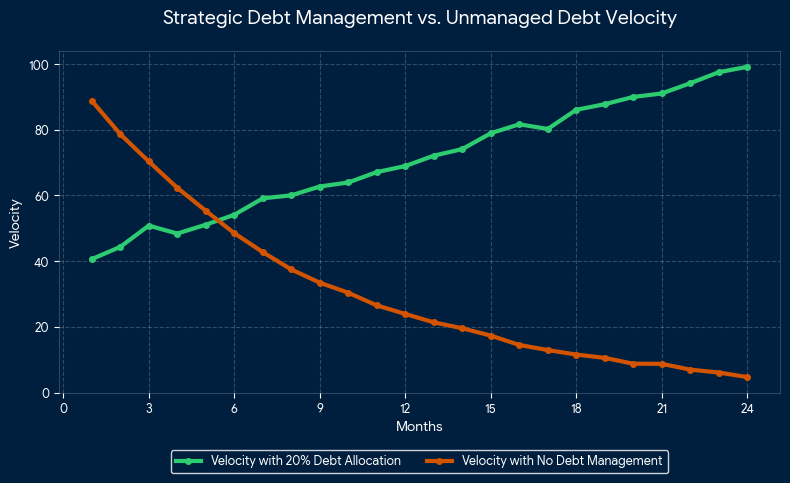
Why does everything take 3x longer than it used to? Let me show you the invisible tax you’re paying.
You’re in sprint planning. Again. And that “simple” feature everyone agreed should take two weeks? Your lead engineer just estimated it at six weeks. When you ask why, you get the familiar litany: “We need to refactor the authentication layer first,” “The payment module is held together with duct tape,” “We can’t add anything new until we update the database schema.”
Sound familiar?
Here’s the brutal truth: your velocity isn’t dying because your team suddenly forgot how to code. It’s dying because technical debt is compounding like credit card interest you’ve been ignoring for years. Every sprint, the interest payment gets larger. Every feature takes longer. Every release becomes riskier.
And nobody’s measuring it. Nobody’s prioritizing it. Nobody’s presenting it to the board in language that gets approvals and budget.
Until now.
I’ve spent 30 years rescuing B2B SaaS companies from this exact death spiral. As a Fractional CTO and COO, I’ve seen development velocity collapse under technical debt so often I can spot the warning signs before founders even realize they have a problem. The good news? Technical debt isn’t a death sentence. It’s a solvable problem—once you quantify it, prioritize it, and build a roadmap that your board will actually approve.
Let me show you how.
The Compounding Interest Rate of Technical Debt
Hidden Problem #1: The 20-40% productivity drain nobody measures
Technical debt works exactly like financial debt. You borrow time today (ship faster by cutting corners) and pay it back later with interest (slower development, more bugs, harder maintenance). The problem? Most teams never calculate the interest rate they’re paying.
Here’s what the research shows: organizations with high technical debt spend 20-40% of their engineering capacity just keeping the lights on. That’s nearly half your team’s time consumed by maintenance, bug fixes, workarounds, and fighting against your own codebase instead of building new features.
Think about that. If you’re paying your engineers $120,000 per year and you have a team of ten developers, technical debt is costing you somewhere between $240,000 and $480,000 annually in lost productivity. That’s before you even count the opportunity cost of features you didn’t ship and revenue you didn’t capture.
The compounding happens because ignored technical debt breeds more technical debt. That quick hack you shipped last quarter? It forced your team to build three more hacks this quarter to work around it. Code complexity increases. Coupling tightens. Every change touches more files. Every bug takes longer to fix. Your cycle time stretches from days to weeks.
Solution: Calculate Your Technical Debt Ratio (TDR)
The industry standard metric is Technical Debt Ratio (TDR), calculated as:
TDR = (Estimated Remediation Effort ÷ Total Development Effort) × 100
Here’s how to measure it:
- Estimate remediation effort: Have your engineering team estimate (in story points or developer-days) how long it would take to fix the major technical debt items they’re aware of. Don’t aim for perfection—a rough estimate across your top 20 debt items gives you enough signal.
- Calculate total development effort: Look at your last 6-12 months of sprint capacity. What’s your total delivered story points or developer-days?
- Do the math: If your team could deliver 500 story points worth of work in the next quarter, but you’ve identified 75 story points worth of critical technical debt, your TDR is 15%.
What’s a good TDR? Under 5% is healthy. 10-15% is manageable but requires attention. Above 20% and you’re in the danger zone where velocity starts collapsing exponentially.
Track your TDR quarterly. If it’s climbing, you’re accumulating debt faster than you’re paying it down. If it’s stable or declining, your debt management strategy is working.
Most importantly, your TDR gives you a number to show leadership. “Our TDR is 18% and climbing” is infinitely more compelling than “the code is messy and slowing us down.”
How to Measure Debt in Dollars and Delivery Days
Hidden Problem #2: “It feels slow” isn’t a business case
I’ve sat through countless engineering meetings where talented developers explained—correctly—that technical debt was killing their velocity. And I’ve watched those same developers fail to get budget approval because they couldn’t translate “the monolith is unmaintainable” into business impact.
Your board doesn’t speak in architectural patterns. They speak in dollars, days, and competitive advantage. If you want budget for debt remediation, you need to quantify the problem in their language.
Hidden Problem #3: Developers can’t articulate the pain in financial terms
Most engineers have never been taught to calculate the business cost of technical complexity. They know the code is a mess. They know it’s slowing them down. But when asked “how much is this costing us?” they shrug or throw out a wild guess.
This communication gap is why technical debt goes unfunded while the business continues demanding more features. Nobody’s connecting the dots between slow delivery and the architectural choices made two years ago.
Solution: 5 Concrete Measurement Techniques
Here’s how to measure technical debt in language your CFO and board will understand:
1. Calculate Productivity Loss in Dollars
Use this formula:
Annual Cost = (Number of Developers × Average Salary) × % Time Spent on Debt
Example: 10 developers averaging $120K salary, spending 30% of their time on technical debt issues = $360,000 per year in lost productivity.
But that’s just the direct cost. Add the opportunity cost: what features could you have shipped with that recovered time? What revenue could those features have generated?
2. Measure Velocity Degradation Over Time
Pull your sprint velocity data for the past 12-24 months. Calculate the trend line. Most teams with accumulating technical debt see velocity decline 10-25% year-over-year.
Chart it. Show leadership: “Two years ago we shipped 50 story points per sprint. Today we ship 35. That’s a 30% velocity loss. At our current pace, we’ll be at 25 story points by next year.”
That visual hits different than “the code is hard to work with.”
3. Track Cycle Time Increase
Measure how long it takes to move a feature from “ready for development” to “deployed in production.” Break it down by feature size (small, medium, large).
If your median cycle time for medium features has gone from 8 days to 15 days over the past year, that’s a 87% increase. Every feature now takes almost twice as long to ship.
Calculate what this means for time-to-market and competitive positioning. If your competitor can ship in 8 days and you need 15, they’re iterating twice as fast as you are.
4. Identify Code Hotspots
Use code analysis tools to identify files with the highest churn rate (files that get modified most frequently). These hotspots typically represent 10-20% of your codebase but consume 60-80% of debugging time.
Calculate the hours spent per quarter fixing bugs in your top 10 hotspots. Multiply by your hourly developer cost. That’s your hotspot tax.
Example: Your authentication module gets touched in 40% of all sprints, generates 30% of production bugs, and consumes an average of 15 developer-hours per sprint for bug fixes. At $75/hour fully loaded cost, that single module is costing you $1,125 per sprint or ~$29,000 per year.
5. Measure the Velocity Tax
Compare your team’s velocity to industry benchmarks for similar-sized B2B SaaS companies. Tools like DORA metrics and LinearB provide benchmarking data.
If healthy teams in your industry ship features 40-60% faster than you do, you’re paying a significant velocity tax. Quantify it: “Our competitors release weekly. We release monthly. In the time they ship 12 iterations, we ship 3. That’s 9 missed opportunities to capture feedback, improve conversion, and stay ahead.”
DIY vs. Expert Approach
You can implement these measurements yourself using sprint tracking tools (Jira, Linear), code analysis tools (SonarQube, CodeClimate), and basic spreadsheet analysis. Budget: $500-2000/month in tools plus 10-15 hours of engineering time to set up dashboards.
Why bring in a Fractional CTO? Speed and objectivity. I can instrument these metrics in 1-2 weeks instead of 1-2 months, and I bring external credibility that internal teams often lack when presenting bad news to leadership. More importantly, I’ve presented technical debt business cases to dozens of boards—I know which numbers resonate and which get ignored.
The ROI math is simple: if your technical debt is costing you $400K annually in lost productivity, spending $15-25K on fractional CTO expertise to quantify, prioritize, and build the remediation roadmap pays for itself in weeks, not months.
The Prioritization Matrix: Pain vs. Payoff
Hidden Problem #4: Everything feels urgent, nothing gets fixed
I see this pattern constantly: engineering teams maintain massive technical debt backlogs where everything is marked “high priority.” Authentication needs refactoring. The database schema is a mess. The monolith should be broken up. The payment integration is brittle. The test coverage is under 30%.
All true. All important. And all equally unfunded because leadership can’t figure out where to start.
When everything is priority one, nothing is priority one. Your team burns out fighting fires while the strategic architectural improvements that would actually solve the underlying problems never get scheduled.
Solution: The Pain-Payoff Quadrant Framework
Here’s the prioritization matrix I use with every B2B SaaS client:
Map each technical debt item on two axes:
X-Axis (Effort to Fix): Low effort → High effort
Y-Axis (Business Pain/Impact): Low pain → High pain
This creates four quadrants:
Quadrant 1: Quick Wins (High Pain, Low Effort)
These are your gold mines. Major pain points that can be fixed quickly.
Examples:
- Upgrading a critical library that’s three versions behind (2 days of work, eliminates 40% of security vulnerabilities)
- Adding database indexes to slow queries (1 day of work, cuts API response time by 60%)
- Refactoring the most frequently modified 500-line function (3 days of work, reduces 80% of bugs in that module)
Strategy: Ship these immediately. Get wins on the board. Show leadership that technical debt remediation delivers measurable results fast.
Quadrant 2: Strategic Investments (High Pain, High Effort)
These are your big architectural improvements that will take quarters, not weeks.
Examples:
- Breaking up the monolith into microservices
- Migrating from legacy framework to modern stack
- Complete payment system rewrite
- Database sharding implementation
Strategy: Build the business case using the measurement techniques from Section 2. Show the long-term velocity ROI. Break into phases. Ship incremental value. Get these on your roadmap with protected time.
Quadrant 3: Defer (Low Pain, Low Effort)
Nice-to-haves that aren’t causing real problems yet.
Examples:
- Code style inconsistencies
- Minor test coverage gaps in stable code
- Deprecated but functional API endpoints with no current usage
Strategy: Document these. Revisit quarterly. Let them sit unless they migrate into higher-pain quadrants.
Quadrant 4: Avoid (Low Pain, High Effort)
The trap. Massive efforts that won’t move the needle on velocity or quality.
Examples:
- Rewriting working code just because it’s “old”
- Over-engineering for scale you won’t hit for 3+ years
- Perfectionist refactoring of rarely-touched modules
Strategy: Say no. Explicitly. Document why you’re not doing these to prevent them from creeping back onto the roadmap every quarter.
Implementation Framework:
- Workshop with your team (4 hours): List all known technical debt items. For each one, estimate effort (story points or days) and score business pain (0-10 scale based on: How often does this cause bugs? How much does it slow us down? What’s the risk if we ignore it?).
- Plot the matrix: Use a simple spreadsheet or Miro board. Place each item in the appropriate quadrant.
- Prioritize within quadrants: Within Quick Wins, rank by pain score. Within Strategic Investments, rank by velocity ROI.
- Set allocation rules:
- Quick Wins: Start immediately, aim to clear 80% within one quarter
- Strategic Investments: Pick your top 2-3, allocate dedicated sprint capacity
- Defer: Review quarterly
- Avoid: Say no and document why
This framework does something crucial: it makes prioritization decisions visible and defensible. When a stakeholder asks “why aren’t we fixing X?” you can point to the matrix and show exactly where it falls and why other items deliver more impact per unit of effort.
The 80/20 rule applies viciously to technical debt. Roughly 20% of your debt items cause 80% of your velocity problems. The Pain-Payoff matrix helps you identify that 20% and attack it systematically instead of randomly firefighting whatever broke most recently.
Creating a Debt Paydown Roadmap Your Board Will Approve
Hidden Problem #5: Technical debt roadmaps get ignored or rejected
I’ve reviewed hundreds of technical roadmaps over my career. The ones that fail share a common pattern: they treat technical debt as a separate track parallel to the product roadmap.
“We need Q1 for refactoring, then we’ll get back to features in Q2.”
This fails for two reasons:
First, it asks the business to stop revenue-generating work for an entire quarter to fix invisible problems. That’s a non-starter for most boards.
Second, it creates an adversarial relationship between engineering and product. Engineers want time to “fix things.” Product wants new features. Everyone loses.
Solution: The Integrated Debt Roadmap
The roadmaps that get approved and actually deliver results embed technical debt remediation into the product roadmap as a first-class concern, not an afterthought.
Here’s the framework:
Step 1: Calculate the Velocity ROI
For each major debt item in your Strategic Investments quadrant, calculate the velocity improvement if you fix it.
Example: Your monolithic architecture slows down every new feature by an average of 3 days because of tight coupling and fragile dependencies. You ship roughly 12 features per quarter. That’s 36 days of overhead per quarter.
If you invest 8 weeks to break out your most-coupled module into a microservice, you’ll recover 12 days per quarter going forward. Payback period: 6 quarters. But the velocity improvement is permanent and compounds.
Show this math to your board. “We invest 8 weeks once to save 12 days every quarter thereafter. By Q3 next year, we’re net positive. By year two, we’re 25% faster at shipping features.”
That’s a business case leadership understands.
Step 2: Bundle Debt Paydown with Feature Work
Instead of “Q1 is refactoring, Q2 is features,” structure your roadmap as:
Q1 Goal: Ship Payment Integration V2 + Modernize Payment Architecture
- Week 1-2: Extract payment logic into isolated service (debt paydown)
- Week 3-6: Build new Stripe integration on clean architecture (feature)
- Week 7-8: Migrate existing payment flows (debt paydown + risk reduction)
This approach delivers the feature the business wants while permanently improving the architecture. Stakeholders see new capabilities shipping. Engineers see systemic improvements happening.
Step 3: Protect 15-20% Sprint Capacity for Technical Health
This is non-negotiable. Every sprint, 15-20% of your team’s capacity is reserved for:
- Quick wins from the Pain-Payoff matrix
- Incremental progress on strategic debt items
- Proactive refactoring of code being modified for features
- Test coverage improvements
- Security patches and dependency updates
I call this the “technical health tax.” It’s the minimum payment required to keep debt from compounding faster than you can pay it down.
Make this visible on your roadmap. Don’t hide it. Show leadership: “17% of sprint capacity goes to technical health. This keeps our velocity stable. Without it, we’d see continued 10-15% yearly velocity degradation.”
Step 4: Build the Business Case Framework
When presenting to your board, structure your debt remediation request around three pillars:
Pillar 1: Velocity ROI
- Current velocity: X story points per sprint
- Velocity after debt reduction: Y story points per sprint
- Business impact: Z% more features shipped per quarter
Pillar 2: Risk Reduction
- Security vulnerabilities eliminated
- Compliance issues resolved
- System stability improvements (fewer outages, faster recovery)
- Technical due diligence prep (if acquisition is a possibility)
Pillar 3: Competitive Positioning
- Time-to-market improvements
- Feature parity with competitors
- Ability to respond to market changes faster
Use real numbers from your measurement work in Section 2. Show the trend lines. Demonstrate what happens if you don’t address the debt (continued velocity decline, increasing bug rates, growing security exposure).
Step 5: Show Incremental Progress
Break large debt items into phases that deliver measurable value every 4-8 weeks. Boards hate “trust us, it’ll be better in 6 months.” They love “here’s what improved this month.”
Example: Instead of “6-month monolith breakup project,” show:
- Month 1: Extract user service, improve login performance by 40%
- Month 2: Extract notification service, reduce email bugs by 60%
- Month 3: Extract reporting service, enable new analytics features
- Month 4-6: Continue extraction, measure velocity improvements
Each phase proves the value of the investment and builds confidence for continued funding.
Why Fractional CTO Expertise Matters Here
Building board-approved technical roadmaps requires fluency in two languages: engineering and finance. Most CTOs excel at one but struggle with the other.
As a Fractional CTO, I spend half my time with engineering teams understanding the technical constraints and half my time with boards translating those constraints into business impact. I’ve presented technical debt business cases to dozens of boards, PE firms, and operating partners. I know which metrics they care about (velocity ROI, risk reduction, competitive positioning) and which ones they ignore (code complexity scores, cyclomatic complexity, architecture purity).
More importantly, I bring external credibility. When an internal CTO says “we need to refactor,” boards sometimes hear “engineers want to play with new toys.” When a Fractional CTO with 30 years of experience across dozens of companies says “this organization’s TDR of 23% is in the danger zone and will cause material business impact if not addressed,” boards listen.
The investment in fractional expertise typically pays for itself in one board meeting. Instead of getting your technical debt request deferred again, you get approved funding, protected capacity, and board-level buy-in for systematic improvement.
Your Velocity Isn’t a People Problem. It’s a Debt Problem.
Here’s the conversation I have at least once a month:
Founder: “My team used to be so productive. Now everything takes forever. I think I need to hire better engineers.”
Me: “How much technical debt are you carrying?”
Founder: “I mean, sure, the code isn’t perfect, but—”
Me: “What’s your Technical Debt Ratio?”
Founder: “We don’t really measure that.”
Me: “When’s the last time you allocated sprint capacity to fixing architectural problems?”
Founder: “We can’t afford to. We’re racing to hit our revenue targets.”
Here’s the brutal truth: you can’t hire your way out of technical debt.
Adding more developers to a codebase with 20%+ technical debt doesn’t speed you up. It slows you down further. More people mean more coordination overhead, more chances for conflicting changes, more time explaining the workarounds and landmines buried in your architecture.
I’ve seen teams double their engineering headcount and watch their velocity stay flat or even decline. Why? Because the problem wasn’t insufficient resources. The problem was structural inefficiency in the codebase that made every additional person less effective.
The fix isn’t more people. The fix is paying down the debt that’s making your existing team unproductive.
The Cultural Shift You Need
Treating technical debt as a first-class concern requires a fundamental shift in how you think about engineering capacity:
Old mindset: “Engineering’s job is to ship features. Everything else is overhead.”
New mindset: “Engineering’s job is to ship features sustainably at high velocity. Technical health is what enables sustained velocity.”
This shift starts at the top. If your CEO views refactoring as wasted time, your team will never get the capacity they need to pay down debt. If your board sees technical debt reduction as nice-to-have instead of business-critical, your roadmap will always prioritize short-term feature velocity over long-term architectural health.
Leadership has to make technical debt visible, measurable, and funded. That means:
- Tracking TDR quarterly alongside revenue, churn, and other key metrics
- Protecting 15-20% sprint capacity for technical health as religiously as you protect sales team quotas
- Celebrating debt reduction wins with the same enthusiasm you celebrate feature launches
- Holding teams accountable for not accumulating new debt on top of old debt
The 20% Sprint Allocation Rule
Let me be specific about what “protecting capacity” means:
Every sprint, 15-20% of your story points are allocated to technical health before any feature work gets planned. This is non-negotiable capacity that the team controls.
They use it for:
- Quick wins from your Pain-Payoff matrix
- Incremental progress on strategic architectural improvements
- Boy Scout rule refactoring (leave code better than you found it)
- Test coverage for critical paths
- Security updates and dependency maintenance
- Technical exploration for upcoming feature work
This isn’t “slack time” or “engineers playing around.” This is the minimum investment required to prevent velocity from degrading over time.
Think of it like this: if you never did maintenance on your car—no oil changes, no tire rotations, no brake replacements—it would run fine for a while. Then performance would gradually decline. Then one day it would catastrophically fail.
Your codebase works the same way. The 20% rule is your maintenance schedule. Skip it long enough and you’ll end up in the engineering equivalent of catastrophic engine failure: a complete rewrite that costs 10x more than preventive maintenance would have.
Moving from Blame to Systems
When velocity collapses, the natural instinct is to blame people. The team isn’t working hard enough. The architect made bad decisions. The product manager keeps changing requirements.
But velocity problems are almost never people problems. They’re systems problems.
Your best engineers are working nights and weekends and still can’t ship features fast enough—not because they’re incompetent, but because every change requires modifying 47 files across 12 modules and coordinating with 5 other developers to avoid breaking things.
Your talented architect is drowning in firefighting—not because their original design was stupid, but because the business kept demanding features the architecture wasn’t designed to support and nobody allocated time to evolve the architecture alongside the feature demands.
Your product manager keeps getting frustrated with engineering estimates—not because they’re unreasonable, but because nobody’s translating “we have to refactor the payment module first” into business impact they can weigh against feature priorities.
Fix the system. Measure the debt. Prioritize systematically. Allocate capacity. Hold the line.
Your velocity will recover. Your team will be happier. Your business will ship faster.
And you’ll stop having those painful sprint planning meetings where simple features take six weeks.
How Cerebral Ops Helps B2B SaaS Companies Reclaim Their Velocity
Over 30 years, I’ve worked with hundreds of B2B SaaS companies facing the same velocity death spiral. Development slowing down. Technical debt compounding. Teams burning out. Boards demanding more features while engineering begs for time to fix foundational problems.
The pattern is consistent. The solution is systematic.
At Cerebral Ops, we help B2B SaaS founders, operating partners, and PE investors turn technical debt from an invisible productivity killer into a measured, prioritized, manageable part of your roadmap.
Here’s how we work:
Week 1-2: Quantify the Problem
- Calculate your Technical Debt Ratio
- Measure velocity degradation trends
- Identify code hotspots consuming disproportionate maintenance time
- Translate technical complexity into business impact (dollars, days, competitive risk)
Week 3-4: Prioritize Using Pain-Payoff Framework
- Workshop with your engineering team to inventory debt items
- Map to the prioritization matrix
- Identify quick wins for immediate velocity improvement
- Build business cases for strategic architectural investments
Week 5-6: Create Board-Approved Roadmap
- Embed debt remediation into product roadmap
- Calculate velocity ROI for major debt items
- Structure incremental progress with measurable milestones
- Present business case to board/investors using their language (revenue impact, risk reduction, competitive positioning)
Ongoing: Embedded Partner Support
- Quarterly TDR tracking and trend analysis
- Coaching engineering leaders on debt communication
- Roadmap adjustment as priorities shift
- Board presentation support and translation
We work as Fractional CTO/COO/Embedded Partners—which means you get 30 years of experience across multiple companies and industries without the cost and commitment of a full-time executive hire.
We’ve helped companies:
- Recover 40% velocity by systematically paying down high-impact debt
- Get board approval for 6-figure technical remediation budgets by presenting clear ROI
- Reduce time-to-market from 8 weeks to 3 weeks for new features
- Pass technical due diligence for acquisitions by proactively addressing architectural risks
- Improve engineering retention by eliminating the frustration of fighting against your own codebase
If your development velocity is slowing down, if features that should take days now take weeks, if your board keeps asking why engineering needs more time and resources—let’s talk.
We serve B2B SaaS companies in the $5M-50M revenue range across the US, UK, EU, ANZ, and India through our local offices.
Ready to Turn Your Velocity Problem into a Competitive Advantage?
Technical debt doesn’t have to kill your roadmap. With the right measurement, prioritization, and roadmap integration, you can pay down debt systematically while continuing to ship features your customers need.
Let’s quantify what’s slowing you down and build a plan your board will approve.
Contact us:
- Website: https://cerebralops.in/contact/
- WhatsApp: +91-877 995 2916
Let’s reclaim your velocity together.
About the Author
Deepkumar Janardhanan is the founder of Cerebral Ops, specializing in Fractional CTO/COO/CPO/CMO roles as well as Delivery Rescue and Embedded Partner roles for B2B SaaS companies. With 30 years of experience in technology, startup operations, and marketing across the US, UK, EU, ANZ, and India, Deep helps founders turn operational chaos into competitive advantage.
Cerebral Ops works with B2B SaaS companies in the $5M-50M revenue range, providing fractional leadership expertise without the commitment and cost of full-time executive hires. We specialize in technical debt remediation, velocity recovery, operational efficiency, and translating complex technical challenges into board-approved business strategies.
Whether you’re facing a technical crisis, preparing for due diligence, or simply want to scale more efficiently, Cerebral Ops brings the strategic and tactical expertise to accelerate your growth.
Connect with Deep:
- Email: hello@cerebralops.in
- LinkedIn: linkedin.com/in/djanardhanan
- Website: cerebralops.in
Want more insights on B2B SaaS operations, technical leadership, and growth strategy? Subscribe to the Cerebral Ops blog for weekly articles on turning operational challenges into competitive advantages.
Related Articles:
- 7 Hidden Operational Bottlenecks Killing Your Startup’s Growth (2025 Guide)
- Why Most B2B SaaS Companies Still Can’t Measure Marketing ROI in 2025
- Creating SLAs for Small Business Success: A Practical Guide
Keywords: technical debt prioritization, measuring technical debt, technical debt roadmap, development velocity, B2B SaaS, sprint velocity, code quality metrics, fractional CTO, engineering leadership, velocity ROI
!– ARTICLE SCHEMA (JSON-LD) –>