
Customer Onboarding Is Where Your Deals Go to Die: How to Fix It
You closed the deal. Celebrated. Then… crickets. 90 days later they churn. Here’s why.
Picture this: Your sales team just closed a $50K annual contract. Champagne emojis in Slack. High-fives all around. The founder breathes easier for exactly 48 hours.
Then reality hits.
Three months later, that customer churns. They never got value. Never hit their first milestone. Your CS team is confused—”We sent them emails!” Your sales rep shrugs—”They signed, didn’t they?” Your CFO is doing math that makes everyone uncomfortable.
Here’s the brutal truth nobody wants to say out loud: Your sales team is crushing it, but your business is bleeding revenue through a hole you can’t see on your dashboard.
That hole? It’s called customer onboarding. And it’s where most SaaS deals go to die.
I’ve seen this movie a hundred times. Fast-growing B2B SaaS company, revenue climbing, sales team celebrating. Then six months later, the board meeting gets awkward. Churn is creeping up. Net revenue retention is dropping. And everyone’s pointing fingers.
The problem isn’t your product. It’s not your pricing. It’s not even your customers.
It’s the 90-day gap between “sold” and “actually using your product to solve their problem.”
Let’s fix it.
The Invisible Graveyard: Where Your Deals Actually Die
You know what’s worse than losing a prospect? Losing a customer you already paid to acquire.
Every churned customer in their first 90 days represents:
- Wasted CAC (Customer Acquisition Cost)
- Lost expansion revenue
- A reference customer that will never materialize
- A team that’s slowly losing faith in the product
But here’s what makes this truly painful: Most of these deaths are preventable. They don’t die because your product is bad. They die because nobody helped them get to value fast enough.
Let me walk you through the two silent killers that create this invisible graveyard.
Problem 1: The Black Hole Between Sales and Customer Success
Your sales team closes the deal on Friday. Celebration time.
Monday morning, the customer gets… nothing. No welcome email. No kickoff scheduled. No clear next steps.
Tuesday, they email their sales rep asking what happens next. The rep forwards it to CS. CS doesn’t see it until Wednesday because they’re underwater with other customers.
Thursday, someone finally responds: “Let’s schedule a kickoff call for next week!”
Two weeks have passed. Your customer’s excitement is already fading.
This is what I call “the black hole”—that terrifying period where the customer has signed the contract but nobody is actively driving them toward value. No clear owner. No structured process. Just a bunch of people assuming someone else is handling it.
Sound familiar?
I’ve watched companies lose 30% of their new customers in this black hole. Not because the product didn’t work. But because nobody owned the transition from “sold” to “activated.”
The Fix: Structured Handoff Rituals with Real Accountability
Here’s what winning companies do differently:
Within 24 hours of contract signature, the customer receives:
- A welcome email from their dedicated CS manager (yes, assigned before the deal closed)
- A clear 30-day success plan showing exactly what happens when
- A scheduled kickoff call within 5 business days
- Access credentials and getting-started resources
Within 48 hours, there’s an internal handoff meeting where:
- Sales transfers complete customer context (goals, pain points, buying committee dynamics)
- CS reviews the success plan with sales still in the room
- Engineering flags any technical requirements or potential blockers
- Everyone agrees on the first-value milestone and date
This isn’t rocket science. It’s just discipline. But here’s why most companies don’t do it: It requires sales to stay involved past the signature.
That’s uncomfortable. Sales wants to move on to the next deal. But guess what? If that customer churns in 90 days, your CAC just went to zero. You’re running on a treadmill, not building a business.
DIY Approach: Create a simple handoff checklist. Make it mandatory. Tie comp to it if you have to. Schedule a recurring 30-minute weekly meeting where sales and CS review every new deal closed in the past 7 days.
Expert Approach: Bring in someone who’s built these handoff systems dozens of times. They’ll set up the rituals, train your team, and most importantly—get buy-in from sales leadership. This typically pays for itself within one quarter through improved retention alone.
Problem 2: Nobody Owns Days 1-30
Here’s a question that should be easy to answer but usually isn’t:
Who is personally accountable for getting each new customer to their first value milestone within 30 days?
If you hesitated, you’ve found your problem.
In most SaaS companies, onboarding is a relay race where everyone thinks someone else has the baton:
- Sales thinks CS owns it
- CS thinks implementation owns it
- Implementation thinks the customer owns it
- The customer thinks you own it
Meanwhile, 25 days have passed and nothing has happened except a few emails and a kickoff call where everyone nodded politely.
I’ve seen companies with beautiful onboarding workflows, perfect email sequences, and comprehensive documentation. But when I ask, “Who wakes up every morning thinking about getting Customer X to their first win by Day 30?”—I get blank stares.
That’s the problem. Processes don’t drive results. People do.
The Fix: Clear Ownership Mapping and Success Milestones
Here’s the framework that actually works:
Assign a single owner for every new customer—call them whatever you want (Onboarding Manager, Implementation Specialist, Customer Success Manager). That person is personally accountable for one outcome: Customer achieves first measurable value within 30 days.
Not “completes onboarding.” Not “attends training sessions.” But gets real value from your product.
What does this owner do?
Days 1-7:
- Conduct kickoff call within 5 days
- Complete technical setup
- Get at least 3 users actively logging in
- Identify the first-value milestone (specific to this customer)
Days 8-21:
- Weekly check-ins (not status updates—actual problem-solving sessions)
- Remove blockers proactively
- Escalate technical issues immediately
- Adjust the plan if the customer’s reality changed
Days 22-30:
- Drive toward the first-value milestone
- Document what worked
- Celebrate the win (seriously—make it a thing)
- Transition to ongoing CS management
Notice what’s missing? Lengthy training sessions. Comprehensive feature tours. “Best practice” webinars.
Why? Because none of that matters if the customer doesn’t get value fast. You can train them on advanced features later—after they’ve seen the product actually solve their problem.
DIY Approach: Map your current onboarding journey. Identify who touches the customer when. Then consolidate ownership to one person per customer. Define what “first value” means for different customer segments. Track days-to-first-value religiously.
Expert Approach: Someone who’s built CS teams knows exactly how to structure this ownership model, what to measure, how to staff it efficiently, and how to scale it as you grow. They’ve made all the mistakes already—on someone else’s dime. For a $10-50M ARR company, this usually means getting to value 40-60% faster, which translates to significantly better retention economics.
Time-to-Value: Why 90 Days Is a Death Sentence in Modern SaaS
Let me tell you about two companies I worked with in the same vertical. Both had great products. Both charged similar prices. Both targeted mid-market B2B customers.
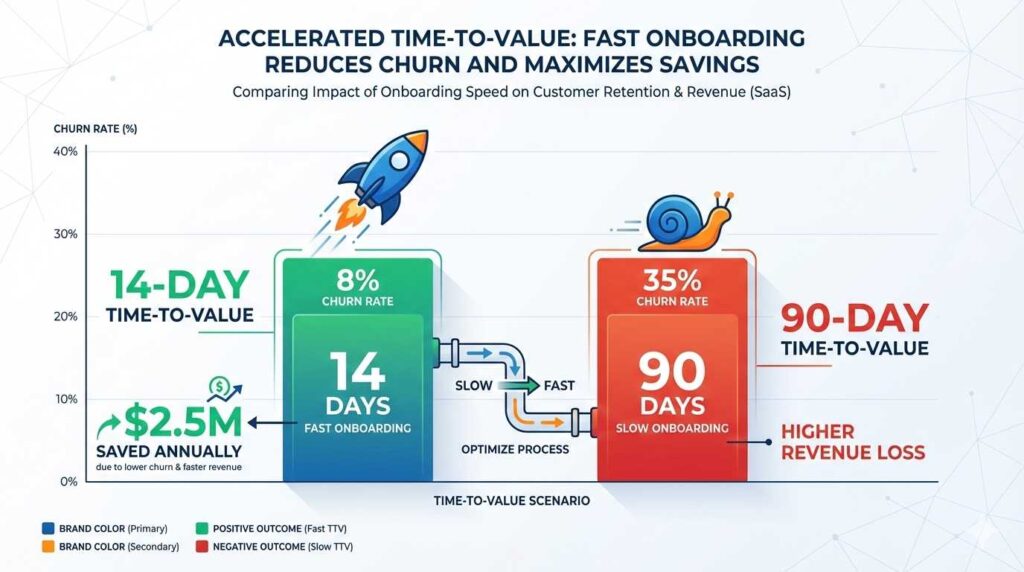
Company A got customers to first value in 14 days. Company B took 90 days.
Guess which one had 8% annual churn and which one had 35%?
Here’s what makes this worse: Company B’s founders genuinely believed 90 days was “industry standard” for their complexity level. They’d built this elaborate onboarding program with training sessions, certification courses, and comprehensive documentation.
Meanwhile, Company A had stripped everything down to one question: What’s the fastest path to this customer solving their first real problem with our product?
The difference in outcomes wasn’t subtle. It was catastrophic.
Problem 3: Your Competitors Activate in 14 Days, You Take 90
Time-to-value (TTV) isn’t just a metric. It’s a race against your customer’s patience, budget scrutiny, and internal political capital.
Here’s what happens in that 90-day window while you’re “properly onboarding” them:
Week 2: Your champion who bought the product gets pulled into a company crisis. They stop responding to your emails.
Week 4: The CFO starts asking questions: “We’re paying $50K/year for this. What results have we seen?”
Week 6: Someone mentions a competitor that promises faster results. “Should we have gone with them instead?”
Week 8: Your champion is now defensive about their purchase decision. They stop advocating internally.
Week 10: The renewal conversation starts early. And it’s not going well.
Week 12: You’re scrambling to show any value. But 90 days of organizational momentum is hard to reverse.
Meanwhile, your competitor who gets customers to value in 14 days? Their champion is a hero by Week 3. By Week 6, they’re expanding usage. By Week 12, they’re a reference customer and already renewed early.
The brutal math: Every extra week in your time-to-value increases your churn risk by 5-8%. A 90-day TTV versus a 14-day TTV isn’t 6x worse. It’s an entirely different business model.
I’ve seen companies with incredible products lose to inferior competitors purely because they couldn’t get customers to value fast enough. The customer never saw the product’s full potential—they churned before they got there.
The Fix: Reverse-Engineer the Activation Path
Most companies build onboarding programs forward: “What should we teach customers?” Wrong question.
The right question: “What’s the absolute minimum this customer needs to do to solve their first real problem?”
Here’s how to find that path:
Step 1: Define Your First-Value Milestone
Not “completed training.” Not “integrated the API.” But actual business value.
Examples:
- Project management software: “Customer’s team successfully completed their first project sprint using our tool”
- Analytics platform: “Customer generated their first actionable insight that changed a business decision”
- Marketing automation: “Customer sent their first campaign and saw measurable engagement lift”
Get specific. “User logged in” is not value. “User accomplished [specific outcome] faster than their old process” is value.
Step 2: Map the Critical Path Backward
Start with that first-value milestone. Work backward:
- What does the customer need to DO right before achieving this?
- What do they need to KNOW to do that?
- What needs to be SET UP for them to know that?
Keep asking “What’s the prerequisite?” until you get back to Day 1.
Now here’s the magic: Everything NOT on this critical path gets deprioritized.
That advanced feature training? Push it to Week 6—after they’ve seen value. That comprehensive best-practices webinar? Make it optional. That 47-page implementation guide? Condense it to the critical path only.
Step 3: Remove Every Unnecessary Step
I once audited a company’s onboarding process. They had customers do 23 things before they could get their first value. When I asked “Why?” for each step, 14 of them were “We’ve always done it this way.”
We cut it to 9 steps. Time-to-value dropped from 67 days to 18 days. Churn dropped by 40% over the next two quarters.
Look at your onboarding process. For each step, ask:
- Is this required for first value, or just “nice to have”?
- Can this be automated instead of manual?
- Can this happen AFTER first value instead of before?
Be ruthless. Your customer’s patience is not unlimited.
Step 4: Build for the 80%, Not the 100%
The perfectionist trap: “But some customers need [complex feature] configured before they can start!”
Yes. Some. How many? Usually 10-20%.
Design your critical path for the 80% who need the simple path. Build an express lane for them. The 20% who need complexity? They get a different onboarding model (we’ll cover that in the next section).
DIY Approach: Get your CS team in a room. Map your current onboarding journey on a whiteboard. Circle everything required for first value. Cross out everything else. Rebuild the process around just the circled items. Test with your next 10 new customers. Measure time-to-first-value before and after.
Expert Approach: Someone who’s optimized dozens of onboarding processes can spot inefficiencies you’re blind to because you’re too close to it. They’ve seen what works across industries, customer segments, and product complexities. They’ll also handle the internal politics of changing “how we’ve always done it”—which is often harder than the actual process redesign. Typical result: 50-70% reduction in TTV within 60 days of engagement.
Problem 4: You’re Measuring Activity, Not Value Realization
Pop quiz: Open your onboarding dashboard right now. What metrics are you tracking?
If your answer includes things like:
- “Completed training modules”
- “Attended kickoff call”
- “Percentage of users who logged in”
- “Documentation pages viewed”
You’re measuring activity. Not value.
And here’s why that’s killing you: You can have 100% completion on all those activities and still have customers who’ve received zero value from your product.
I’ve seen it dozens of times. Beautiful onboarding completion metrics. Everyone congratulating themselves. Then 90 days later—churn. “But they completed everything!” Yeah, and they still never solved their actual problem.
Activity metrics make you feel good. Value metrics make you money.
The Fix: Define and Track First-Value Milestones
Here’s what actually matters: Did the customer achieve a measurable business outcome using your product?
Let’s get specific about what this looks like:
Bad Metric: “95% of customers completed onboarding” Good Metric: “78% of customers achieved their first process improvement within 30 days”
Bad Metric: “Average of 12 users per account logged in during first month” Good Metric: “Average customer saved 8 hours per week in their first month”
Bad Metric: “85% attended live training session” Good Metric: “71% of customers generated their first report that influenced a business decision”
See the difference? One measures what you did TO the customer. The other measures what value the customer GOT.
How to Build Value-Based Metrics:
1. Ask Your Best Customers
Pull up your top 10 customers by NRR (Net Revenue Retention). Ask them: “When did you first realize our product was worth the investment?”
You’ll hear things like:
- “When we closed our month-end books 3 days faster”
- “When we reduced support tickets by 40%”
- “When we won that deal using insights from your platform”
Those are your value milestones. Now track them.
2. Make Them Measurable and Time-Bound
Vague: “Customer sees value” Specific: “Customer completes their first automated workflow that saves at least 2 hours per week, within 21 days”
Vague: “Customer is engaged” Specific: “Customer’s team logs 3 measurable wins using the platform within 30 days”
3. Track Leading Indicators Too
You need both:
- Leading indicators: Actions that predict value (e.g., “imported their data,” “invited their team,” “configured their first automation”)
- Lagging indicators: Actual value achieved (e.g., “saved 10 hours,” “increased conversion rate by 15%”)
If leading indicators are low, you can intervene before churn happens. If lagging indicators are low, you know the process itself needs fixing.
4. Make It Personal
Not every customer gets value the same way. A 10-person startup and a 500-person enterprise might use your product completely differently.
Define value milestones by segment:
- SMB customers: First value in 7 days (simpler use case)
- Mid-market: First value in 21 days (needs integration)
- Enterprise: First value in 45 days (complex, multi-department)
Then track each segment separately. If SMB customers aren’t hitting value in 7 days, your express onboarding is broken. If enterprise takes 90 days, your high-touch process needs work.
The Dashboard You Actually Need:
Stop tracking vanity metrics. Build a dashboard that shows:
- Days-to-First-Value by Segment (trending over time)
- Percentage Achieving First Value Within Target Window (by cohort)
- Value Milestones Achieved vs. Planned (for active onboarding customers)
- Correlation Between Time-to-Value and 12-Month Retention
- Leading Indicator Completion Rates (predictive of value achievement)
When you review this dashboard weekly, you’ll spot problems early:
- “May cohort is taking 45 days instead of 30 for first value—why?”
- “Only 60% of customers are achieving value this month vs. 78% last month—what changed?”
- “Customers who complete [specific action] in Week 1 have 95% chance of value achievement—how do we drive more of that?”
DIY Approach: Start simple. Pick ONE value milestone. Track it manually in a spreadsheet for 60 days. Record: Customer name, Contract date, Date they achieved first value, Days elapsed. Calculate average and look for patterns. Once you understand what drives it, build more sophisticated tracking.
Expert Approach: Someone experienced knows which metrics actually correlate with retention and expansion. They’ve built these measurement systems before and know how to integrate them with your existing tools (CRM, product analytics, CS platform). More importantly, they know how to get your team to actually USE the data instead of just collecting it. This typically pays for itself by identifying and fixing value gaps that are invisibly costing you 20-30% of new customer revenue.
The 3 Onboarding Models (And When Each One Actually Works)
Here’s where most SaaS companies screw up: They pick one onboarding model and force every customer through it.
The $5K/year customer gets the same treatment as the $500K/year customer. The 10-person startup gets the same process as the 5,000-person enterprise. The simple use case gets the same complexity as the highly customized implementation.
Then they wonder why some customers love them and others churn.
The reality: One size fits none.
You need three different onboarding models. Not because it’s trendy, but because your customers have fundamentally different needs based on their deal size, complexity, and willingness to self-serve.
Let me break down each model, when to use it, and how to know you’ve picked wrong.
High-Touch Onboarding: The White Glove Experience
What It Is: Dedicated human resources walking the customer through every step. Think: assigned implementation manager, weekly calls, custom configuration, hands-on training, proactive check-ins.
When To Use It:
- Deal size: $50K+ annual contract value
- Complexity: Multi-department rollout, custom integrations, change management required
- Sales cycle: Long (3+ months), multiple stakeholders involved
- Customer expectation: They expect (and paid for) hand-holding
What It Looks Like:
- Dedicated Customer Success Manager or Implementation Specialist
- Kickoff call within 48 hours of contract signature
- Weekly 1:1 strategy sessions for first 60 days
- Custom success plan built collaboratively
- Proactive outreach when activity drops
- Executive Business Reviews at 30, 60, 90 days
The Economics: High-touch is expensive. You’re dedicating 20-40 hours of professional time per customer in the first 90 days. At a fully-loaded cost of $75-150/hour, that’s $1,500-6,000 per customer.
But here’s the math that matters: If it increases first-year retention from 70% to 95% on a $100K contract, you just protected $25K in revenue. The high-touch model paid for itself 4-5 times over.
How You Know You’re Doing It Wrong:
- Your CS team is overwhelmed and can’t give quality attention to any customer
- You’re offering high-touch to $5K/year customers (the economics don’t work)
- Customers are complaining about “too many check-in calls” (they wanted to self-serve)
- Your onboarding costs exceed 20% of first-year contract value
Pro Tip: High-touch doesn’t mean high-waste. Build a structured playbook so your team isn’t reinventing the process for each customer. The human attention is high-touch; the underlying process should be repeatable.
Low-Touch Onboarding: Guided Self-Service
What It Is: Customers do most of the work themselves, but with clear guidance, readily available help, and milestone-based check-ins. Think: automated onboarding emails, video tutorials, self-service resources, with human touchpoints at critical moments.
When To Use It:
- Deal size: $10K-50K annual contract value
- Complexity: Moderate—some setup required, but relatively standard
- Product: Intuitive enough for self-service, but benefits from some guidance
- Customer profile: Comfortable with technology, prefers autonomy
What It Looks Like:
- Automated welcome sequence with clear next steps
- On-demand video library and documentation
- Product tours and in-app guidance
- Human check-ins at Days 7, 14, and 30
- Email-based support with <4 hour response time
- Group webinars for common questions
- Proactive outreach triggered by usage data (e.g., “We noticed you haven’t set up [critical feature] yet”)
The Economics: Low-touch runs at about 5-10 hours of human time per customer in first 90 days. At $75-100/hour fully loaded, that’s $375-1,000 per customer.
For a $25K contract, if low-touch gets you from 80% to 88% first-year retention, you’ve protected $2,000 in revenue per customer. Still a great ROI, and you can scale it across more customers than high-touch.
The Secret Sauce: The “low-touch” part is about efficiency, not neglect. You’re using automation and self-service for the routine stuff (training, FAQs, basic setup), and reserving human touchpoints for the moments that actually matter:
- First-value milestone coaching
- Removing unexpected blockers
- Course-correcting when usage drops
How You Know You’re Doing It Wrong:
- Customers are getting stuck and can’t find help when they need it
- Your self-service resources are comprehensive but nobody uses them
- You’re spending CS time answering the same questions repeatedly (automate those)
- Customers are churning because they never figured out the critical path to value
Pro Tip: Build your low-touch onboarding by watching what questions your high-touch customers ask most frequently. Those become your video tutorials, help docs, and automated emails. Don’t guess—use real customer data.
Tech-Touch Onboarding: Fully Automated, Zero Human Contact
What It Is: The customer onboards themselves using product-led growth tactics. In-app tutorials, tooltips, progress bars, automated emails—all triggered by user behavior. No human ever reaches out unless the customer asks.
When To Use It:
- Deal size: <$10K annual contract value
- Complexity: Low—product is intuitive, minimal setup required
- Product: Self-explanatory, consumer-grade UX
- Customer profile: Individual contributors or small teams who want to try it themselves
What It Looks Like:
- Sign up and start using the product immediately (no sales call required)
- In-app onboarding flow walks them through setup
- Contextual tooltips and product tours
- Automated email sequences based on behavior triggers
- Self-service knowledge base and community forum
- Chatbot for basic questions
- Human support available, but customer initiates all contact
The Economics: Tech-touch should cost you less than $100 per customer in the first 90 days—mostly engineering/product time to build the automation, and support time for those who reach out.
For a $5K contract, if tech-touch gets you to 75% retention (versus 50% with no onboarding at all), you’re protecting $1,250 per customer. The ROI is massive at scale.
Why Most Companies Mess This Up: They build tech-touch assuming customers will “figure it out.” Wrong. Tech-touch isn’t “no onboarding”—it’s automated onboarding. You still need to:
- Guide them to first value quickly
- Remove friction in the critical path
- Celebrate their wins
- Re-engage them when they go quiet
You’re just doing it all programmatically instead of manually.
How You Know You’re Doing It Wrong:
- Activation rates below 40% (most people sign up and disappear)
- Time-to-value exceeds 14 days for a simple product
- Your support team is overwhelmed with basic “how do I…?” questions
- Customers are upgrading to paid plans but churning immediately after (they never got value in trial)
Pro Tip: Tech-touch works when your product is genuinely intuitive AND you’ve instrumented everything. You need to know exactly where users get stuck, what paths lead to activation, and which behaviors predict retention. Without data, you’re flying blind.
The Hybrid Reality: Most Companies Need All Three
Here’s the truth: You probably need all three models operating simultaneously.
Example segmentation strategy:
- Enterprise ($100K+ ACV): High-touch dedicated CSM
- Mid-Market ($25K-100K ACV): Low-touch with milestone check-ins
- SMB ($5K-25K ACV): Tech-touch with human support available
- Freemium/Trial: Pure tech-touch
But don’t just segment by dollars. Consider:
- Complexity of use case: Complex integrations → high-touch, regardless of deal size
- Strategic importance: Your first customers in a new vertical might get high-touch even at lower ACV
- Customer preference: Some customers want to DIY even on large contracts (let them)
The key is having clear rules for which model applies when, and the operational discipline to actually deliver each model well.
The Transition Trap: One mistake I see constantly: Companies start with high-touch for everyone (because they’re small and can), then try to shift customers to low-touch or tech-touch as they scale.
Customers revolt. “We used to have a dedicated CSM, now we get automated emails?!”
Better approach: Start with the right-touch model from Day 1 based on clear criteria. Set expectations during the sales process. “For contracts in this range, you’ll have quarterly check-ins and 24-hour email support” is fine—as long as you’re upfront about it.
Building Handoff Rituals That Actually Work
We’ve covered the models. Now let’s talk about the moment that makes or breaks everything: the handoff from sales to customer success.
This is where most deals go to die. And it’s almost always because of one core problem.
Problem 5: Sales Throws Deals Over the Wall (And Disappears)
Let me paint the typical scenario:
Friday, 4:47 PM: Sales rep closes a deal. Updates Salesforce. Sends a Slack message: “Just closed Acme Corp! $75K ACV! 🎉”
Monday, 9:23 AM: Customer Success Manager sees a new account in their queue. No context. No notes beyond what’s in the CRM (which is sparse). No idea what was promised, what the customer’s goals are, or why they bought.
Monday, 11:15 AM: CSM emails the customer: “Hi! I’m your new Customer Success Manager. Let’s schedule a kickoff call!”
Customer’s reaction: “Wait, what happened to Jamie who sold me this? I already explained everything to them. Now I have to repeat it all?”
The customer feels passed around. The CSM is flying blind. The sales rep has already moved on to the next deal.
This is the handoff failure pattern. And it kills deals that should have been easy wins.
I’ve watched companies lose 6-figure contracts in the first 60 days purely because the handoff was botched. Not product issues. Not pricing problems. Just a failure to transfer context and maintain continuity.
The Fix: Joint Accountability Frameworks and Handoff Ceremonies
Here’s the controversial truth: Sales doesn’t end at signature. It ends at first value.
Until the customer has achieved their first measurable win with your product, sales is still accountable. Not solely responsible—but accountable.
Why? Because sales knows things CS doesn’t:
- What pain points actually drove the purchase
- Which stakeholders are champions vs. skeptics
- What was promised (explicitly and implicitly)
- What the customer’s success criteria look like
- What competitive alternatives they considered
If that context dies with the sale, you’re starting the customer relationship with amnesia.
The Handoff Ceremony (Not Just a Meeting):
Winning companies treat the sales-to-CS handoff as a ritual with real weight. Here’s what it looks like:
Within 48 hours of contract signature:
1. Internal Handoff Meeting (30 minutes) Who attends: Sales rep, CS owner, technical lead (if applicable)
What gets covered:
- Customer’s business context: Industry, size, current process, why they’re changing
- The “why now” trigger: What event or pain point prompted them to buy?
- Buying committee map: Who made the decision? Who will be your champions? Who might resist?
- Promised outcomes: What did sales explicitly commit to? What does success look like at 90 days?
- Technical requirements: Integrations, data migrations, customizations needed
- Landmines: Any concerns, objections, or risks that surfaced during the sale?
- First-value milestone: Based on their use case, what’s the fastest path to their first win?
Deliverable: A shared document (in your CRM or CS platform) that captures all this context.
2. Three-Way Introduction Call (Within 5 Business Days) Who attends: Sales rep, CS owner, customer’s main contact
This isn’t the kickoff call. This is the transition call.
Sales rep’s role:
- Introduces the CS team warmly (builds trust)
- Recaps what the customer is trying to achieve
- Confirms timeline and success criteria
- Explicitly hands off: “From here, [CS name] is your main point of contact, and I’m here as backup if you need me”
CS owner’s role:
- Demonstrates they already know the customer’s context (builds confidence)
- Outlines the next 30 days clearly
- Schedules the actual kickoff/implementation call
- Sets expectations for response times and touchpoints
Customer’s role:
- Confirms their goals (or corrects any misunderstandings)
- Raises any questions or concerns
- Leaves feeling continuity, not disruption
Critical: Sales doesn’t disappear after this call. They remain available for questions and stay updated on progress through 30-day check-ins.
3. Sales Stays in the Loop (30-60-90 Days)
Sales receives automated updates:
- Day 7: “Customer completed initial setup”
- Day 14: “Customer is 60% toward first-value milestone”
- Day 30: “Customer achieved first value—ready for expansion conversation”
- Day 30: “Customer at risk—usage below threshold, intervention needed”
When a customer hits first value, sales gets visibility. Why? Because that’s when expansion conversations become natural. A customer who’s succeeding wants to do more—and sales knows how to have that conversation.
When a customer is at risk, sales knows immediately. They can reach out personally: “Hey, I heard you’re hitting some roadblocks with [issue]. Let me help remove that blocker.”
This keeps sales invested in customer success beyond the initial sale.
The Accountability Framework:
Make it structural, not just cultural:
Sales comp tied to value achievement:
- 70% of commission at contract signature
- 30% of commission at 90-day first-value milestone
Suddenly, sales cares deeply about making sure CS has everything they need to get customers to value fast.
CS comp tied to handoff quality:
- Quarterly bonus tied to % of new customers achieving first value within target window
- CS managers review handoff quality in 1:1s (“Did sales give you everything you needed?”)
Shared OKR:
- “95% of new customers achieve first-value milestone within 30 days”
This is a JOINT objective for sales and CS. Not sales’ job to close deals and CS’s job to keep them. It’s everyone’s job to get customers to value.
DIY Approach: Start with a simple handoff checklist. Make it non-negotiable—deals don’t officially “close” in your CRM until the handoff meeting is completed and documented. Track how many new customers achieve first value, and correlate it with handoff quality. You’ll spot the pattern fast.
Expert Approach: Changing comp structures and building cross-functional accountability requires executive buy-in and careful design. Someone who’s done this before knows how to handle the politics (sales leaders will resist), structure the incentives correctly, and make it stick. This typically pays for itself immediately because you stop losing deals you already paid to acquire.
The Framework: Days 1-90 Orchestrated
Let me give you the exact framework that works across hundreds of B2B SaaS companies I’ve seen or worked with:
Pre-Sale: What Sales Must Collect
Before the contract is signed, sales captures:
- ✅ Customer’s current process and pain points
- ✅ Desired outcomes (specific, measurable)
- ✅ Success criteria for 30/60/90 days
- ✅ Buying committee map and champion identification
- ✅ Technical requirements and integration needs
- ✅ Timeline constraints or deadlines
- ✅ Internal approval process and stakeholders
This becomes the “handoff brief” that CS receives.
The Handoff: Who Shows Up, What Gets Transferred
Within 48 hours of signature:
- Internal handoff meeting (sales, CS, technical)
- Shared handoff document created
- CS owner assigned and briefed
Within 5 business days:
- Three-way introduction call (sales, CS, customer)
- Customer confirms goals and timeline
- Next steps clearly communicated
Days 1-7: The Critical First Week
Day 1:
- Welcome email with clear next steps (automated)
- Access credentials delivered
- Resources sent (only the critical path items, not everything)
Day 3:
- Kickoff call scheduled and completed
- Customer’s specific first-value milestone identified and documented
- Technical setup initiated
Day 7:
- Key users actively using the product (not just “logged in once”)
- First checkpoint: Are we on track for first-value milestone?
- Any blockers identified and escalated
CS Owner Action: If customer isn’t engaging, proactive outreach (call, don’t email)
Weeks 2-4: Value Milestone Tracking
Weekly check-ins (not status updates—actual problem-solving):
- What progress toward first-value milestone?
- What blockers emerged this week?
- What help do you need from us?
Behind the scenes:
- CS reviews usage data daily
- Flags accounts showing low engagement
- Escalates technical issues to engineering
- Adjusts the plan if customer’s reality changed
By Day 21:
- Customer should be 80%+ toward first-value milestone
- If not, executive escalation and intervention plan
Day 30: The Moment of Truth
First-Value Milestone Review:
- Did the customer achieve measurable value?
- Document what worked and what didn’t
- Celebrate the win (seriously—send a congrats email, acknowledge their progress)
- Identify next value milestone (ongoing value)
If milestone NOT achieved:
- Root cause analysis: What blocked them?
- Recovery plan with clear ownership
- Executive sponsor assigned if needed
- Sales looped in to help
Transition to Ongoing Management:
- Move from weekly to bi-weekly or monthly check-ins (based on model)
- Shift focus from activation to adoption and expansion
- Begin identifying expansion opportunities
Days 31-90: Adoption and Expansion
Month 2 Goals:
- Expand usage to more users/departments
- Introduce advanced features (now that basics are working)
- Deepen product adoption
Month 3 Goals:
- Quarterly Business Review scheduled
- Expansion conversation initiated (if customer is thriving)
- Renewal conversation planted (even if 9 months away)
The Key: By Day 90, customer should be:
- ✅ Achieving ongoing value (not just first value)
- ✅ Embedded in their workflow (habitual usage)
- ✅ Advocating internally (becoming champions)
- ✅ Identified as expansion opportunity or stable account
The Economics of Broken Onboarding (What Your Board Sees)
Let’s talk about the numbers your board is actually looking at—and why broken onboarding shows up as a massive hole in your P&L, even if you can’t see it clearly in your dashboards.
CAC Waste: You Paid to Acquire Them, Then Lost Them
Let’s do the brutal math on a single churned customer:
Customer X:
- Contract value: $50,000/year
- CAC (Customer Acquisition Cost): $18,000
- Churned at: Day 87 (before first renewal)
What you lost:
- $18,000 in sales and marketing investment (gone)
- $50,000 in year-one revenue (gone)
- $50,000+ in year-two revenue (gone)
- Expansion potential: conservatively $25K-50K over 3 years (gone)
Total economic impact: ~$143,000 minimum
But here’s what makes this worse: That $18K you spent acquiring them? You have to spend another $18K to replace that revenue slot. So you’re really down $36K in CAC for zero return.
Now multiply this across 20-30% of your new customers (typical broken-onboarding churn rate), and you’re looking at millions in wasted acquisition spend annually.
Your board sees this in these metrics:
- CAC payback period increasing (because customers are churning before you recover CAC)
- LTV:CAC ratio deteriorating (should be 3:1+, broken onboarding pushes it toward 1:1)
- Net revenue retention below 100% (you’re shrinking, not growing existing revenue)
When your CFO presents these trends, the board asks the same question every time: “Why are we pouring money into sales if we can’t keep the customers?”
That’s when the uncomfortable conversations start about whether you have a product-market fit problem. Spoiler: Usually you don’t. You have an onboarding problem.
Expansion Revenue Lost
Here’s what most founders miss: The cost of broken onboarding isn’t just lost renewals. It’s lost expansion.
Your best customers—the ones who got to value fast and succeeded early—they’re the ones who expand. They add seats, upgrade tiers, buy additional modules, and increase usage.
The data I’ve seen across dozens of B2B SaaS companies:
- Customers who achieve first value in <30 days: 130-150% NRR (they expand)
- Customers who achieve first value in 60-90 days: 85-95% NRR (they might renew, but don’t expand)
- Customers who never hit first value: 30-50% NRR (most churn)
That means every customer stuck in slow onboarding isn’t just a churn risk—they’re also not contributing to your expansion revenue engine.
Example:
- 100 customers onboard per quarter
- Current state: 30-day time-to-value, 78% achieve first value
- Lost potential: 22 customers never achieve value = $1.1M in lost year-one revenue
- But also: 78 customers who did achieve value but took 30 days instead of 14 days = slower expansion ramp
- Expansion revenue delayed by one quarter = another $400K-600K in timing impact
The invisible cost of mediocre onboarding is measured in the expansion revenue you never captured.
Reference Customer Pipeline Destroyed
Here’s a cost that doesn’t show up in your financial statements but is absolutely killing your growth: Lost reference customers.
Your sales team needs proof. Case studies. Customer quotes. References who’ll take calls with prospects.
Where do reference customers come from? Not from customers who “successfully onboarded” and quietly use your product.
They come from customers who achieved transformational value fast, became champions internally, and are genuinely excited about your product.
Broken onboarding kills this pipeline:
- Customer who struggled for 90 days finally gets value → They’re relieved, not enthusiastic
- Customer who churned at Day 87 → Actively negative if prospects call them
- Customer who achieved value in 14 days → They’re evangelists
I’ve watched companies with superior products lose deals because they had weak reference customers compared to competitors with inferior products but stellar onboarding experiences.
The board-level impact:
- Sales cycle lengthens (fewer strong references to speed deals)
- Win rate decreases (prospects talk to lukewarm references)
- Deal size shrinks (without proof, you can’t command premium pricing)
Every customer lost to bad onboarding is also a reference customer you’ll never have. In enterprise B2B, that’s often more costly than the lost revenue.
Team Morale Impact
This one’s harder to quantify, but if you’ve lived it, you know it’s real.
What happens to your team when onboarding is broken:
Sales team:
- Closes deals, watches them churn
- Starts questioning the product
- Becomes defensive: “I brought in good customers, CS lost them”
- Eventually: Top performers leave for companies with better retention
Customer Success team:
- Inherits customers with no context
- Constantly firefighting instead of proactively driving value
- Watches customers churn despite their best efforts
- Eventually: Burnout and attrition
Engineering/Product team:
- Keeps hearing “customers don’t get it”
- Gets blamed for “complex product”
- Becomes demoralized when good features don’t stick
- Eventually: Stops innovating, starts playing defense
I’ve seen high-performing teams fall apart within 18 months when onboarding dysfunction creates this blame cycle.
The board sees this as:
- Increasing employee attrition (especially in CS and sales)
- Higher recruiting costs
- Delayed product roadmap
- Declining Glassdoor ratings
Fix onboarding, and team morale often fixes itself. People want to win. Broken systems prevent them from winning.
DIY vs. Bringing in Experience: The Real Cost-Benefit
Alright, let’s address the elephant in the room: Can you fix this yourself, or do you need outside help?
The honest answer: It depends on three factors.
When to DIY
You should fix onboarding yourself if:
1. You have the internal expertise
- Someone on your team has built scalable onboarding systems before
- Your CS leader has done this at 2+ companies successfully
- You have the operational discipline to execute consistently
2. You have the bandwidth
- Your team isn’t already underwater
- You can dedicate focused time (not “we’ll work on it between customer fires”)
- You have executive support to prioritize this over other initiatives
3. The changes are tactical, not strategic
- You know what to fix, you just need to execute it
- It’s about tightening existing processes, not rebuilding them
- You’re optimizing, not transforming
How to DIY successfully:
Step 1: Audit your current state (2 weeks)
- Map your onboarding journey end-to-end
- Interview 10 recent customers (5 who succeeded, 5 who struggled)
- Calculate current time-to-value and activation rates by segment
- Identify the top 3 bottlenecks
Step 2: Define your target state (1 week)
- What should time-to-value be by segment?
- What does “first value” look like specifically?
- Which onboarding model for which customer segments?
Step 3: Build the MVP (4-6 weeks)
- Create handoff process and documentation
- Build value-milestone tracking
- Redesign critical path for fastest segment
- Train the teams involved
Step 4: Test and iterate (8-12 weeks)
- Run new process with next 20 customers
- Measure time-to-value and activation rate
- Gather feedback from CS team and customers
- Refine based on what you learn
Timeline: 4-6 months to see meaningful improvement Cost: Internal time only (opportunity cost of what else your team could be building)
Risk: If you’re wrong about what needs fixing, you’ve spent months going in circles. If your team doesn’t have bandwidth, this becomes a “someday” project that never ships.
When to Bring in an Expert
You should bring in outside expertise if:
1. You don’t know what “good” looks like
- Your team hasn’t built this before
- You’re guessing at what needs to change
- You’ve tried to fix it before and it didn’t stick
2. You need speed
- Board is pressuring you on retention metrics
- You’re in a competitive market and need to catch up fast
- You can’t afford 6 months of trial-and-error
3. The problem is systemic, not tactical
- It’s not one broken process—it’s organizational dysfunction
- Sales and CS aren’t aligned (and won’t align without outside intervention)
- You need to change compensation structures or team design
4. You need political air cover
- Changing onboarding requires buy-in from multiple executives
- Sales leadership will resist changes to comp or process
- You need an external voice to break internal logjams
What an expert actually does (and why it’s cost-effective):
Weeks 1-2: Rapid diagnosis
- They’ve seen this movie 50 times—they spot issues in days, not months
- Interview key stakeholders and customers
- Analyze your data (retention cohorts, time-to-value, usage patterns)
- Deliver a clear diagnosis: “Here are the 3 things killing you, in priority order”
Weeks 3-6: Design the system
- Build onboarding models tailored to your segments
- Design handoff rituals and accountability frameworks
- Create measurement dashboards that actually matter
- Get buy-in from sales, CS, and exec team
Weeks 7-12: Implementation and training
- Roll out new processes with first cohort
- Train teams on new playbooks
- Troubleshoot issues in real-time
- Adjust based on early results
Weeks 13-16: Optimization and handoff
- Refine based on data from first 30-50 customers
- Train your team to run it independently
- Document everything so it’s repeatable
- Exit with clear metrics and ongoing measurement plan
Timeline: 3-4 months to full implementation Cost: Typically $30K-80K depending on company size and complexity (fractional engagement)
ROI Math:
Let’s use a $20M ARR company as example:
- New customer acquisition: 200/year
- Current churn in first year: 25% (50 customers)
- Average ACV: $50K
- CAC: $15K per customer
Lost revenue from bad onboarding:
- 50 customers × $50K = $2.5M annual revenue lost
- 50 customers × $15K CAC = $750K wasted acquisition spend
- Total annual impact: $3.25M
If expert engagement costs $60K and improves first-year retention from 75% to 88%:
- You save 26 customers from churning
- Revenue saved: $1.3M annually
- CAC saved: $390K
First-year return: ~$1.7M value created from $60K investment = 28x ROI
And that’s just year one. The compounding effect of better retention flows through to LTV, expansion revenue, and reference customer pipeline.
The experience premium:
Here’s what you’re really paying for when you bring in expertise:
- Pattern recognition: They’ve debugged this exact problem across industries
- Speed: They build in weeks what would take your team months
- Best practices: They know what works and what’s a waste of time
- Political capital: External experts can say things internally that would be career-limiting
- Operational muscle memory: They’ve trained teams on these systems before
You’re not paying for advice. You’re paying for implementation guided by someone who’s already made all the mistakes on someone else’s dime.
The Hybrid Approach (Often the Best Answer)
In my experience, the sweet spot is usually:
Bring in an expert to:
- Diagnose the core issues
- Design the system and frameworks
- Train your team
- Guide implementation for first 90 days
Your team does:
- Day-to-day execution
- Customer interactions
- Ongoing optimization
- Long-term ownership
Think of it like building a house: You could YouTube how to pour a foundation, but hiring an experienced contractor ensures it’s done right the first time. Once the foundation is solid, you can finish the interior yourself.
Same with onboarding. Get the strategic architecture right with expert help, then run it yourself.
How I Help B2B SaaS Companies Stop Losing Customers They Paid to Acquire
Over the past 30 years, I’ve worked with B2B SaaS founders, operating partners, and PE boards across the US, EU, UK, ANZ, and India. I’ve been in the trenches—as CTO, COO, CPO, and CMO—building the systems that turn sales wins into retained, expanding customers.
Here’s what I do differently:
I don’t show up with a playbook and force your company into it. Every B2B SaaS company has different customer segments, product complexity, and team dynamics. What works for a $5M ARR company selling to SMBs is completely different from a $40M ARR company selling to enterprise.
My approach:
Week 1: I audit your entire customer journey from “contract signed” to “first value achieved.” I interview your sales team, CS team, and most importantly—your customers. I look at your data: cohort retention, time-to-value, activation rates, usage patterns.
Week 2: I tell you the truth. Not the polite consulting version—the “here’s what’s actually killing you” truth. Usually it’s 2-3 core issues, not 47 things. We prioritize ruthlessly.
Weeks 3-12: We build the system together. I design the onboarding models, handoff rituals, and measurement frameworks. I train your team. I get sales and CS aligned (yes, even when they initially resist). I implement with your first cohort of customers and troubleshoot in real-time.
Week 13+: I hand it off to your team to run independently. You own it. I’m available for questions, but you’re not dependent on me.
Why this works:
I’ve built customer success functions from scratch at 5 companies. I’ve rescued failing implementations at 15+ others. I’ve seen every failure mode—the sales team that won’t share context, the CS team that measures activity instead of value, the exec team that won’t align on accountability.
I know how to navigate the politics. I know which metrics actually matter. And I know how to get it done in 90 days instead of 9 months.
The typical outcome:
- Time-to-value reduced by 40-60%
- First-year retention improved by 10-15 percentage points
- Expansion revenue accelerated (happy customers buy more)
- Team alignment restored (people stop blaming each other)
Most importantly: You stop hemorrhaging revenue through broken onboarding and start building a real business with compounding customer value.
If you’re a B2B SaaS founder, operating partner, or board member watching customers churn after the sale, let’s talk.
I work with companies in the $5M-$50M ARR range—large enough that broken onboarding is costing you millions, small enough that fixing it creates transformational impact.
Schedule a conversation here →
No sales pitch. Just a straightforward conversation about what’s actually broken and whether I can help you fix it.
About the Author
Deepkumar Janardhanan is the founder of Cerebral Ops, a fractional executive firm specializing in operational rescue and growth acceleration for B2B SaaS companies.
With 30 years of experience across technology, operations, and marketing, Deep has served as Fractional CTO, COO, CPO, and CMO for dozens of B2B SaaS companies in the US, EU, UK, ANZ, and India. He specializes in delivery rescue, customer success operations, and building scalable growth systems for companies in the $5M-$50M revenue range.
Cerebral Ops helps B2B SaaS founders and PE-backed companies solve the operational challenges that prevent them from scaling: broken customer onboarding, delivery dysfunction, unclear go-to-market strategy, and organizational misalignment.
We work as Embedded Partners—not consultants who deliver reports and leave, but operators who roll up our sleeves, build the systems, train your team, and stay until it’s running smoothly without us.
Services include:
- Fractional CTO/COO/CPO/CMO roles
- Customer Success & Onboarding System Design
- Delivery Rescue & Project Recovery
- Go-to-Market Strategy & Execution
- Operational Due Diligence for PE Investors
Based in India with clients across the US, EU, UK, and ANZ, we operate through local offices to provide hands-on support where you need it.
Ready to fix what’s broken? Contact Cerebral Ops →
Losing customers after the sale? Your onboarding is broken. Let’s fix it.