
Why SaaS Delivery Is Different from Traditional Software Development
Your PM comes from enterprise software. Great experience. Wrong playbook. Here’s why.
You hired a PM with a stellar resume. Ten years at IBM. Led major releases. Delivered mission-critical software on time and on budget. Their LinkedIn recommendations glow.
Then they join your B2B SaaS company, and everything breaks.
Releases slow to a crawl. Your engineering team looks frustrated. Customers complain about outdated features while competitors ship daily. Your PM keeps talking about “the next major release” while your subscription revenue bleeds.
What’s happening?
You’re watching someone try to fly a helicopter using a car manual. The vehicle has changed, but they’re still following the old instructions.
SaaS delivery isn’t just “software in the cloud.” It’s a completely different operating model that demands new mindsets, new processes, and new leadership skills. And if you’re running a B2B SaaS company between $5M-$50M ARR, understanding these differences isn’t academic—it’s survival.
Ship vs. Perfect: The Continuous Delivery Mindset
The Old Way: Perfection Before Release
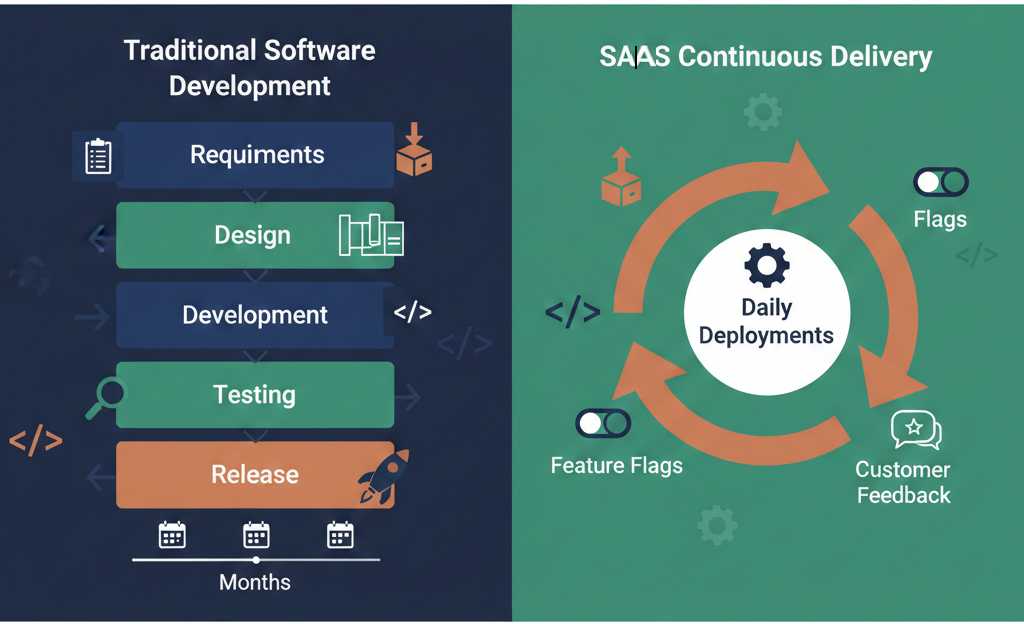
Traditional enterprise software followed a simple rule: ship when it’s ready.
Release cycles ran 6-18 months. Teams spent months in requirements gathering. Developers built in isolation for quarters. QA tested exhaustively before launch. Then came “release day”—a high-stakes event where everything had to work perfectly because you couldn’t easily fix it later.
This made sense. When customers installed software on their own servers, every bug became a nightmare. Updates required on-site visits or complicated upgrade procedures. Customers resisted updates because they disrupted operations. So you aimed for perfection.
The New Reality: Done Is Better Than Perfect
SaaS flips this model on its head.
Your customers don’t download anything. They access your application through a browser. You control the entire stack—from infrastructure to UI. You can deploy fixes in minutes, not months.
This changes everything.
Problem #1: Teams hold releases for “completeness”
Your team wants to bundle 10 features into the next release. They’re waiting until everything is “complete” before shipping. Meanwhile, three months pass.
Solution: Implement weekly release cycles. Ship features individually as they’re ready. Use feature flags to control rollout. Your competitors are deploying multiple times per day—you need at minimum weekly releases to stay competitive.
The math is brutal: deploying monthly means you learn monthly. Deploying weekly means you learn 4x faster. Companies that ship daily learn 30x faster than monthly shippers. That’s not a small advantage—it’s a different business entirely.
Problem #2: “It’s not ready” becomes the default answer
Your PM says a feature “isn’t ready” because it doesn’t have analytics integration, doesn’t work on mobile, and needs two more edge cases handled. In reality, 80% of your users would get value from it today.
Solution: Define “done” as “valuable to customers” rather than “completely finished.” Launch with the core value proposition. Add polish based on real usage data, not hypothetical scenarios.
I’ve seen companies waste six months perfecting features nobody used. Meanwhile, the rough-cut feature they were afraid to ship would have solved real problems immediately. You’re not building space shuttles—you’re building tools that evolve.
Problem #3: Fear of shipping bugs paralyzes teams
Traditional software culture treats bugs like catastrophes. In SaaS, bugs are information.
Solution: Build monitoring systems that catch issues before customers report them. Implement automated rollback capabilities. Create a culture where shipping and fixing fast beats waiting for perfection.
When Netflix’s entire system went down in 2015, they recovered in hours because their systems could quickly revert. When traditional enterprise software had issues, customers were stuck for weeks waiting for patches.
Problem #4: No clear definition of “minimum viable”
Teams confuse “minimum” with “incomplete” or “embarrassing.” They add feature after feature to avoid looking bad.
Solution: Minimum viable means the smallest thing that delivers customer value. If customers will pay for it and use it, ship it. Add the bells and whistles later based on actual demand.
Stripe shipped with just seven payment methods. Slack launched without video calls. Both became billion-dollar companies by shipping the minimum that mattered, then iterating fast.
Problem #5: Release ceremonies create artificial pressure
When releases happen monthly or quarterly, each one feels like a moon landing. Everyone’s stressed. Marketing needs to coordinate. Sales needs talking points. Support needs training.
Solution: Make shipping boring. Releases should be so routine that nobody notices. Use continuous deployment with gradual rollouts. Test in production with small user segments first.
The best SaaS companies treat releases like breathing—automatic, continuous, unremarkable. The worst treat them like childbirth—rare, painful, and requiring everyone’s attention.
Why hiring a fractional expert makes sense: Most engineering leaders learned their craft in traditional software. They genuinely don’t know how to build CD pipelines, implement feature flags, or create a culture of continuous shipping. A fractional CTO who’s built these systems multiple times can establish the infrastructure and processes in 90 days—faster and cheaper than learning through trial and error with your full-time team.
Customer Expectations in Subscription Models
Traditional Software: Pay Once, Use Forever
Enterprise software customers paid six figures upfront. They owned the license. If they didn’t like it, tough—the money was spent. Switching meant another six-figure purchase plus implementation costs.
This created patient customers. They’d wait for annual updates. They’d submit feature requests and forget about them for years. They had no leverage except during renewal negotiations every 3-5 years.
SaaS Reality: Pay Monthly, Leave Anytime
Your customers pay $500/month. If you disappoint them in March, they cancel in April. They’re not “owners”—they’re subscribers making continuous buying decisions.
This fundamental shift changes everything about how you operate.
Problem #6: Treating feedback as “nice to have”
Traditional PMs collected feedback quarterly. Feature requests went into a backlog that everyone knew was where ideas went to die. Customers learned not to bother asking.
Solution: Build feedback loops that close in weeks, not years. When a customer requests a feature, respond within 48 hours with your plan—even if the plan is “we’re not building this, here’s why.”
The companies winning in SaaS respond to customer feedback faster than competitors. Intercom famously built and shipped a customer’s requested feature while on a call with them. That’s extreme, but the principle stands: speed matters.
Problem #7: “We’ll fix it in the next version” mentality
In traditional software, “next version” meant next year. Customers accepted it. In SaaS, customers expect fixes in weeks.
Solution: Classify issues by impact and fix high-impact problems immediately. A bug affecting 30% of users should have a fix deployed within 24-48 hours, not “scheduled for Q3.”
I’ve watched companies lose $500K in ARR because they delayed fixing a critical workflow issue for “the next sprint.” The customers who churned never came back, even after the fix shipped.
Problem #8: Slow feature delivery drives churn
Your competitor ships new capabilities monthly. You ship quarterly. Customers compare. Guess who wins?
Solution: Maintain a public roadmap showing what you’re building and when. Ship improvements continuously so customers see progress weekly. Use your changelog as a marketing tool.
Companies like Linear and Notion treat their changelogs as growth engines. Every update reinforces to customers that they’re backing an active, improving product. Your changelog should make customers think “I’m glad I’m paying for this.”
Problem #9: One-size-fits-all releases frustrate enterprise customers
You ship a feature that SMB customers love but breaks enterprise workflows. Or vice versa.
Solution: Use customer segmentation and feature flags to deliver different experiences to different customer tiers. Enterprise customers might need stability. Growth customers might want bleeding-edge features.
Problem #10: No visibility into what you’re building
Customers feel like they’re paying a monthly fee into a black box. They have no idea what’s coming or why certain features take time.
Solution: Share your prioritization framework. Show customers what you’re building, what’s on deck, and what you’ve decided not to build (with explanations). Transparency builds trust in subscription relationships.
Why this justifies expert help: Building proper feedback systems, managing segmented feature releases, and creating customer communication workflows requires expertise most companies don’t have in-house. A fractional COO who’s built these systems can implement them in 60 days while training your team to maintain them—far more cost-effective than fumbling through it yourself and losing customers in the process.
Managing Multiple Release Tracks Simultaneously
Traditional Software: One Release, One Track
Enterprise software companies ran one track at a time. Everyone used version 3.2. Then everyone upgraded to 4.0. Simple, linear, manageable.
Testing focused on a single configuration. Support trained on one version. Documentation covered the current release.
SaaS Complexity: Multiple Tracks Running Simultaneously
In SaaS, you’re running a circus with multiple rings going at once.
You have production (serving customers right now), staging (testing tomorrow’s production), development (building next week’s features), and often multiple production versions running simultaneously for different customer segments.
Enterprise customers might be on a quarterly release schedule with extensive testing. Growth customers might opt into weekly beta features. Internal teams use daily builds. All of these coexist, all need support, all generate data.
Problem #11: No strategy for managing multiple environments
Teams treat staging like a dumping ground. Production has emergency patches that staging doesn’t. Nobody’s sure what version is running where.
Solution: Implement environment parity with infrastructure as code. Every environment should be a reproducible snapshot. Use containers (Docker) and orchestration (Kubernetes) to maintain consistency.
The cost of environment confusion is catastrophic. I’ve seen teams waste weeks debugging issues that only existed because staging was running a different database version than production.
Problem #12: Enterprise customers demand private releases
Your biggest customer wants features first, or wants to test updates before they hit production, or needs compliance approval before any changes.
Solution: Build a tiered release strategy. Create separate release channels—stable (quarterly), regular (monthly), fast (weekly), canary (daily). Let customers choose their risk tolerance.
This sounds complex, but it’s table stakes for B2B SaaS. Salesforce has been doing this for 20 years. Your customers expect it too.
Problem #13: Feature flags become tangled chaos
You start using feature flags to control releases. Six months later, you have 200 flags, nobody knows which ones are still needed, and deployments take forever because you’re checking hundreds of conditions.
Solution: Treat feature flags like technical debt. Every flag needs an expiration date. Run monthly audits to remove obsolete flags. Use a proper feature flagging service (LaunchDarkly, Split) rather than homegrown systems.
Problem #14: Testing becomes impossible
With multiple releases running simultaneously, comprehensive testing before deployment is a fantasy. You can’t test every combination of features, flags, and configurations.
Solution: Invest heavily in automated testing, monitoring, and observability. Shift from “test everything before shipping” to “detect and fix problems immediately after shipping.” Use progressive rollouts to limit blast radius.
The best SaaS companies ship first to 1% of users, monitor for issues, gradually expand to 10%, then 50%, then 100%. Problems are caught early and affect few customers.
Problem #15: Support teams drown in version confusion
A customer reports a bug. Your support team doesn’t know which version they’re on, which features are enabled, or what configuration is running.
Solution: Build admin tools that show exactly what a specific customer is experiencing. Support should be able to see a customer’s exact configuration, feature flags, and version with one click.
Why expert guidance is valuable: Managing multiple release tracks requires sophisticated DevOps infrastructure most companies build poorly the first time. A fractional CTO with 15+ years of experience can design your release management strategy in weeks and help you avoid the common pitfalls that plague SaaS companies for years.
The Feedback Loop Acceleration Challenge
Traditional Software: Slow, Annual Feedback Cycles
Enterprise software companies gathered feedback once per year at customer conferences. They conducted “customer advisory board” meetings. They sent surveys.
The feedback-to-action cycle took 12-18 months. Customers requested features in 2022 and saw them in 2024. Everyone accepted this.
SaaS Demand: Real-Time Feedback Loops
Your customers use your product daily. They have opinions about it daily. They expect you to listen daily.
Modern SaaS companies collect feedback continuously, analyze it weekly, and ship improvements based on it within weeks. The companies that do this well dominate their categories.
Problem #16: Feedback disappears into a black hole
Customers send feature requests to support. Support logs them in Zendesk. Nobody reads Zendesk tickets for product feedback. Customers feel ignored.
Solution: Create a centralized feedback system where all customer input flows to one place. Use tools like Productboard, Canny, or Aha! that connect customer requests to your product roadmap.
The best companies make their feedback system visible to customers. Customers can see what others have requested, vote on features, and track progress. This transforms feedback from “shouting into the void” to “collaborating on the product.”
Problem #17: Product decisions happen in vacuum chambers
Your PM decides priorities based on their intuition, the CEO’s latest idea, or whoever shouted loudest in Slack. Customer feedback doesn’t systematically influence decisions.
Solution: Implement a prioritization framework that weights customer feedback. Score features by customer demand, revenue impact, and strategic value. Make decisions transparent.
At every company I’ve advised, introducing systematic prioritization revealed that teams were building things nobody wanted while ignoring high-demand features. The clarity is shocking.
Problem #18: Long feedback-to-deployment cycles
A customer requests a feature in January. You discuss it in February. It gets added to the roadmap in March. Development starts in May. It ships in August. Seven months later, the customer has forgotten they asked for it—or they’ve churned.
Solution: Create fast-track processes for high-value feedback. If three enterprise customers request the same capability, don’t wait for the next planning cycle. Build it now.
Linear famously ships customer-requested features within days when possible. They’ve built this speed into their culture. It’s a competitive moat.
Problem #19: No systematic way to close the loop
Customers provide feedback. You build the feature. You ship it. The customer never knows their request was heard.
Solution: Implement automatic notifications when requested features ship. Email customers: “You asked for X. We built it. Here’s how to use it.” This transforms anonymous users into engaged partners.
I’ve seen this single change reduce churn by 5-8%. Customers who feel heard stay longer.
Problem #20: Analysis paralysis from too much data
You’re collecting feedback from support, sales, in-app surveys, user interviews, social media, and review sites. Nobody can process it all. Decisions get delayed because you’re “waiting for more data.”
Solution: Assign ownership. Someone must synthesize all feedback sources weekly and present actionable insights to leadership. Use AI tools to categorize and summarize at scale.
The insight isn’t in the individual comments—it’s in the patterns. You need systems that surface patterns quickly.
Why fractional expertise helps: Building feedback systems that actually inform decisions requires understanding customer success, product management, and engineering workflows. A fractional COO who’s implemented these systems 20+ times can set up your entire feedback infrastructure in 30-60 days, including tools, processes, and team training. The alternative is months of trial-and-error while hemorrhaging customer goodwill.
Why Traditional Experience Can Hurt You
Here’s the uncomfortable truth: hiring someone with deep enterprise software experience can actively harm your SaaS company.
They’ll instinctively apply patterns that worked brilliantly in traditional software but fail catastrophically in SaaS:
- They’ll want quarterly planning cycles when you need weekly adaptation
- They’ll hold releases for completeness when you need continuous deployment
- They’ll build for stability when you need rapid iteration
- They’ll treat customers like permanent owners when they’re temporary subscribers
This isn’t their fault. They’re applying years of learned expertise. The problem is the landscape has changed.
It’s like hiring a print journalist to run your TikTok strategy. They’re skilled professionals—at the wrong medium.
How I Help B2B SaaS Founders Navigate This Transition
Over 30 years in technology, startup operations, and marketing, I’ve watched hundreds of companies struggle with the transition from traditional software thinking to SaaS reality. I’ve led these transformations as CTO, COO, and embedded partner.
The companies that adapt quickly thrive. The ones that don’t… well, you know what happens to ARR when churn exceeds growth.
I work with B2B SaaS founders, PE operating partners, and board members to transform delivery operations from traditional to SaaS-native:
Delivery Infrastructure: I assess your current processes, identify bottlenecks blocking continuous delivery, and implement the systems (CI/CD pipelines, feature flags, progressive rollout strategies) that enable daily shipping.
Customer Feedback Systems: I build the infrastructure that turns customer insights into shipped features within weeks. This includes feedback collection tools, prioritization frameworks, and rapid-response processes.
Release Management: I design multi-track release strategies that serve different customer segments simultaneously without chaos. Enterprise customers get stability. Growth customers get innovation. Both stay happy.
Team Transformation: Most importantly, I coach your existing team through the mindset shift from “ship when ready” to “ship and iterate.” This cultural change determines whether your transformation succeeds or fails.
The result? Companies typically see deployment frequency increase 5-10x, customer satisfaction scores improve 20-30%, and development velocity increase 40% within 90 days.
If your delivery process feels like it’s holding your business back, let’s talk. Book a consultation at https://cerebralops.in/contact/ and we’ll discuss whether your challenges need a fresh perspective.
Your Next Step
Here’s what happens if you don’t address these challenges:
- Your competitors ship features 10x faster than you
- Customers churn because you’re too slow to adapt
- Your best engineers leave because they’re frustrated
- Your ARR plateaus while costs increase
Or you can acknowledge that SaaS delivery is fundamentally different, get expert help transforming your operations, and start winning again.
The choice is yours. But choose quickly—in SaaS, standing still means falling behind.
Schedule a consultation today →
About Cerebral Ops
Cerebral Ops specializes in Fractional CTO/COO/CPO/CMO roles and Delivery Rescue services for B2B SaaS companies generating $5-50M in revenue. We help founders in the US, UK, EU, ANZ, and India transform their operations from traditional software patterns to SaaS-native excellence.
Our team brings 30+ years of experience in technology leadership, startup operations, and go-to-market strategy. We work as embedded partners, not consultants—getting our hands dirty with your team to implement lasting change.
We maintain representation in key markets globally, allowing us to serve clients across time zones with local presence and global expertise.
Common engagements include:
- Delivery transformation and rescue
- Technical due diligence for PE investors
- Interim executive leadership during transitions
- Strategic technology planning and execution
Contact us at https://cerebralops.in/contact/ to discuss how we can accelerate your growth.