
The Cost of Deferred Refactoring: A Founder’s Guide
That ‘quick fix’ from 2 years ago just cost you a $2M customer. Here’s the math you ignored.
You’re sitting in a customer call when your lead engineer drops the bomb: “We can’t deliver that integration for Enterprise Corp. Our authentication system wasn’t built for multi-tenancy.”
The deal dies. Two million dollars walks out the door. And the painful truth hits you—this isn’t a new problem. Your team’s been warning you about this exact limitation for eighteen months.
Welcome to the real cost of deferred refactoring.
I’ve seen this movie a hundred times. Founder takes a shortcut to ship faster. Team keeps building on that shaky foundation. Technical debt compounds. Then one day, the house of cards collapses—usually right when you can least afford it.
Here’s what nobody tells you: that ‘quick fix’ isn’t free. It’s a loan with compounding interest, and sooner or later, the bill comes due.
Let me show you the math they don’t teach in accelerators, the decision frameworks that actually work, and how to get your board to fund the fix before your competitors eat your lunch.
The Hidden Mathematics of Technical Shortcuts
Let’s talk numbers. Real numbers.
Organizations with high technical debt spend 10-20% more on engineering to deliver identical outcomes compared to companies with clean codebases. That’s not my opinion—it’s data from the Software Improvement Group’s 2023 research.
But here’s where it gets ugly: developers spend up to 42% of their time dealing with technical debt rather than building new features. Think about that. You’re paying your $150K engineers to essentially pay interest on old decisions.
Problem 1: The Invisible Productivity Tax
The Reality: Your engineering velocity drops by 30% year-over-year, but nobody connects it to that “temporary” workaround from 2022.
How to Calculate the True Cost:
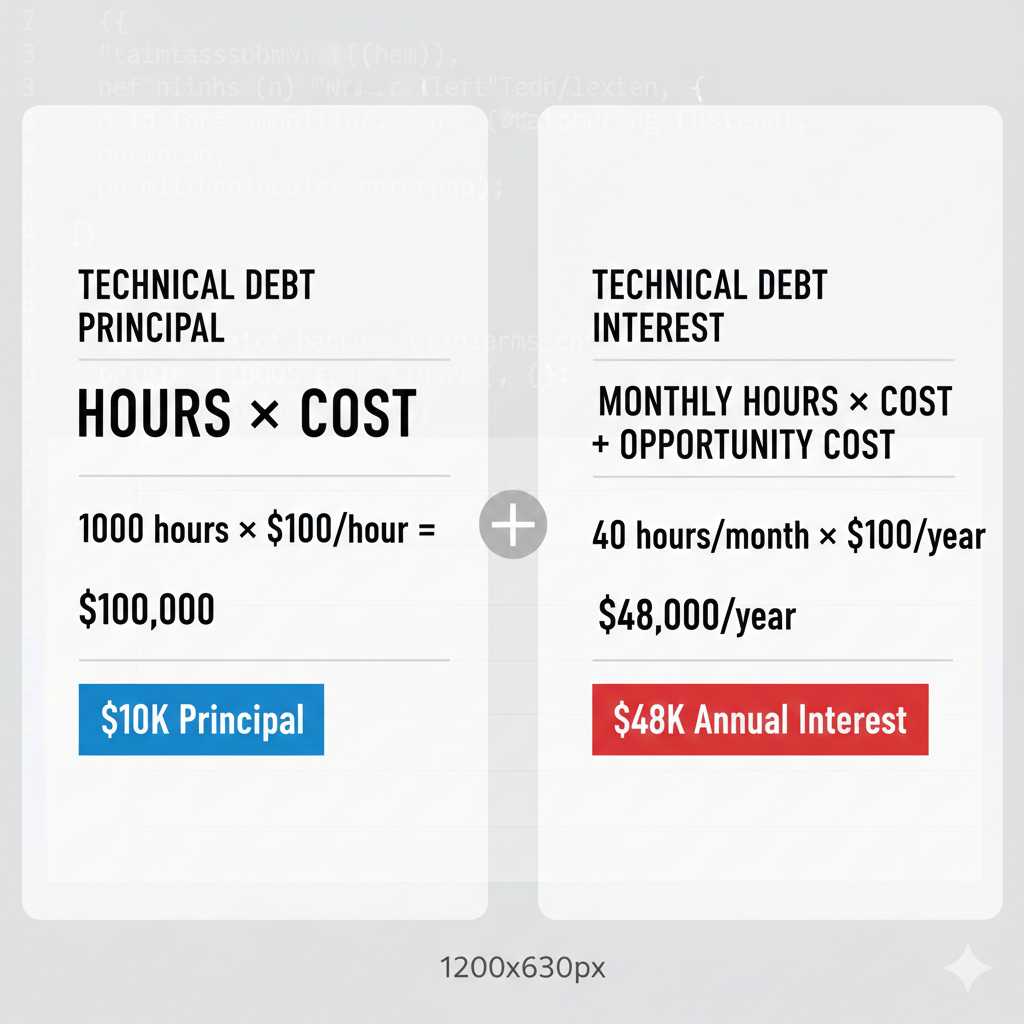
Start with the Technical Debt Principal formula:
Technical Debt Principal = (Hours needed for proper refactoring) × (Fully loaded developer cost per hour)
If your team identifies 1,000 hours of needed refactoring and your fully loaded developer cost is $100/hour, your technical debt principal is $100,000.
But that’s just the principal. Now calculate the interest:
Technical Debt Interest = (Extra maintenance hours per month × Developer hourly cost) + Opportunity cost of delayed features
Let’s say that shortcut costs you 40 extra hours per month in workarounds and bug fixes. That’s $4,000 monthly interest, or $48,000 annually. Over two years, you’ve paid $96,000 in interest on a $100,000 debt.
The Solution:
DIY Approach: Implement a technical debt tracker. Every sprint, categorize work into “new features,” “bugs,” and “technical debt.” Calculate the percentage of engineering time spent on each. If technical debt crosses 25%, it’s time for intervention.
Expert Approach: Bring in a fractional CTO or technical operations expert who can audit your codebase, quantify the debt with precision, and create a paydown roadmap that doesn’t kill feature velocity. Cost-effective because they’ve seen this pattern 50 times before and know exactly where to look.
Tools like SonarQube, Code Climate, or CodeScene can give you quantified metrics. But the real value comes from someone who can translate those metrics into business impact.
Problem 2: The Compound Interest Effect on Code Quality
The Reality: Bad code begets worse code. Each new feature built on a shaky foundation makes the next one harder.
Martin Fowler categorizes technical debt into quadrants: reckless/deliberate, reckless/inadvertent, prudent/deliberate, and prudent/inadvertent. Most companies don’t even know which quadrant they’re in.
Here’s what compounds:
- Cyclomatic complexity increases exponentially (functions with complexity above 15 need immediate refactoring)
- Code duplication spreads like cancer (when you find one bug, you have to fix it in 8 places)
- Mean Time to Recovery (MTTR) from incidents grows linearly with code complexity
- Deployment frequency drops as teams become afraid to ship
How Compound Interest Works in Code:
Year 1: Quick fix saves 2 weeks, costs 5 hours/month in workarounds = 60 hours/year Year 2: New features need workarounds around the workaround = 120 hours/year
Year 3: Onboarding new engineers takes 40% longer due to “legacy patterns” = 200+ hours/year
By Year 3, you’re spending 380 hours dealing with a shortcut that initially saved 80 hours. That’s a 375% “interest rate.”
The Solution:
DIY Approach: Implement the “Boy Scout Rule”—leave code better than you found it. Allocate 20-30% of each sprint to refactoring work. Make it non-negotiable. Stripe does this religiously.
Create a “Technical Debt Budget” as part of your quarterly planning. Treat it like R&D—it’s not overhead, it’s investment in future velocity.
Expert Approach: A fractional CTO can establish a continuous refactoring culture and implement automated quality gates that prevent new debt from accumulating. They’ve built these systems before and know which tools actually work versus which ones create alert fatigue.
The key is making refactoring a first-class citizen in your planning process, not something you “get to when there’s time.” (Spoiler: there’s never time.)
Problem 3: The Wrong Decision Tree
The Reality: You’re agonizing over refactor versus rebuild, but you’re asking the wrong questions.
Most founders treat the rebuild versus refactor decision emotionally. Engineers want to rebuild because old code embarrasses them. Product wants to refactor because rebuilds delay features. Finance wants to do nothing because both options cost money.
Nobody’s making the decision based on data.
The Decision Framework That Works:
Ask these questions in order:
Question 1: What’s the business impact of doing nothing?
- Can you sign enterprise deals with your current architecture?
- How many support escalations trace back to technical debt?
- What’s your deployment frequency compared to competitors?
Question 2: What’s the blast radius?
- Does the debt affect isolated components or core architecture?
- Can you encapsulate and replace piece by piece, or is it monolithic?
Question 3: Do you have the knowledge?
- Can your current team understand and modify the existing code?
- Has tribal knowledge walked out the door?
Question 4: What’s the ROI timeline?
- Refactoring breaks even faster (typically 6-12 months)
- Rebuilding has higher upfront cost but may be cheaper long-term for fundamental flaws
The Refactor Decision Tree:
Choose REFACTOR when:
- Issues are superficial (code organization, optimization)
- Core architecture is sound
- Team understands existing codebase
- You need to maintain feature velocity
- You have 6-12 month payback tolerance

Choose REBUILD when:
- Fundamental architecture blocks strategic needs
- Technology stack is genuinely obsolete (hiring risk)
- Technical debt exceeds 40% of your codebase value
- Refactoring would take longer than rebuilding
- You can afford 12-24 month investment horizon
The Solution:
DIY Approach: Run a time-boxed (2-week) architectural assessment. Have senior engineers document:
- Top 10 pain points in current architecture
- Estimated hours to refactor each
- Estimated hours to rebuild equivalent functionality
- Business features blocked by each pain point
Score each on: Business Impact (1-10) × Technical Difficulty (1-10) × Frequency of Problem (1-10)
Tackle highest scores first.
Expert Approach: A fractional CTO or COO brings a portfolio view. They’ve made this decision across multiple companies and can spot patterns you can’t see from inside. They’ll audit your architecture, interview your team, analyze your roadmap, and deliver a decision framework tied to your business KPIs.
The cost-effectiveness comes from speed and accuracy—they can do in 2 weeks what would take your team 3 months of internal debate.
Getting Board Buy-In for Engineering Investment
Here’s the uncomfortable truth: your board doesn’t care about your code quality. They care about ARR, retention, and market position.
Your job? Translate technical debt into their language.
Problem 4: Speaking the Wrong Language
The Reality: You walk into the board meeting talking about cyclomatic complexity and get blank stares. You needed to talk about customer churn risk.
I’ve sat in 200+ board meetings. Here’s what gets funded:
Not This: “We need to refactor our authentication layer because it’s got high technical debt.”
This: “Three enterprise deals totaling $4.8M are blocked because our auth system can’t handle their compliance requirements. We have two options: a $400K, 4-month refactor that unblocks these deals and prevents this from recurring, or we walk away from every enterprise opportunity in our pipeline.”
See the difference?
How to Build Your Business Case:
Step 1: Quantify Revenue Impact
- Revenue blocked: List specific deals that can’t close
- Revenue at risk: Identify customers who might churn due to performance/stability
- Revenue opportunity: Calculate faster feature velocity impact on win rates
Step 2: Calculate the Cost of Delay
- Every month you defer costs you X in lost revenue
- Every quarter costs you competitive position
- Use urgency appropriately—this is warfare
Step 3: Show the ROI
ROI Framework:
- Investment: $400K engineering time over 4 months
- Return Year 1: $4.8M blocked deals + $600K reduced maintenance cost = $5.4M
- Return Year 2-3: 30% faster feature velocity = estimated $3M additional ARR
- Payback Period: 1.8 months
- 3-Year ROI: 2,150%
Step 4: Present Risk vs. Risk
Don’t position it as “invest in refactoring vs. do nothing.” Position it as “invest $400K in controlled refactoring vs. face $2M emergency rewrite when the system melts down during our Series B due diligence.”
The Solution:
DIY Approach: Create a one-page Technical Debt Business Case template:
- Revenue Impact (blocked + at-risk + opportunity)
- Cost of Delay (monthly)
- Investment Required (time + cost)
- Expected ROI (timeline + percentage)
- Risk of Inaction (what breaks, when)
Update it quarterly. Make it a standing board agenda item.
Expert Approach: A fractional CTO/COO who reports to boards regularly knows exactly how to frame technical decisions in business terms. They can:
- Build the business case with PE-grade rigor
- Present to your board alongside you
- Field technical questions with business answers
- Negotiate the funding and timeline
This is worth every penny because they get deals approved that internal teams can’t. They speak fluent CFO and CTO simultaneously.
Problem 5: The Prioritization Trap
The Reality: Refactoring always loses to features in the roadmap poker game.
You know the pattern. Q1 planning: “We’ll definitely tackle that auth refactor this quarter.” Reality: urgent customer request bumps it. Q2: “Okay, NOW we’ll do it.” Reality: new competitor launches, sales needs parity features. Q3: Same story. Q4: “Let’s just push it to next year.”
Meanwhile, your technical debt interest compounds.
Why This Happens:
Refactoring is:
- Invisible to customers (no one thanks you for code they never see)
- Hard to measure (no obvious completion metrics)
- Easy to postpone (urgent always beats important)
- Politically weak (Product has CEO’s ear, Engineering doesn’t)
Breaking the Cycle:
The only way refactoring happens is if you make it non-discretionary.
Solution Framework: The 70-20-10 Rule
Allocate engineering capacity:
- 70% – Committed roadmap features
- 20% – Technical debt and refactoring (non-negotiable)
- 10% – Innovation/exploration
That 20% isn’t “when we have time.” It’s scheduled, planned, tracked, and celebrated.
Make It Measurable:
Track these metrics monthly:
- Deployment frequency (should increase)
- Mean time to recovery (should decrease)
- Defect escape rate (should decrease)
- Engineer satisfaction (should increase)
- Velocity trend (story points per sprint should stabilize or increase)
When these metrics improve, you can prove refactoring ROI.
The Solution:
DIY Approach:
- Block 20% of every sprint for technical debt (not negotiable)
- Create a Technical Debt backlog that’s visible to the entire company
- Make refactoring wins visible: “This week’s refactor enables us to ship feature X 40% faster”
- Celebrate debt paydown in all-hands meetings like you celebrate feature launches
Expert Approach: A fractional COO or CTO institutionalizes this as process, not willpower. They:
- Set up governance structures that protect engineering capacity
- Build dashboards that make technical debt visible to non-technical executives
- Create accountability frameworks where refactoring is measured and rewarded
- Train product managers to think in terms of sustainable velocity, not just feature count
The value? This becomes organizational muscle memory. When they leave, the system persists.
The Refactoring-First Operating Model
Here’s what successful companies do differently: they don’t defer refactoring. They make it continuous.
Google surveys engineers quarterly on how frequently they encounter technical debt. They treat it like a KPI. Microsoft allocates 20% of engineering time to debt reduction, scheduled and protected. Stripe has a “code health” team whose only job is to make the codebase better.
These aren’t luxuries of scale. These are the practices that enabled scale.
Creating Your Refactoring Culture
1. Change the Language
Stop calling it “technical debt” (sounds like failure). Start calling it “technical investment” (sounds like strategy).
Not: “We need to pay down our auth debt”
Yes: “We’re investing in auth infrastructure to support enterprise scale”
2. Create Refactoring Champions
Designate senior engineers as “code health leads.” Their job: identify high-impact refactoring opportunities and make the business case. Give them a budget and authority.
3. Implement Quality Gates
Use automated tools to prevent new debt:
- Code review requirements (no merge without review)
- Automated testing minimums (no deploy below 70% coverage for critical paths)
- Complexity checks (functions over complexity 15 trigger warnings)
- Duplicate code detection (flags when duplication exceeds thresholds)
4. Make Refactoring Visible
Create a “Refactoring Wins” channel in Slack. Every time someone cleans up code, they post:
- What they fixed
- How it helps (faster features, fewer bugs, easier onboarding)
- Time saved or risks eliminated
Recognition changes behavior.
The Fractional Advantage
Here’s where I get specific about what I do.
I’ve spent 30 years in B2B SaaS technology, operations, and growth. I’ve been the CTO who had to sell refactoring to skeptical boards. I’ve been the COO who had to balance technical investment with growth targets. I’ve been the fractional partner who came in to fix what others couldn’t.
When you bring in someone like me, here’s what changes:
Week 1-2: Assessment
- Audit your technical debt (quantified, categorized, prioritized)
- Interview your engineering team (what keeps them up at night)
- Review your roadmap (what’s blocked, what’s at risk)
- Analyze your metrics (velocity, quality, satisfaction trends)
Week 3-4: Strategy
- Business case for top 5 refactoring priorities
- ROI models board members actually understand
- Refactor-vs-rebuild decision tree for your specific architecture
- Resource allocation plan that protects both features and refactoring
Month 2-3: Execution Setup
- Implement the 70-20-10 framework
- Train product managers on sustainable velocity thinking
- Set up dashboards that make code health visible
- Establish quality gates that prevent new debt
Month 4+: Embedded Partnership
- Attend board meetings to defend engineering investment
- Review and adjust refactoring priorities quarterly
- Coach your engineering leaders on communicating up
- Serve as translation layer between tech and business
The value proposition is simple: I’ve done this 50 times. I know what works. I can compress 12 months of internal trial-and-error into 90 days of focused progress.
More importantly, I can get your board to say yes to things your internal team couldn’t get funded. Because I speak their language.
The Real Cost of Doing Nothing
Let me paint you the alternative timeline—the one where you keep deferring.
Year 1: Minor annoyances. Features take a bit longer. A few more bugs than expected. You hire more engineers to compensate. Problem solved, right?
Year 2: Velocity drops 30%. Your best engineers start complaining about “legacy code.” Two quit and cite technical debt in their exit interviews. Hiring replacements takes longer because candidates research your stack and reputation. Recruiting costs spike.
Year 3: A critical outage happens during your biggest sales quarter. You lose a major customer. Engineering is now spending 50% of their time on maintenance. New feature development has ground to a halt. Your burn rate is 40% higher than it should be because you need twice the engineers to deliver the same output.
Year 4: Your Series B investors bring in technical due diligence. The assessment is brutal. They discover your technical debt represents 40% of your entire codebase value. Your valuation gets cut. The term sheet includes mandatory hiring of a new CTO. Your founder equity gets diluted more than it should have.
Or there’s the other version: A well-funded competitor with a modern stack launches. They’re not better product people. They’re not better sales people. But they can ship features in a week that take you six weeks. They’re not carrying your debt. They win.
Here’s the math you can’t ignore:
Organizations with high technical debt experience:
- 30-50% slower service delivery
- 20-40% of IT budget consumed by crisis management instead of innovation
- 50% higher developer turnover (yes, half your engineering team)
- 200x slower deployment frequency compared to high-performing teams
The companies that address technical debt systematically achieve:
- 20-40% productivity gains
- 30% reduction in their enterprise application landscape
- 65% reduction in production incidents
- 40% increase in development velocity for new features
This isn’t theory. This is measured data from McKinsey, Gartner, DORA, and my own client engagements.
Your Next Move
You’re at a fork in the road.
Path 1: Keep deferring. Keep accumulating debt. Keep paying compound interest. Watch your velocity slowly strangle your growth.
Path 2: Face it now. Quantify it. Fix it systematically. Build a culture where technical investment is as sacred as sales targets.
The choice seems obvious. So why don’t more companies take Path 2?
Because it’s hard. Because it requires executive courage. Because someone has to stand in front of the board and defend investing in something customers never see.
That’s where I come in.
How I Help B2B SaaS Founders
I work with B2B SaaS companies in the $5-50M range across the US, UK, EU, ANZ, and India. My services:
Fractional CTO Services:
- Technical architecture assessment and refactoring strategy
- Engineering team optimization and velocity improvement
- Technology roadmap aligned with business goals
- Board communication and technical due diligence support
Fractional COO Services:
- Operational excellence and process optimization
- Cross-functional alignment between Product, Engineering, and Sales
- Metrics frameworks that connect technical work to business outcomes
- Scaling operations without sacrificing quality
Delivery Rescue Services:
- When projects are stalled or failing, I diagnose and fix
- Refactor-vs-rebuild decision-making with ROI analysis
- Technical debt crisis management
- Velocity restoration programs (typically 90 days)
Embedded Partner Services:
- Long-term strategic partnership for growing SaaS companies
- Act as your technical and operational executive without full-time cost
- Board-level technical representation
- Continuous improvement culture implementation
The model is simple: You get 30 years of technology, startup operations, and marketing experience without the full-time executive salary. You get someone who’s seen your exact problem before and knows the solution. You get board credibility and execution capability in one package.
Most engagements show measurable ROI within 90 days. Because I’m not learning on your dime—I’m implementing what I already know works.
Ready to stop paying compound interest on technical debt?
Let’s talk about your specific situation. No sales pitch. Just a conversation about whether what’s blocking your growth is something I can fix.
Author Bio
Deepkumar Janardhanan is the founder of Cerebral Ops, specializing in Fractional CTO/COO/CPO/CMO roles for B2B SaaS companies. With 30 years of experience in technology leadership, startup operations, and growth marketing, Deep has helped dozens of companies in the $5-50M revenue range optimize their technical operations, rescue stalled deliveries, and build sustainable growth engines.
Cerebral Ops works with clients across the US, UK, EU, ANZ, and India, providing the executive technical and operational leadership that growing SaaS companies need without the full-time cost. Deep specializes in translating complex technical challenges into business terms that boards understand and fund.
Whether you need a Fractional CTO to assess your technical debt, a Fractional COO to optimize your operations, or an Embedded Partner to drive your next growth phase, Cerebral Ops brings battle-tested experience and measurable results.
Connect: https://cerebralops.in/contact/