
Your First 10 Hires: Who to Bring On and in What Order
Hire wrong in the first 10 and you’ll spend the next 2 years fixing it. Here’s the playbook.
I’ve watched founders make the same hiring mistakes over and over again. They hire their college roommate as CTO when they need a customer success champion. They bring on a VP of Sales before they’ve figured out what actually sells. They stack their team with brilliant engineers while their go-to-market engine sputters.
The result? Two years of expensive do-overs, damaged relationships, and burned runway that could have funded your Series A.
Your first 10 hires aren’t just employees. They’re the DNA of your company. They set your culture, define your execution speed, and determine whether you’ll hit product-market fit before your money runs out. Get these hires right, and you’ll compound value with each addition. Get them wrong, and you’ll spend more time managing performance issues than building your business.
After 30 years in technology, startup operations, and working with B2B SaaS founders from pre-seed to scale, I’ve seen the patterns. The founders who nail early hiring follow a specific playbook. The ones who struggle either ignore sequencing entirely or fall into predictable traps.
Let me share what actually works.
The Founding Team Gaps That Kill Momentum
You can’t hire your way out of founding team problems, but you can amplify them spectacularly. Before you make your first hire, you need brutal honesty about what your founding team actually brings to the table.
Most founding teams fall into predictable patterns. You’ve got the technical founder who can build anything but freezes when asked to sell. Or the business founder with massive market knowledge but who couldn’t deploy a Docker container if their life depended on it. Sometimes you’ve got two technical founders who both want to code and neither wants to talk to customers.
Here’s what kills you: hiring for comfort instead of gaps.
I worked with a SaaS founder who had an exceptional product vision and could code circles around most CTOs. His first five hires? All engineers. Brilliant ones. They built a gorgeous, scalable architecture that nobody bought because the founder had zero go-to-market muscle and refused to hire for it.
When he finally brought on a sales leader at employee #6, they had nine months of runway left and no validated sales process. The sales hire failed. The company pivoted three times trying to find buyers. They survived, barely, but those early hiring mistakes cost them 18 months and their entire seed round.
Your founding team’s strengths determine your first hires. If you’re all technical, your first hire should be someone who can sell or talk to customers. If you’re business-heavy, you need someone who can actually build and ship. And if you’ve got one of each, you need someone who can scale operations before your processes collapse under growth.
Map your gaps honestly:
- Customer discovery and validation: Who’s actually talking to customers every day?
- Product execution: Who’s shipping code and closing technical debt?
- Go-to-market: Who’s bringing in revenue or validating that someone will pay?
- Operations: Who’s making sure nothing catches fire while everyone else builds?
Whatever boxes are empty, that’s your hiring priority. Everything else is ego or comfort hiring.
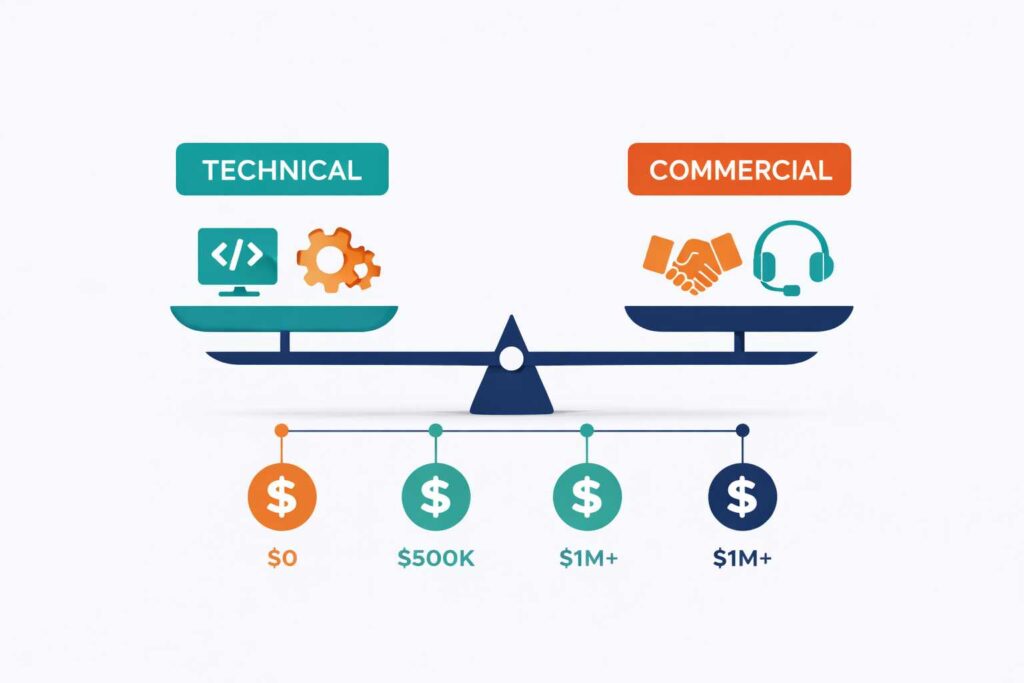
Technical vs. Commercial: Which Comes First at Each Stage
The sequencing question keeps founders up at night. Do you hire engineers to build faster, or do you hire salespeople to validate that anyone cares what you’re building?
The answer depends entirely on your stage and what you’ve actually proven.
Pre-Product Market Fit: Hire for Learning Speed
Before PMF, you’re not building a company. You’re running experiments to figure out what company to build. Your hiring should optimize for learning speed, not execution scale.
Most B2B SaaS founders need product execution first. You can’t sell vapor. But “product execution” doesn’t mean hiring five senior engineers to build your dream architecture. It means hiring one exceptional full-stack engineer who can ship a working MVP in weeks, not months.
Your first three hires should usually include:
- One exceptional engineer (if you’re non-technical) or your first engineering hire (if you’re technical)
- One person who can talk to customers and translate insights into product requirements
- One operational generalist who can handle everything from customer onboarding to basic bookkeeping
Notice what’s not on that list? VP of Sales. Head of Marketing. Chief Revenue Officer. You don’t need specialists. You need people who can wear five hats and switch contexts every 20 minutes.
I worked with a founder who bootstrapped to $500K ARR with a team of four. Their secret? Every single person could do customer discovery calls, write code, close deals, and onboard customers. They moved absurdly fast because there were no handoffs, no territorial battles, and no “that’s not my job” conversations.
The $500K-$1M ARR Inflection: Start Specializing
Something shifts around $500K ARR. Your product is real. Customers are paying. You’ve got some repeatable motion, even if it’s mostly founder-led.
This is when you start hiring specialists, but you still need to sequence correctly:
Hire sales before you hire your second marketer. Marketing doesn’t matter if you can’t close. Get to three salespeople hitting quota before you build a marketing team.
Hire customer success before you hire product managers. Keeping the customers you have beats shipping features nobody asked for. A great CS person will tell you exactly what to build next.
Hire your first operations person before everything breaks. Around $750K ARR, the ad-hoc systems that got you here will start failing. Hire someone who can build scalable processes before you’re drowning in operational debt.
The sequence usually looks like:
- Hire #4: Your first dedicated salesperson (assuming founders are still closing deals)
- Hire #5: Customer success or account management to handle growing customer base
- Hire #6: Second engineer to accelerate product velocity
- Hire #7: Second salesperson to prove the sales motion works beyond you
- Hire #8: Operations or customer success manager to scale support
- Hire #9: Marketing generalist to start building demand gen
- Hire #10: Third engineer or sales development rep, depending on your bottleneck
Your actual sequence will vary. The principle doesn’t: hire for your current bottleneck, not your future org chart.
The Dangers of Hiring Friends and Former Colleagues
Let’s talk about the elephant in every startup’s early cap table: hiring people you know.
Every founder does it. You should do it too. But you need to understand exactly what you’re signing up for.
Hiring friends and former colleagues has massive advantages. You’ve seen them work. You trust them. They’ll accept below-market compensation because they believe in you. They’ll work weekends without being asked. In those early, desperate days when you’re not sure the company will survive another quarter, having people who are ride-or-die makes all the difference.
I’ve hired friends. Some became my best hires ever. Others became expensive lessons in why personal relationships and professional requirements don’t always align.
Here’s what works:
Hire former colleagues before college friends. If you’ve actually worked with someone in a professional setting, you know their work habits, communication style, and how they handle pressure. College friendships are built on pizza and all-nighters, not shipping products under deadline pressure.
Set crystal-clear expectations before they join. The conversation should be awkward. “Here’s what might happen to our friendship if this doesn’t work out. Here’s how I’ll give you feedback. Here’s how I’ll measure your performance. Here’s what happens if you’re not meeting expectations.”
If that conversation feels too uncomfortable to have, don’t make the hire. The conversation after you fire them will be ten times worse.
Treat them like any other candidate. Interview them. Check references. Give them a project. If you’re willing to skip steps because “I already know they’re great,” you’re not hiring on merit. You’re hiring for comfort.
The failure modes are predictable:
You hire your brilliant friend for a role they’ve never done before, assuming talent transfers. It doesn’t. Your rockstar product manager friend can’t sell. Your exceptional sales friend can’t code. Potential doesn’t ship products.
You avoid giving hard feedback because you don’t want to damage the friendship. They underperform. You resent them. They know something’s wrong but you won’t tell them what. The friendship dies anyway, just slower and more painfully.
You create a culture of favoritism that poisons everyone else. Your other employees watch you give your friend special treatment, flexible hours, or higher comp than they’re worth. They start updating their LinkedIn profiles.
Here’s my rule after 30 years: Hire friends if you’ve worked with them professionally and they’re genuinely the best candidate for the role. Be prepared to lose the friendship if it doesn’t work out. Set expectations that would make a stranger uncomfortable. And whatever you do, don’t hire someone because you feel sorry for them or want to help them out.
Charity kills startups.
Creating Hiring Sequences That Compound Value
Most founders think about hiring as filling seats. You need an engineer, so you hire an engineer. You need a salesperson, so you hire a salesperson. This is wrong.
Great early-stage hiring creates compounding value. Each hire should make the next hire more valuable, more effective, and easier to onboard.
Think about sequencing like building a foundation. Your first hire in any function sets the standard for everyone who comes after. Hire a mediocre first engineer, and you’ll attract mediocre engineering candidates. Hire an exceptional one, and great engineers will want to work with them.
Start with force multipliers. Your early hires should be people who make everyone around them better. Look for people who:
- Document as they go so the next person doesn’t have to reverse-engineer their work
- Mentor junior talent instead of hoarding knowledge
- Build systems that outlive their involvement
- Raise standards that become cultural expectations
I worked with a SaaS company that made a brilliant first engineering hire. Not the most talented coder they interviewed, but someone who obsessively documented every decision, created onboarding materials, and set up systems for code review and deployment. When they hired engineers 2-5, each one ramped in days instead of weeks because the systems were already there.
Sequence for capability building. Each hire should unlock a capability that enables the next phase of growth. Your first salesperson should build a repeatable sales process. Your first customer success hire should create retention systems. Your first operations hire should build scalable infrastructure.
If you’re just hiring people to do work, you’re thinking too small.
Plan two moves ahead. Before you make hire #5, think about hires #6 and #7. Will hire #5 make those next hires easier or harder? Will they build systems that scale or create dependencies that bottleneck growth?
The wrong first sales hire will bring in deals but leave no playbook. You’ll need to replace them when you scale. The right first sales hire will document everything, test different approaches, and leave a process that your next three salespeople can follow.
Avoid premature specialization. Early hires need to be comfortable in chaos. If someone says “that’s not my job” in your first 10 employees, you hired wrong. These people need to do whatever it takes to move the company forward.
I’ve seen companies hire specialized roles way too early. A director of content marketing at employee #7. A dedicated DevOps engineer at #5. A customer success manager for 20 customers. These hires optimize for a future org chart, not current needs.
Your first 10 should all be what I call “chaos athletes”—people who thrive when the playbook is being written in real-time.
Five Hidden Problems in Early-Stage Hiring (And How to Fix Them)
Let me share the problems nobody talks about until it’s too late.
Hidden Problem #1: The Talent-Stage Mismatch
You find someone exceptional. VP-level experience at a well-known company. Perfect pedigree. They say they’re excited about startups. You hire them.
Three months later, they’re frustrated that nothing is documented, processes don’t exist, and they’re expected to do individual contributor work. They quit or you fire them. You’ve burned four months and $60K.
This is the most expensive hidden problem in early-stage hiring. People who thrived in structured environments often drown in startup chaos. They wait for direction that isn’t coming. They expect resources that don’t exist. They need clean handoffs that are impossible at your stage.
The fix: Test for chaos tolerance, not just capability. During interviews:
- Describe your actual current chaos, don’t sugarcoat it
- Ask candidates to describe the least structured environment they’ve thrived in
- Give them a project that mimics your actual mess and see how they respond
- Check references specifically asking: “How did they perform in ambiguous situations?”
If you want someone with big company experience, bring them on as a fractional advisor first. Let them experience your chaos on a contract basis before making it permanent.
Or work with someone like me—a fractional COO/CTO who’s seen hundreds of early-stage hiring situations and can help you assess stage-fit before you make expensive mistakes.
Hidden Problem #2: The “Brilliant Asshole” Tax
You hire someone exceptionally talented. They ship amazing work. They’re also condescending to teammates, dismissive of feedback, and create an atmosphere of fear around them.
You tell yourself their output justifies the cultural damage. It doesn’t. Not ever. Not at any stage.
Here’s what actually happens: Your brilliant asshole drives away everyone else who’s good. You hire talent to work alongside them, and that talent leaves within six months. You end up with a team of people who either can’t work anywhere else or are too junior to know better.
The brilliant asshole costs you 3-5 other hires over their tenure. Do the math. Even if they’re twice as productive as a normal engineer or salesperson, they’re still a net negative.
The fix: Establish cultural standards before you make hire #1. Ours were simple: Brilliant and kind. No assholes, no matter how talented. We passed on people who would have made us ship faster because they failed the “kind” test. Every time we did, we were grateful six months later.
If you’re already dealing with a brilliant asshole, the fix is uncomfortable but clear: Let them go. Yes, even if they’re your best engineer. Yes, even if they’re hitting 200% of quota. The long-term damage outweighs any short-term productivity gain.
When you make this decision, be transparent with your team about why. It sets a cultural standard that matters more than any mission statement.
Hidden Problem #3: Hiring for Today’s Pain Instead of Tomorrow’s Need
You’re drowning in customer support tickets. You hire someone to answer tickets. Three months later, you’ve got more customers, more tickets, and the same problem.
You hired a symptom solver instead of a system builder.
This pattern repeats across functions. You hire a salesperson to close deals instead of someone who can build a sales engine. You hire an engineer to ship features instead of someone who can establish technical standards. You hire a marketer to run campaigns instead of someone who can build a demand generation strategy.
The fix: Every hire in your first 10 should be someone who can both execute today AND build systems for tomorrow.
In interviews, ask: “If you were successful in this role for 18 months, what systems would exist that don’t exist today?” If they can’t articulate this, they’re a doer, not a builder. You need builders.
For complex functions like operations or customer success where system-building is critical, consider bringing in a fractional expert first. They can set up the systems, then you hire someone to run them. This is exactly what I do with B2B SaaS companies—I come in, build the operational foundation, and then help them hire the right person to scale it.
Hidden Problem #4: The Compensation Cascade
You hire your first salesperson at $120K base plus commission because that’s market rate. Your first engineer is at $140K because that’s what you had to pay to get them.
Hire #3 finds out and wants parity. Hire #4 negotiates even higher because they know what everyone else is making. By hire #10, your compensation structure is a disaster of one-off deals and hurt feelings.
Early-stage compensation is tremendously hard because you’re trading cash for equity, present value for future upside, and trying to be fair in a fundamentally unfair situation (early employees take more risk and should get more equity, but later hires might be more talented).
The fix: Establish compensation bands before you make your first hire. Decide on cash versus equity trade-offs. Document why different roles pay differently. Be transparent about your philosophy, even if you can’t be transparent about specific numbers.
Use benchmarking data from sources like Pave, Option Impact, or Carta for your industry and stage. Don’t let candidates negotiate you into bad precedents. Every exception you make will haunt you for years.
And be careful with equity. Your first 10 employees should get meaningful ownership (typically 0.5%-2% each depending on role and stage), but not so much that you’re unable to hire a senior leadership team later. I’ve seen companies give away 30% of equity in their first 10 hires and then struggle to recruit VPs who want 1-2% minimums.
If you’re uncertain about compensation strategy, this is another area where a fractional COO can save you from expensive mistakes. We’ve structured hundreds of early-stage comp plans and know the landmines.
Hidden Problem #5: Not Firing Fast Enough
You make a bad hire. You know it’s not working by week three. But you wait. You coach. You give them another project. You hope they’ll turn it around.
Six months later, you finally let them go. You’ve paid them $50K to underperform and demoralize your team. The opportunity cost of what a good hire could have accomplished is easily another $100K.
Most founders fire too slowly. This is especially true with their first 10 hires because each termination feels personal, risky, and like an admission of failure.
Here’s the reality: If someone isn’t working out after 60 days, they’re not going to work out. All you’re doing is delaying the inevitable and burning cash while you do it.
The fix: Establish clear 30-60-90 day expectations before someone starts. In writing. What does success look like at each milestone? What are the specific deliverables and behaviors you expect?
This serves two purposes. First, it sets clear expectations so there’s no confusion about performance. Second, it gives you objective criteria for deciding whether to keep someone.
If they’re not hitting the 60-day milestones, have a direct conversation. Not a coaching conversation—a “this isn’t working and here’s what needs to change immediately” conversation. If it doesn’t change in two weeks, let them go.
I know this sounds harsh. But keeping underperformers is more harmful to them and to your team than a quick, respectful termination. You’re not doing anyone favors by extending the failure.
If you struggle with performance management (most founders do), having an outside perspective helps enormously. A fractional COO can assess performance objectively, have the hard conversations, and help you make decisions without the emotional baggage.
How Sequencing Your First 10 Hires Compounds Into Scale
Everything compounds in startups. Your code architecture. Your cultural standards. Your hiring quality.
Get your first 10 hires right, and hiring becomes easier. They’ll refer great people. They’ll set standards that attract more great people. They’ll build systems that make onboarding seamless.
Get them wrong, and hiring becomes harder. You’ll struggle to attract top talent because word spreads. You’ll spend more time managing than building. You’ll second-guess every hire because your hit rate is so low.
I’ve seen both patterns play out hundreds of times. The difference isn’t luck. It’s not even timing or market conditions. The difference is whether founders approach early hiring strategically or reactively.
Strategic founders:
- Assess founding team gaps ruthlessly
- Hire for current bottlenecks, not future org charts
- Prioritize culture carriers over resume bullets
- Sequence hires so each one compounds the value of the next
- Fire quickly when it’s not working
- Build systems alongside people
Reactive founders:
- Hire for comfort instead of capability
- Fill roles based on who’s available, not who’s needed
- Tolerate performance or cultural issues too long
- Stack the team with one function while neglecting others
- Make one-off compensation deals that create future problems
- Hope people will figure it out without clear expectations
After 30 years building and fixing B2B SaaS operations, I can usually predict a company’s trajectory by looking at their first 10 hires. The companies that nail it follow the patterns I’ve outlined here. The ones that struggle ignore them.
You don’t get many chances to build a foundation. Your first 10 hires are it.
How I Help B2B SaaS Founders Get This Right
Most of the founders I work with don’t need another board advisor telling them what to do. They need someone who can actually execute—someone who’s been in the trenches, made these mistakes, and learned how to avoid them.
That’s what I do as a Fractional COO/CTO/Embedded Partner.
I work with B2B SaaS founders, Operating Partners, and PE Board Members who are navigating exactly these early-stage hiring challenges. Over 30 years in technology, startup operations, and marketing, I’ve helped dozens of companies build their first teams, scale operations, and avoid the expensive mistakes that kill momentum.
When you’re trying to figure out whether to hire that engineer or that salesperson first, whether to promote from within or hire experienced leadership, whether someone’s not working out or just needs more time—these are the moments where outside perspective from someone who’s seen it before can save you months and hundreds of thousands of dollars.
I work embedded in your business, not from a comfortable distance. I’m the person who helps you:
- Map your real gaps versus your perceived needs
- Assess candidates for stage-fit, not just capability
- Build compensation structures that scale
- Set up onboarding systems that compound
- Make the hard calls on underperformers
- Sequence hires so each one multiplies the value of the last
If you’re building a B2B SaaS company and the hiring decisions are keeping you up at night, let’s talk. I’m not here to give you a framework and disappear. I’m here to help you actually execute on building the team that will take you from here to $10M ARR and beyond.
The founders who win aren’t the ones with the best initial ideas. They’re the ones who build the best teams to execute on those ideas. Your first 10 hires determine which category you’re in.
About the Author
Deep Janardhanan is the founder of Cerebral Ops, specializing in Fractional CTO/COO/CPO/CMO and Embedded Partner roles for B2B SaaS companies generating $5-50M ARR. With 30 years of experience in technology, startup operations, and marketing, Deep works with founders, Operating Partners, and PE Board Members in the US, UK, EU, ANZ, and India to solve complex operational challenges and accelerate growth. Cerebral Ops works through local offices to provide hands-on, embedded support that drives measurable results.
Contact Cerebral Ops to discuss how we can help you build, scale, or rescue your B2B SaaS operations.