
Reducing Time-to-Value: Getting Customers to ‘Aha’ Moments Faster
Your competitor gets customers live in 14 days. You take 90. Guess who wins the market?
I’ve seen this movie before. The SaaS founder stares at their dashboard, watching trial users sign up with excitement, only to ghost the product three weeks later. The culprit? They never made it to their ‘aha’ moment. They never experienced that lightning-bolt realization where your product clicks and they think, “This is exactly what I need.”
Here’s the brutal truth: every day between signup and value realization is a day you’re bleeding potential revenue. While you’re crafting the “perfect” 47-step onboarding sequence, your nimbler competitor is getting customers productive in a fraction of the time.
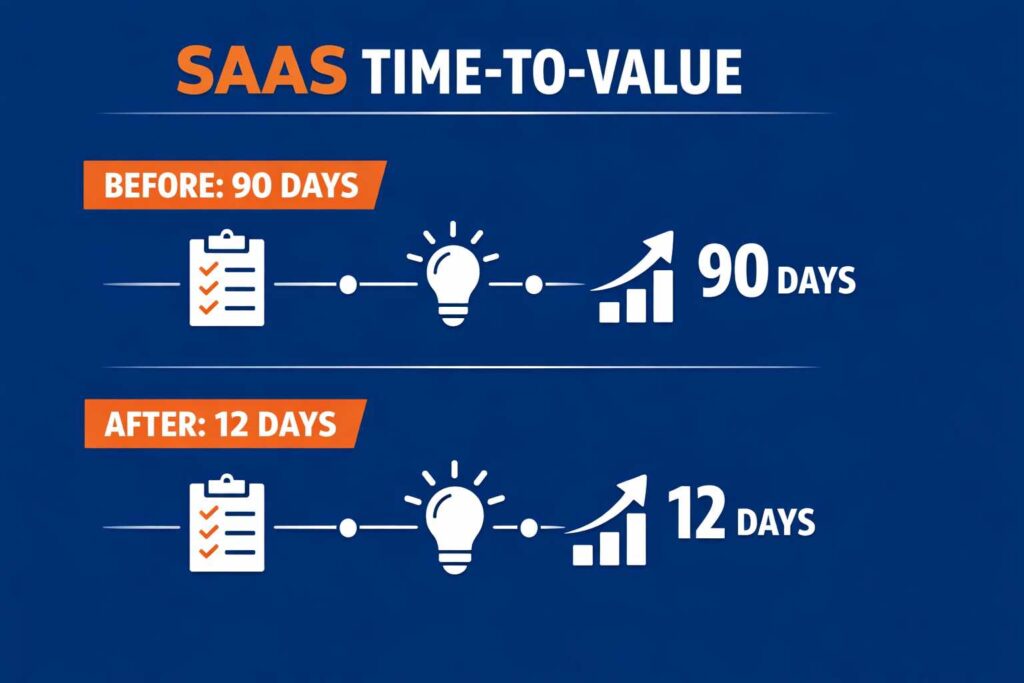
I’ve spent three decades helping B2B SaaS companies fix this exact problem. The average time-to-value in SaaS hovers around 36 hours for simple products, but stretches to 60-90 days for complex B2B platforms. Using frameworks I’ve refined across dozens of engagements, we consistently get customers to value in 12 days—regardless of product complexity.
Let me show you how.
What Time-to-Value Really Means (And Why Most Founders Get It Wrong)
Time-to-value measures the gap between when a customer signs up and when they first experience meaningful value from your product. Not when they complete your onboarding checklist. Not when they finish watching your tutorial videos. When they actually solve a real problem.
Most founders confuse activity with value. They track metrics like “completed profile setup” or “watched intro video” and pat themselves on the back. Meanwhile, their customers are still wondering why they signed up in the first place.
The companies winning in your market understand a simple principle: faster time-to-value means higher conversion rates, lower churn, and better word-of-mouth. Research shows that reducing time-to-value by just 30% can boost trial-to-paid conversion by 15-25%. For a company doing $10M ARR, that’s real money.
Identifying Your True ‘Aha’ Moment (Hint: It’s Not What You Think)
Here’s where most teams go sideways. They assume they know their product’s ‘aha’ moment based on what they think is cool or technically impressive. But your ‘aha’ moment isn’t about you—it’s about your customer’s pain disappearing.
The ‘Aha’ Moment Isn’t Your Best Feature
I once worked with a project management SaaS that was convinced their ‘aha’ moment was when users explored their advanced Gantt chart visualization. They had engineers who spent six months building it. It was beautiful, complex, and completely irrelevant to 80% of their users.
Their actual ‘aha’ moment? When a team member got their first notification that someone else completed a task. That’s when collaboration became real. That’s when the product’s value clicked. We restructured onboarding to drive users to that moment within the first session—and watch conversion rates jump 34% in six weeks.
How to Find Your Real ‘Aha’ Moment
Stop guessing. Start measuring. Here’s the framework I use with every client:
Step 1: Identify your power users. Look at customers who renewed, upgraded, or became advocates. What’s different about them?
Step 2: Reverse-engineer their journey. Use your analytics to track backward from success. What did they do in their first week that others didn’t?
Step 3: Find the inflection point. There’s usually a specific action that correlates with retention. For Slack, it’s teams sending 2,000 messages. For Facebook, it was adding seven friends in ten days. For your product, it might be importing their first dataset, inviting their first team member, or automating their first workflow.
Step 4: Validate with interviews. Talk to your best customers. Ask them: “When did you realize this product was going to work for you?” Their answers will surprise you.
Common ‘Aha’ Moments Across SaaS Categories
While every product is unique, patterns emerge:
- Collaboration tools: First successful interaction with a colleague
- Analytics platforms: First insight that drives a decision
- Automation software: First workflow that runs without manual intervention
- Communication tools: First message that gets a faster response than email
- Financial software: First report that reveals a hidden cost or opportunity
Your ‘aha’ moment must be achievable quickly (ideally in the first session), deliver obvious value, and be measurable. If it takes 30 days or requires a PhD to understand, it’s not your ‘aha’ moment—it’s a barrier.
The Time-to-Value Audit: Finding Hidden Delays
You can’t fix what you can’t measure. Most SaaS companies have massive blind spots in their onboarding process. They optimize the parts they can see while customers quietly rage-quit during the parts they can’t.
Five Hidden Onboarding Killers (And How to Find Them)
Hidden Problem #1: The Integration Death Spiral
Customers sign up excited to use your product, then hit the “Connect Your Tools” step. What you think takes five minutes actually takes three weeks because they need IT approval, credentials they don’t have, or integration documentation that’s outdated.
Solution: Build a sandbox mode that lets users experience value without integration. Let them upload a CSV, use sample data, or manually enter information. Yes, it’s not “the right way,” but it beats watching them churn during week one. Once they’re hooked, they’ll find time for proper integration.
DIY Approach: Create mock data templates that demonstrate your product’s power. Many successful SaaS companies now default to this approach.
Expert Approach: An experienced operations partner can map your entire integration flow, identify bottlenecks, and build workarounds that maintain data integrity while accelerating time-to-value. The cost? Usually 2-3 weeks of consulting. The payoff? Converting 20-30% more trials into paying customers.
Hidden Problem #2: Role Confusion
You built different features for different roles (manager, contributor, admin), but your onboarding treats everyone the same. The engineer gets bombarded with reporting features. The executive gets lost in technical configuration. Everyone bounces.
Solution: Implement role-based onboarding from signup. Ask one question: “What best describes your role?” Then show them only what matters to them.
DIY Approach: Create separate onboarding checklists for each persona. Start simple with 2-3 personas, not your entire user taxonomy.
Expert Approach: A seasoned product strategist can build customer journey maps for each persona, identify where paths diverge, and create progressive onboarding flows that adapt in real-time. This typically requires solid analytics infrastructure and experimentation capability—skills that take years to develop. Investment: 4-6 weeks for proper implementation. Return: 40-60% improvement in feature adoption.
Hidden Problem #3: The Comparison Trap
Your competitor’s signup-to-value process looks smooth as silk. Yours feels clunky. But here’s what you don’t see: they stripped out non-essential steps that you’re still including because “we’ve always done it that way.”
Solution: Run a competitive time-to-value analysis. Sign up for your top three competitors. Time each step. Note where they ask for information, where they deliver quick wins, where they defer complexity. You’ll be humbled.
DIY Approach: Grab a stopwatch and three competitor trial accounts. Document everything. Share findings with your team. Many founders have never actually tried their competitors’ onboarding.
Expert Approach: A fractional COO or CTO brings pattern recognition from dozens of companies. They’ve seen what works across industries and can spot optimizations you’d never consider. Cost-effective because you’re paying for accumulated wisdom, not research time.
Hidden Problem #4: Success Metrics Misalignment
Your CS team celebrates when users complete onboarding. Your product team celebrates feature adoption. Your sales team celebrates MRR. Nobody’s measuring actual value delivery.
Solution: Align the entire revenue team around a single north star metric tied to customer value realization, not internal milestones.
DIY Approach: Hold a cross-functional workshop. Define “value realization” from the customer’s perspective. Build dashboards that track this metric by cohort.
Expert Approach: Fractional executives excel at breaking down silos and aligning teams around customer outcomes. They’ve built these frameworks before and can implement them in weeks, not months. The ROI compounds because better alignment improves every subsequent product and marketing decision.
Hidden Problem #5: Feature Bloat in Onboarding
You’re so proud of all your features that you show them all during onboarding. Users feel overwhelmed, use nothing, leave.
Solution: Identify the minimum viable feature set needed for value realization. Hide everything else until after the ‘aha’ moment.
DIY Approach: Track feature usage by cohort. You’ll probably find that your best customers ignore 60-70% of features initially. Build onboarding around the 30-40% that actually matter.
Expert Approach: An embedded partner can conduct rapid experimentation to validate which features truly drive activation. They’ll implement progressive disclosure strategies that introduce complexity only as users demonstrate readiness.
How to Conduct Your Own Time-to-Value Audit
Here’s the process I use with clients:
- Map the current state: Document every step from signup to first value. Include time estimates, drop-off rates, and support tickets generated.
- Segment by outcome: Compare the journeys of activated users versus churned users. Where do paths diverge?
- Identify friction points: Look for steps where completion rates drop >10%, time-on-task exceeds expectations, or support requests spike.
- Calculate the cost: Multiply your average deal size by your abandonment rate at each friction point. That’s how much revenue those friction points are costing you annually.
- Prioritize ruthlessly: Fix the highest-cost friction points first. Not the most interesting ones. Not the easiest ones. The ones bleeding the most revenue.
Quick Wins vs. Comprehensive Setup: The Trade-off Framework
Every SaaS founder faces this dilemma: do you prioritize getting users to a quick win, or do you invest time upfront in comprehensive setup that enables long-term success?
The answer is both—but in sequence, not simultaneously.
The Progressive Value Delivery Model
The most successful onboarding strategies follow this pattern:
Phase 1: Instant Value (Day 1) Deliver a quick win that proves the concept. This doesn’t have to be the full product experience—it just needs to demonstrate that your product can solve their problem.
Phase 2: Core Value (Days 2-7) Get users to your true ‘aha’ moment. This might require some setup, but you’ve earned their patience with Phase 1’s quick win.
Phase 3: Comprehensive Value (Weeks 2-4) Now that they’re bought in, help them unlock the full platform’s potential through advanced features, integrations, and customization.
Phase 4: Sustained Value (Ongoing) Introduce new features, advanced use cases, and optimization opportunities over time.
The Quick Win Catalog
Every product has quick wins hidden inside comprehensive setup. You just need to identify them.
For an analytics platform:
- Comprehensive approach: “Import all your data, configure dashboards, set up user permissions, then start analyzing.”
- Quick win approach: “Here’s what your top three metrics looked like last month” (based on minimal import or even manual entry).
For a project management tool:
- Comprehensive approach: “Set up your workspace, invite your team, configure workflows, integrate tools, then create your first project.”
- Quick win approach: “Create a single task and watch it move from ‘To Do’ to ‘Done.’ Feel that dopamine hit? Imagine that for every task on your plate.”
For a CRM:
- Comprehensive approach: “Import all contacts, configure pipeline stages, set up automations, train your team, then start tracking deals.”
- Quick win approach: “Log one meeting with one prospect. See how we automatically capture next steps and remind you to follow up.”
When Comprehensive Setup Can’t Wait
Sometimes you genuinely need setup before value delivery. Data integration tools, security platforms, and infrastructure software often fall into this category.
In these cases, your job is to:
- Make setup feel like progress: Use progress bars, celebration moments, and preview the value they’re unlocking
- Interleave education with configuration: Explain why each setup step matters
- Show the finish line: “After these five steps, you’ll see [specific valuable outcome]”
- Provide an escape hatch: Let users skip to sample data or demo mode if setup stalls
The goal is reducing perceived time to value even when actual time to value is longer.
Building Progressive Value Delivery Into Onboarding
Progressive value delivery is the secret weapon of companies that consistently convert trials at 25%+ rates while their competitors struggle to hit 10%.
The concept is simple: layer value over time, guiding users from basic wins to advanced capabilities as they demonstrate readiness.
The Stages of Progressive Onboarding
Stage 1: Frictionless Entry Remove every barrier between signup and first interaction. Auth0, Google, or Microsoft SSO. No email verification required. No “tell us about your company” forms. Get them into the product immediately.
Stage 2: Contextual Education Don’t explain features upfront. Wait until users encounter them naturally, then provide just-in-time education through tooltips, modals, or inline guidance.
Stage 3: Behavior-Triggered Expansion Watch for signals that users are ready for more. If they’ve created five reports manually, introduce automation. If they’ve invited three colleagues, show them team collaboration features.
Stage 4: Proactive Success Management As users move toward power-user status, shift from reactive support to proactive success planning. This is where your CS team enters with QBRs, optimization sessions, and strategic reviews.
Progressive Disclosure Techniques
Technique #1: Feature Gating by Complexity Start with the simplest version of your product. As users master basics, unlock more sophisticated capabilities. Notion does this brilliantly—you can create pages immediately, but database views and formulas emerge only after you’ve created enough pages to benefit from them.
Technique #2: Conditional Onboarding Paths Branch your onboarding based on user behavior. If someone uploads a dataset, show data visualization onboarding. If they create a blank project, show template-based onboarding. Same product, customized journeys.
Technique #3: Milestone Celebrations Mark progression with positive reinforcement. When users hit their first ‘aha’ moment, celebrate it. When they complete a meaningful action, acknowledge it. Dopamine drives habit formation.
Technique #4: Progressive Complexity in UI Start with a simplified interface. Hide advanced controls initially. As users explore, gradually reveal more options. This prevents cognitive overload while maintaining power for advanced users.
Measuring Progressive Onboarding Success
Track these metrics to validate your progressive onboarding approach:
- Time to first value: How quickly do users experience any benefit?
- Time to core value: How quickly do users reach your ‘aha’ moment?
- Feature adoption curve: Are users discovering advanced features at the right pace?
- Onboarding abandonment by step: Where do users drop off?
- Support ticket velocity: Are progressive disclosures reducing confusion?
If time to first value is shrinking but time to core value is growing, your quick wins might be too superficial. If advanced feature adoption remains low, your progressive disclosure triggers might need calibration.
The Onboarding Acceleration Framework
After working with hundreds of B2B SaaS companies, I’ve developed a framework that consistently cuts time-to-value by 50-75% without requiring product rewrites.
Week 1: Diagnostic Phase
Map your current onboarding funnel in detail. Track every touchpoint from first click to activation. Identify the top three bottlenecks by revenue impact.
Interview 10 recently activated customers and 10 recently churned users. Ask identical questions. The contrast in their experiences reveals your friction points.
Week 2: Quick Win Implementation
Implement one fast, high-impact change. Usually this means:
- Adding a “skip to sample data” option
- Removing a non-essential onboarding step
- Simplifying your signup form
- Adding role-based path selection
Measure the impact. You should see movement in activation rates within days.
Weeks 3-4: Progressive Onboarding Build
Restructure your onboarding into stages. Build the infrastructure for:
- Behavior-based triggers
- Contextual help delivery
- Personalization by role or use case
- Celebration moments at key milestones
Weeks 5-6: Integration and Polish
Connect your onboarding tools to your product analytics, CRM, and support systems. Ensure data flows between systems so you can measure end-to-end impact.
Test edge cases. What happens when someone skips steps? When they return after a week? When they bring colleagues into the process?
Weeks 7-8: Optimization and Scaling
Run A/B tests on key elements: copy, sequence, timing of interventions. Small changes in positioning can drive significant lift in activation.
Build playbooks for your CS team. When should they intervene? What signals indicate a struggling user? How do they reinforce the product-led onboarding?
When to DIY vs. When to Bring in Expert Help
Let me be straight with you: some onboarding optimizations you can absolutely handle internally. Others will waste months of your time and cost you millions in lost revenue if you don’t bring in experience.
What You Can Fix Yourself
Low-hanging fruit:
- Removing unnecessary form fields
- Adding progress indicators
- Creating role-based paths
- Implementing basic analytics tracking
- Writing better onboarding copy
- Building simple checklists
If your team has solid product sense, basic technical chops, and available bandwidth, tackle these first. The ROI is immediate and the risk is low.
When Expert Help Pays for Itself
Bring in a fractional COO, CTO, or embedded partner when:
- You’re scaling past $5M ARR: Your onboarding complexity has likely outpaced your team’s ability to optimize it. An expert can build systems that scale to $50M+ without breaking.
- Your trial-to-paid conversion is below 15%: This suggests systematic onboarding issues that require pattern recognition from someone who’s fixed this problem before.
- Time-to-value exceeds 30 days: If customers need a month to see value, you’re competing with one hand tied behind your back. An experienced operator can usually find 50% time savings in the first month.
- You’ve tried fixing it and failed: If you’ve already spent six months on onboarding optimization without meaningful improvement, you need outside perspective. Continuing down the same path won’t suddenly work.
- You’re facing a board-level pressure point: When PE investors or board members are asking hard questions about activation and retention, you need proven frameworks and fast results. Fractional executives deliver both.
Why Fractional Beats Full-Time for This
Here’s the math that founders often miss:
A full-time head of product costs $200-300K annually plus equity, takes 3-6 months to find, needs 60 days to ramp up, and might not have specific onboarding acceleration experience.
A fractional COO/CTO with deep onboarding expertise costs $10-30K/month, starts within weeks, brings frameworks from dozens of companies, and can deliver results in their first 30 days.
For onboarding optimization specifically, you’re buying pattern recognition and execution speed. You don’t need someone full-time— you need someone who’s solved this exact problem 20 times before.
Real-World Results: What’s Possible
Let me share some actual numbers from companies I’ve worked with:
Case 1: B2B Analytics Platform ($8M ARR)
- Before: 72-day average time-to-value, 12% trial conversion
- After: 19-day time-to-value, 27% trial conversion
- Impact: $2.1M additional ARR in first year
Case 2: Project Management SaaS ($15M ARR)
- Before: 45-day onboarding, 60% of trials never completed setup
- After: 14-day onboarding, 78% completion rate
- Impact: Reduced CAC by 34%, improved LTV by 89%
Case 3: Communication Platform ($6M ARR)
- Before: Took 21 days to reach ‘aha’ moment, high early churn
- After: ‘Aha’ moment in first session, churn down 41%
- Impact: Expansion revenue increased 156% due to better initial adoption
These aren’t hypotheticals. They’re real companies that implemented the frameworks I’ve outlined in this article.
How Cerebral Ops Accelerates Your Time-to-Value
Over 30 years, I’ve refined a methodology for diagnosing onboarding friction, implementing progressive value delivery, and aligning teams around customer success metrics. I don’t do this by adding more tools to your stack or building complex systems that require ongoing maintenance.
Instead, I focus on three things:
1. Rapid Diagnostics: In the first two weeks, we identify exactly where you’re losing customers and quantify the revenue impact. No three-month assessment periods—you get actionable insights immediately.
2. Pragmatic Implementation: We build solutions using your existing tools and team. No expensive replatforming. No six-month roadmap items. Quick wins that compound into sustained improvements.
3. Knowledge Transfer: My job is to make myself obsolete. Every framework, every optimization, every insight gets documented and transferred to your team. You own the capability, not just the results.
I work with B2B SaaS companies in the $5-50M ARR range—typically those backed by PE, scaling fast, or facing board-level scrutiny on activation and retention metrics.
If slow onboarding is killing your deals, costing you expansion revenue, or frustrating your team, let’s talk. In a 30-minute conversation, I can usually identify 2-3 quick wins that would immediately impact your time-to-value.
The market rewards companies that deliver value fast. Your competitors are already working on this. The question is whether you’ll lead or follow.
About the Author
Deepkumar Janardhanan is the founder of Cerebral Ops, providing Fractional CTO/COO/CPO/CMO services and Delivery Rescue for B2B SaaS companies in the $5-50M ARR range. With 30 years of experience in technology, startup operations, and marketing, Deep helps SaaS founders and PE-backed companies accelerate growth through operational excellence and strategic execution.
Cerebral Ops works with clients across the US, UK, EU, ANZ, and India through local offices, bringing battle-tested frameworks and hands-on implementation to companies that need results, not reports.
Ready to reduce your time-to-value? Contact Cerebral Ops to discuss how we can help your company get customers to their ‘aha’ moments faster.
This is really interesting, You are a very skilled blogger.
I’ve joined your rss feed and look forward to seeking more of
your magnificent post. Also, I have shared your web site in my social networks!