
Building Scalable Processes Without Becoming Bureaucratic
You wanted process. You got bureaucracy. Now nothing ships. Here’s where you went wrong.
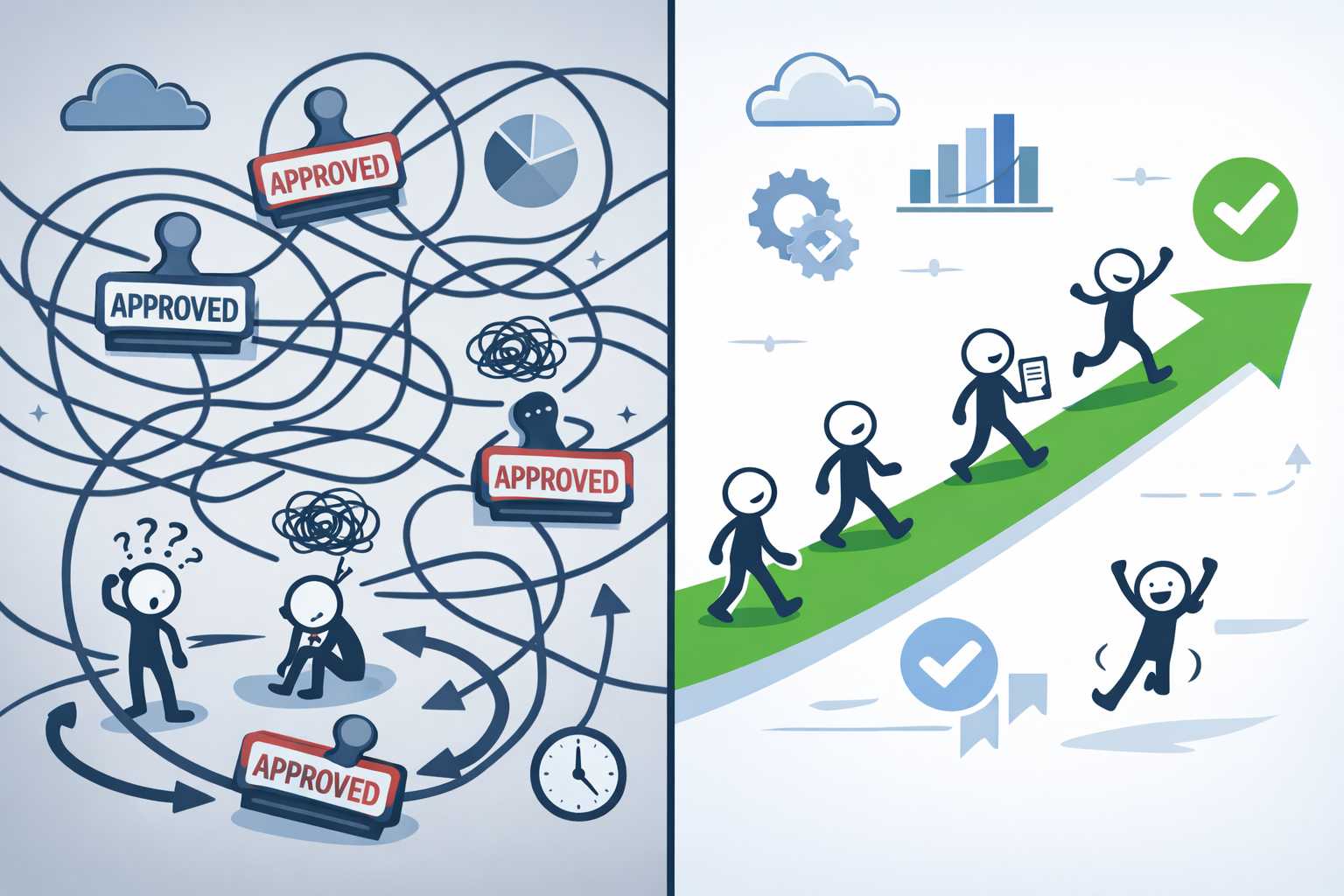
Six months ago, your B2B SaaS company was moving fast. Features shipped weekly. Customers got quick answers. Your team knew what to do without asking permission.
Then you decided to “add some process.”
Now? Three approval layers for a simple bug fix. Documentation nobody reads. Meetings about meetings. Your best engineer just told you they’re spending more time filling out forms than writing code.
Sound familiar?
You’re not alone. According to recent research, 68.4% of SaaS companies generate under $100K revenue per employee—largely because operational inefficiency has replaced operational excellence. They over-processed themselves into paralysis.
But here’s the thing: you do need process as you scale. The question isn’t whether to build processes—it’s how to build the right ones that propel growth instead of strangling it.
I’ve spent three decades helping B2B SaaS founders navigate this exact problem. Let me show you where the wheels typically come off, and more importantly, how to keep your company nimble while you scale from $5M to $50M and beyond.
The Process Trap: How Good Intentions Create Bad Outcomes
Here’s what happened. You started documenting “the way we do things.” Rational, right?
Except nobody asked: Which things actually need documenting?
They documented everything. Customer onboarding? 47-page playbook. Code review? 12-step checklist. Expense reports? Don’t get me started.
The average SaaS operations team now manages between 40 and 60 different applications, with 45% of licenses sitting unused. Your processes multiplied to match every tool, every workflow, every exception someone thought up at 2 AM.
You built process for process’s sake. And that’s where bureaucracy begins.
Problem #1: You Can’t Tell Process from Bureaucracy
The Problem:
Most founders think process and bureaucracy are the same thing. They’re not.
Process enables decisions. Bureaucracy delays them.
Process gives your team a playbook for the 80% of situations they encounter regularly. Bureaucracy gives them a manual for every possible situation, including ones that never happen.
Here’s the test: if removing a step would cause actual problems for customers or team coordination, that’s process. If removing it would just upset the person who invented it, that’s bureaucracy.
The Solution:
Start with this question for every process you’re considering: “What breaks if we don’t have this?”
If the answer is “nothing” or “someone might be confused once,” you don’t need it.
Build processes only for:
- Handoffs between teams (where balls get dropped without clear ownership)
- Critical paths that directly impact customers (onboarding, support escalations, security incidents)
- Compliance requirements that carry real legal or financial risk
- High-stakes decisions where context needs to be preserved (pricing changes, layoffs, major architecture decisions)
Everything else? Start with nothing. Add only when pain becomes recurring.
One client came to me with 127 documented “standard operating procedures.” We audited them together. Seventeen—just seventeen—were actually preventing problems. The other 110? Created in response to one-off situations that never repeated.
We killed 110 processes in a week. Shipping speed increased 40%. Nobody noticed the missing processes except the compliance officer, and even she admitted most were “nice to have.”
DIY or Expert?
If you’re pre-Series A with under 50 people, you can do this yourself. Set aside a week, gather your leadership team, and audit ruthlessly.
Post-Series A with multiple departments? You need outside eyes. You’re too close to see which sacred cows need slaughtering. A fractional COO who has scaled companies through your stage spots the bureaucracy instantly—and more importantly, has the authority to eliminate it without internal politics derailing the cleanup. The cost? Usually 15-20% of a full-time executive, but the ROI shows up immediately in recovered engineering hours and faster cycle times.
Problem #2: You’re Documenting Everything Instead of the Right Things
The Problem:
Your team is drowning in process documentation that nobody uses.
The average B2B SaaS company I work with has process docs spread across Google Drive, Notion, Confluence, Slack pins, email threads, and at least one person’s laptop. When someone needs to know “how we do X,” they ask in Slack rather than hunt through the docs.
Why? Because you documented the wrong things.
You created encyclopedias when you needed cheat sheets. You wrote about every edge case instead of the common path. You optimized for completeness instead of usability.
The 80/20 rule for documentation: 80% of your team will need 20% of your processes, 80% of the time. But they documented the other 80% first.
The Solution:
Focus on the “minimum viable process” for each stage of growth.
Stage 1: Pre-Product-Market Fit ($0-$1M ARR) Document almost nothing. Seriously. Your processes should fit on a single page:
- How we decide what to build next
- How we handle customer emergencies
- How we coordinate deploys
That’s it. Everything else happens through direct conversation. Your team is small enough that institutional knowledge lives in people’s heads, and it should stay there. Premature documentation kills the experimentation you need at this stage.
Stage 2: Initial Traction ($1M-$10M ARR) Now you’re hiring people who weren’t there at the beginning. Document the handoffs:
- Customer onboarding workflow (from sales close to first value delivery)
- Support escalation path (when does a ticket go to engineering?)
- Feature prioritization framework (how do we decide what ships?)
- Security incident response (who does what when things break?)
- New hire onboarding (what does someone need to know by day 30?)
Keep each document under three pages. If it’s longer, you’re documenting exceptions instead of the rule.
Stage 3: Scaling ($10M-$50M ARR) You have departments now. Different offices. People who’ve never met running related workstreams. Document the coordination:
- GTM playbooks for each customer segment
- Product development lifecycle (ideation through deployment)
- Customer health scoring and intervention triggers
- Quarterly planning process
- Department-level OKRs and how they connect
Here’s the key: these aren’t instruction manuals. They’re decision frameworks. They tell people how to think, not what to do in every situation.
One client spent six months creating a 200-slide “Sales Playbook” covering every objection, every use case, every demo flow. Sales reps ignored it. We replaced it with a 12-slide “Deal Qualification Framework” that answered three questions: Is this prospect a fit? What outcome are they buying? What might stop this deal? Revenue per rep increased 35% in two quarters because they spent time selling instead of searching through slides.
The Documentation Formula:
For any process worth documenting:
- One-pager: What is this process? Why does it exist? Who owns it?
- Happy path: The 80% case, step-by-step, in plain language
- Decision points: Where do things branch? What triggers which path?
- Escape hatches: When can you deviate? Who approves exceptions?
That’s it. Four sections maximum. If you need more, you’re building bureaucracy.
DIY or Expert?
Early-stage companies (under $5M) can tackle this internally, but you need discipline. Appoint one person—usually your VP of Ops if you have one, otherwise your most process-minded leader—as the “documentation sheriff.” Their job isn’t to write everything; it’s to stop others from over-documenting.
Companies scaling past $10M ARR need expertise. You’re adding 20-50 people a year. Without the right documentation infrastructure, every new hire makes coordination harder instead of easier. An embedded partner or fractional COO brings patterns from companies who’ve solved this. They build the minimum documentation system that scales—not by adding more docs, but by creating frameworks that reduce the need for documentation. The three-month engagement typically saves 200-300 hours of leadership time and prevents the documentation death spiral before it starts.
Problem #3: Your Processes Don’t Evolve with Your Company
The Problem:
The process that worked brilliantly at $5M ARR is killing you at $15M.
I see this constantly: Companies hit a growth stage, implement processes that solve immediate problems, then never revisit them as the business evolves. Three years later, they’re following procedures designed for a company one-third their current size—or worse, ten times their size because they copied them from a playbook written for enterprises.
Process debt compounds just like technical debt. Every quarter you delay the audit, the cleanup gets harder.
Research shows that companies growing from $1M to $30M ARR need to fundamentally restructure their operations every time they roughly triple in size. But most don’t. They bolt new processes onto old ones until nothing makes sense anymore.
The Solution:
Treat processes like code: they need regular refactoring.
Implement a quarterly “process health check” with your leadership team:
- What’s slowing us down? Where do people complain about unnecessary steps?
- What’s breaking? Where do we have repeated failures in coordination or execution?
- What’s changed? Did we enter a new market, add a new product line, restructure a team?
For each process, ask three questions:
- Does it still solve the problem it was designed for? (Many don’t—the original problem went away)
- Is it scaled correctly for our current size? (Too light for 200 people, too heavy for 30)
- What would happen if we killed it? (If the answer is “nothing,” kill it)
Here’s a framework for right-sizing process to your growth stage:
$1M-$5M ARR: Lightweight Documentation
- Simple checklists
- Quick-reference guides
- Heavy reliance on direct communication
- Emphasis on “why” over “how”
$5M-$15M ARR: Structured Frameworks
- Decision trees for common scenarios
- Clear ownership and escalation paths
- Templates for recurring activities
- Regular process reviews built into quarterly planning
$15M-$50M ARR: Systematic Operations
- Integrated systems across departments
- Metrics-driven process improvement
- Specialized ops roles managing process evolution
- Formal training programs for key processes
The transition points are crucial. At each stage, you’re not just adding process—you’re replacing the previous stage’s approach with something fundamentally different.
One client hit $12M ARR still using the “Slack-first” communication culture from their $2M days. Everything was ad-hoc. Worked great with 15 people. With 75 people across four time zones, critical decisions were being made in side threads that half the team never saw. We didn’t add more Slack channels—we implemented a structured decision-making framework with clear authorities and documentation requirements. Decisions actually got faster because people stopped rehashing the same discussions.
DIY or Expert?
Process evolution requires pattern recognition across growth stages. If you haven’t scaled a company through your current stage before, you lack the reference points.
A fractional COO who’s taken multiple companies from $10M to $30M has seen this movie before. They know which processes scale, which need replacing, and which new ones you’ll need before you realize you need them. More importantly, they have the battle scars from process debt that got out of control. Learning from others’ mistakes is cheaper than creating your own.
The typical engagement runs 6-12 months because process evolution isn’t a one-time fix—it’s building the capability to evolve continuously. But the impact compounds: companies with the right operational infrastructure at each stage grow 45% faster than those who let process debt accumulate.
Problem #4: You Don’t Know When Enough Is Enough
The Problem:
How do you know you’ve over-processed?
Most founders don’t realize they’ve crossed the line until it’s too late. The slide into bureaucracy is gradual, then sudden. Each individual process seems reasonable. Collectively, they’re suffocating your company.
Here are the warning signs you’ve over-processed:
Symptom 1: Cycle Time Explosion How long does it take from “we should do this” to “it’s live”? At $2M ARR, features shipped in 2-3 weeks. Now at $15M, the same-sized feature takes 8-10 weeks—and most of that time isn’t development.
If your cycle time has doubled or tripled but your product complexity hasn’t, you’ve over-processed.
Symptom 2: Decision Proliferation Count the number of people who need to approve a mid-sized decision (say, a $10K spend or a feature that will take two weeks to build). If it’s more than three, you’ve over-processed.
The best organizations keep approval layers shallow. Amazon’s “two-pizza teams” work because they can make most decisions without escalation. If your teams are constantly seeking permission, your processes are too heavy.
Symptom 3: Documentation Divergence What percentage of your documented processes reflect how work actually happens? If people are constantly saying “we don’t follow that anymore” or “that’s not how we really do it,” your documented processes have diverged from reality.
This is deadly. It means either: A) Your processes are too rigid to match business reality, or B) Your processes are being ignored, which means they’re not actually controlling anything
Both are signs of over-processing.
Symptom 4: Talent Flight Your best people are leaving for smaller, faster-moving companies. When you ask why in exit interviews, you hear variations of: “Too much process,” “Can’t get anything done,” “Feels like a big company.”
High performers leave bureaucratic environments. If you’re losing top talent to companies smaller than you, your processes are probably the reason.
Symptom 5: The Bureaucrat Emergence Someone on your team has become the “process person.” Their job is maintaining processes, not delivering customer value. They defend processes against changes. They add steps to prevent theoretical problems that have never happened.
When you have someone whose incentive is to increase process rather than outcomes, you’re in trouble.
The Solution:
Implement process hygiene before you over-process.
The “Kill Rule” For every new process you add, kill one old process. This forces prioritization and prevents accumulation.
The “Explain in Under 2 Minutes” Rule If you can’t explain a process in under two minutes, it’s too complicated. Either simplify or split it into smaller processes.
The “90-Day Sunset” Rule Every new process expires in 90 days unless explicitly renewed. This prevents processes from living forever after their usefulness ends.
The “Test with Your Best” Rule Before rolling out a new process, test it with your highest-performing team member. If they say it will slow them down without commensurate benefits, kill it. Never optimize for your weakest performers at the expense of your strongest.
The “Outcomes over Activities” Rule Measure processes by outcomes (did it improve results?) not activity (did people follow it?). A perfectly-followed process that doesn’t improve results is bureaucracy.
I worked with a company where the engineering team had built a 14-checkpoint code review process. They were proud of their thoroughness. But deploy frequency had dropped 60%, and the defect rate hadn’t improved.
We implemented the “outcomes over activities” test: which checkpoints actually caught bugs? Four of them caught 90% of issues. We killed the other ten. Deploy frequency tripled. Defect rate dropped because developers were iterating faster and fixing issues earlier.
The Hard Truth:
Most over-processing happens because of fear—fear of mistakes, fear of inconsistency, fear of losing control as you scale. But excessive process doesn’t reduce risk; it just moves it. You trade execution risk for coordination risk.
The companies that scale successfully learn to be comfortable with some chaos. They trust their people to make good decisions within clear frameworks rather than following rigid procedures.
DIY or Expert?
Recognizing over-processing requires objectivity you probably don’t have. You’re the frog in slowly boiling water.
This is where an embedded partner delivers outsized value. They show up, look at your processes with fresh eyes, and say “this is insane” about things you’ve normalized. They’ve seen dozens of companies at your stage, so they know what’s normal and what’s not.
The intervention is usually quick—a 2-3 week audit followed by immediate cuts. But it requires someone with authority to make changes over objections from the people who built the processes. That’s why a fractional COO role works better than a consultant here: they have executive authority to actually implement changes, not just recommend them.
Problem #5: You’re Building for Control Instead of Velocity
The Problem:
You built processes to control your team. You should have built them to empower your team.
This is the most insidious form of over-processing because it starts with good intentions. As you scale, you worry about consistency. About junior people making expensive mistakes. About maintaining quality as you grow.
So you build processes that require approval, review, sign-off. Each step adds someone to check someone else’s work. You’re optimizing for mistake prevention instead of value creation.
The result? Your processes select for people who follow rules instead of people who deliver results.
High performers leave. Risk-averse bureaucrats stay and multiply. Within two years, your culture has fundamentally changed—not because you made bad hiring decisions, but because your processes systematically filtered for the wrong behaviors.
The data backs this up: SaaS companies showing execution-to-growth translation problems can trace 41% of their challenges back to processes that slow decision-making. When your best people spend more time navigating approvals than doing their jobs, you’ve optimized for control at the expense of velocity.
The Solution:
Flip your process philosophy. Build for velocity with guardrails, not control with permissions.
Instead of asking “Who needs to approve this?” ask “What’s the worst that could happen if we did this wrong?”
Then design your process around that risk level:
Low-Risk Decisions (Reversible, low cost if wrong):
- Default to “yes”
- Single owner makes the call
- Document the decision afterward if it affects others
- No approval required
Examples: A/B test variations, blog post topics, minor UI changes, internal tool choices
Medium-Risk Decisions (Some cost to reverse, meaningful impact):
- Owner proposes, stakeholders review
- 48-hour window for objections
- If no objections, proceed
- Document the reasoning
Examples: Pricing changes, major feature decisions, hiring offers, marketing campaign budgets
High-Risk Decisions (Irreversible, major impact on company):
- Formal proposal with analysis
- Review by leadership team
- Clear decision date and criteria
- Full documentation including alternatives considered
Examples: Market entry, product strategy pivots, layoffs, major partnerships, M&A
Notice what’s missing from low and medium-risk decisions? Approval meetings. Approval chains. “Let me check with so-and-so.”
You’re replacing process with judgment. You’re trusting people to make good decisions within clear boundaries instead of following procedures.
The “Disagree and Commit” Process
For contentious decisions, implement this simple framework:
- Decision owner presents the choice and their recommendation
- Stakeholders voice disagreement and reasoning
- Decision owner makes the final call
- Everyone commits to executing that decision, even dissenters
- Decision owner owns the outcomes
This prevents endless consensus-seeking while maintaining healthy debate. And it’s fast—most “disagree and commit” decisions happen in a single 30-minute meeting.
One client was spending three weeks getting alignment on every feature decision, running them through product, engineering, design, sales, marketing, and customer success. Everyone had veto power. Features died in committee.
We implemented “disagree and commit” with product managers as decision owners. Feature decisions now take 2-3 days max. Yes, some decisions are wrong. But they’re learning from market feedback in days instead of debating internally for weeks. Revenue per employee increased 33% in six months because they shipped 4x more features to test.
The Cultural Shift
Velocity-based processes require a different culture:
- Celebrate fast learning from mistakes, not perfect planning
- Measure outcomes (did it work?), not process compliance (did you follow the steps?)
- Promote people who deliver results, not people who never break rules
- Fire people for hiding mistakes, not making them
This is uncomfortable for founders who came up in big company environments. But it’s how you maintain startup speed at scale.
DIY or Expert?
Shifting from control-based to velocity-based processes is a cultural change, not just an operational one. And culture change is hard.
If you’re a first-time founder or came from a corporate background, you probably don’t have the muscle memory for what “good” velocity processes look like. You’ll default to what you know—which is probably too heavy.
A fractional COO or embedded partner who has built velocity-based operations in multiple SaaS companies brings the pattern language you lack. More importantly, they have the credibility to push back when you’re adding unnecessary process because you’re scared.
The engagement typically runs 6-9 months because you’re not just changing processes—you’re changing how your leadership team thinks about risk, control, and empowerment. But the impact shows up immediately: companies that successfully make this shift typically see 25-40% improvements in shipping velocity within the first quarter.
Process vs. Playbooks: What Actually Works for SaaS
Here’s what most founders get wrong: they think they need comprehensive processes. What they actually need are lightweight playbooks.
Processes tell you exactly what to do, step by step. They’re designed for consistency and compliance.
Playbooks give you frameworks and principles. They’re designed for good decision-making in variable situations.
SaaS needs playbooks, not processes.
Why? Because SaaS is inherently variable. Every customer is different. Every deal has unique characteristics. Every support issue has its own context. Rigid processes break in variable environments.
What a Good SaaS Playbook Looks Like:
Instead of: “Customer Onboarding Process – 47 Steps” Create: “Customer Onboarding Playbook”
- Goal: Time to first value under 14 days
- Critical path: Account setup → Key integration → First win → Expansion conversation
- Decision framework: When to do white-glove vs. self-serve
- Red flags: What triggers escalation to leadership
- Success metrics: What “good” looks like by day 7, 30, 60
Notice the difference? The playbook gives you the goal, the general path, and decision principles. It doesn’t prescribe every step because every customer is different.
The Playbook Library for Scaling SaaS:
- Sales Qualification Playbook: When is a deal worth pursuing? What disqualifies a prospect?
- Customer Onboarding Playbook: How do we get customers to value fast?
- Support Escalation Playbook: When does a ticket need special handling?
- Feature Prioritization Playbook: How do we decide what to build?
- Quarterly Planning Playbook: How do we set and cascade goals?
- Crisis Response Playbook: Who does what when things go sideways?
Six playbooks. That’s it. These six cover 90% of the critical coordination needs in a $10-50M ARR SaaS business.
Each playbook is 3-5 pages maximum. Longer than that and nobody uses it.
The Key Elements Every Playbook Needs:
- Purpose: Why does this exist? What problem does it solve?
- Ownership: Who owns the outcome? (One name, not a committee)
- Happy Path: The 80% case, described clearly
- Decision Points: Where things branch and how to choose
- Escalation Triggers: When to involve leadership
- Success Metrics: How do we know if it’s working?
That’s the template. Apply it consistently across your six core playbooks.
One company I worked with had 43 different “processes” for how to handle different customer scenarios. We consolidated them into a single Customer Success Playbook with three decision frameworks: health score (green/yellow/red), engagement level (active/at-risk/churned), and growth potential (expand/maintain/reduce). Every customer situation fit into this 3x3x3 matrix, and the playbook told you the appropriate response pattern for each combination.
The team went from constantly asking “what should we do here?” to making confident decisions independently. Customer satisfaction scores increased while CS team size stayed flat during a period when ARR doubled.
How I Help B2B SaaS Founders Build Processes That Scale
I’ve taken companies from $5M to $50M six times now. Every single one struggled with the process paradox: too little and things fall apart, too much and nothing moves.
The pattern is always the same: founders wait too long to add structure, then over-correct by adding too much, then spend a year unwinding the bureaucracy they created.
Here’s how I help clients avoid that trap:
Phase 1: Audit (Weeks 1-2) We identify what’s actually slowing you down vs. what you think is slowing you down. Usually, they’re not the same thing. Most founders are trying to solve process problems that don’t exist while ignoring the real bottlenecks.
I look at:
- Where do decisions get stuck?
- Where are handoffs dropping balls?
- Which processes are being ignored? (That tells you they’re not solving real problems)
- What’s your cycle time from decision to execution?
- Where are your best people spending their time?
Phase 2: Simplification (Weeks 3-6) We kill everything that isn’t driving outcomes. This is uncomfortable. People have invested time in building these processes. But if they’re not measurably improving results, they’re waste.
Then we build the minimum viable playbooks for your stage—not the stage you want to be at, the stage you’re at right now. Over-processing usually happens when companies implement processes designed for companies 3x their size.
Phase 3: Implementation (Weeks 7-12) We roll out the new playbooks with your team, train on the decision frameworks, and most importantly, model the behavior. I’m there in your leadership meetings demonstrating what velocity-based decision-making looks like vs. consensus-seeking.
This is where the culture shift happens. Your team watches how decisions get made with the new playbooks and adjusts their behavior accordingly.
Phase 4: Evolution (Months 4-12) As embedded partner or fractional COO, I stay with you through at least one quarterly cycle. We refine the playbooks based on what’s working, kill the ones that aren’t, and add new ones as you hit new growth stages.
The goal isn’t to build perfect processes—it’s to build the capability to evolve your processes as you scale. That’s the real value: you don’t just get better operations, you get an operating system that scales with you.
The Results:
Companies that get this right typically see:
- 25-40% reduction in time from decision to execution
- 30-50% decrease in process documentation (yes, less is more)
- 20-35% improvement in revenue per employee
- Significant reduction in leadership time spent in coordination meetings
- Higher retention of top performers who were frustrated by bureaucracy
But the biggest impact isn’t in the numbers. It’s in the founders who stop lying awake at 3 AM wondering if their company is becoming the bureaucratic nightmare they left corporate America to escape.
Drowning in Process Docs Nobody Follows? There’s a Better Way.
If you’re reading this and thinking “that’s us,” you’re not alone.
The vast majority of B2B SaaS companies between $5M and $50M ARR are stuck in the process trap. They know they’re over-processed. They just don’t know how to fix it without everything falling apart.
Here’s the truth: you can’t fix this while running the company full-time. You’re too close to it. You built these processes. You have emotional attachment to them. And you don’t have the pattern recognition to know which ones are normal for your stage and which ones are strangling you.
This is exactly why companies bring in a fractional COO or embedded partner. We’ve seen this movie dozens of times. We know which processes scale and which ones don’t. More importantly, we have the authority to make changes over internal objections and the time to see them through.
If you’re a B2B SaaS founder or operating partner struggling with the process paradox, let’s talk. I help companies in the $5-50M ARR range build operational infrastructure that scales without bureaucracy.
Three decades in the trenches—as CTO, COO, and embedded partner—has taught me that scaling SaaS is less about adding process and more about adding the right process at the right time. And knowing when to kill process that’s outlived its usefulness.
Your company doesn’t need more documentation. It needs better judgment infrastructure. Let’s build it together.
Contact Cerebral Ops at https://cerebralops.in/contact/ to discuss how we can help you scale your operations without losing your velocity.
About the Author
Cerebral Ops specializes in Fractional CTO, COO, CPO, and CMO roles for B2B SaaS companies in the $5-50M ARR range. We provide Delivery Rescue and Embedded Partner services for companies across the US, UK, EU, ANZ, and India.
With 30 years of experience in technology, startup operations, and marketing, we help SaaS founders build scalable operational infrastructure that propels growth instead of strangling it. Our clients have local offices in the US and EU, ensuring we can work in your timezone with your team.
We understand the unique challenges of scaling B2B SaaS because we’ve lived them—as founders, operators, and leaders. When you work with Cerebral Ops, you’re not getting theory from consultants. You’re getting battle-tested frameworks from operators who’ve scaled companies through exactly the stage you’re in right now.
Learn more at cerebralops.in