
How to Design, Implement, and Maintain SLAs That Keep Customers Happy and Loyal
Service Level Agreements (SLAs) sound like something only enterprises worry about. In reality, they’re one of the simplest levers a small business or startup can pull to make customers trust you, stay longer, and refer others.
Author’s Note: Ok, I planned this as a small writeup, but I guess I got carried away. So, now this will be a 2 part post.
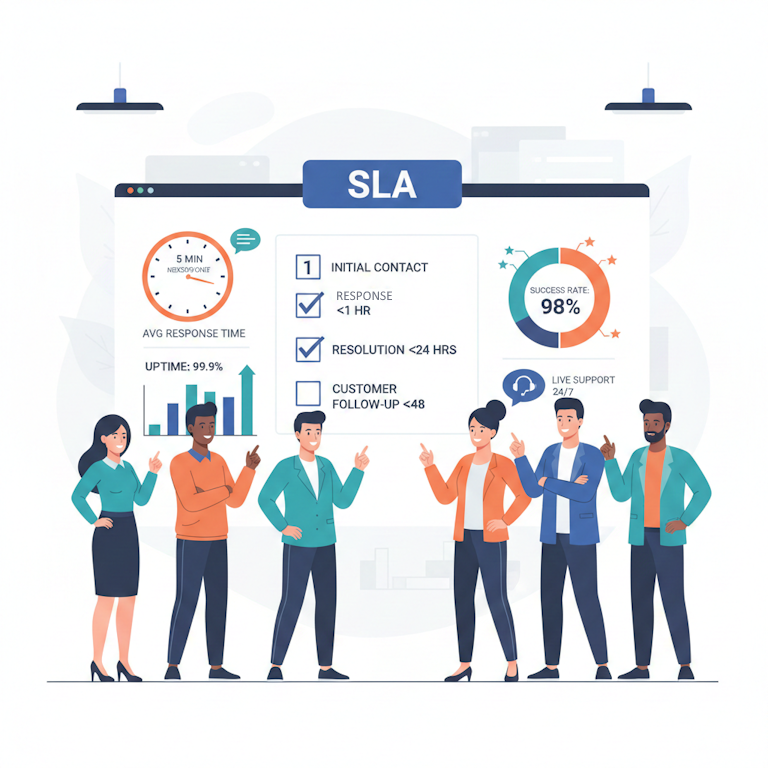
What is an SLA?: An SLA is simply a clear, written agreement about what service you’ll provide, how quickly, how reliably, and what happens when things go wrong. It turns vague promises like “we respond quickly” into specific commitments like “we respond to Priority 1 issues within 1 business hour.”
For small businesses and startups, SLAs matter because they:
- Build trust and predictability in the relationship
- Reduce misunderstandings and disputes
- Improve customer satisfaction and retention
- Force internal discipline, process, and measurement
- Make your business scalable (new team members can see “how we do things here”)
In this guide, we’ll talk about:
- What an SLA is (in plain language) and the core components
- How SLAs drive customer success, retention, and revenue
- The essential SLA metrics and realistic targets for small teams
- A step-by-step method to create your first SLA
- Templates for SLAs, escalation, communication, RACI, and more
- How to roll SLAs out with small or remote teams
- Common pitfalls and how to avoid them
By the end, you’ll have everything you need to create, implement, and improve SLAs without needing enterprise pay-thorough-your-nose tools or a legal team on staff (though you should get legal review for contracts).
What is an SLA?
An SLA (Service Level Agreement) is a documented agreement between a service provider and a customer that defines:
- What service is provided
- How well it will be provided (speed, quality, availability)
- How it’s measured
- What happens if the agreed levels aren’t met
Think of it as a service promise, backed by numbers instead of vague statements.
Core Components of a Practical SLA
At minimum, a solid SLA for a small business should cover:
- Scope of service
- What’s included (and what’s not).
- Example: “Email support for our SaaS platform; excludes custom integrations.”
- Service hours
- When the service is available (and time zone).
- Example: “Support available Mon–Fri, 9:00–18:00 IST, excluding public holidays.”
- Response time targets
- How fast you acknowledge a ticket or request.
- Example: “Priority 1 tickets: 1 business hour; Priority 2: 4 business hours.”
- Resolution time targets
- How long you aim to actually fix or resolve the issue.
- Example: “P1 tickets: 8 business hours to resolution or workaround.”
- Communication channels
- Where customers can reach you and which channel is preferred.
- Example: “Support via email and in-app chat; phone only for P1 issues.”
- Exclusions
- What’s explicitly out of scope (protects you from scope creep).
- Example: “Does not cover third-party shipping delays or payment gateway outages.”
- Maintenance windows
- Planned downtime and how you’ll communicate it.
- Example: “Planned maintenance Saturdays 01:00–03:00 UTC with 48 hours notice.”
- Reporting & monitoring
- How you will track SLA performance and share it (if needed).
- Example: “Monthly SLA performance report for uptime and response times.”
- Escalation paths
- Who gets involved when things go wrong and how quickly.
- Review cadence
- How often the SLA is reviewed and updated.
- Example: “SLA reviewed quarterly based on performance and customer feedback.”
Internal vs Customer-Facing SLAs and OLAs
- Customer-facing SLAs: Shared with clients; often part of a contract or your website.
- Internal SLAs: Used inside the company (e.g., support to product, ops to sales).
- OLAs (Operational Level Agreements): Agreements between internal teams to support the external SLA.
Example:
- Customer-facing SLA: “Orders shipped within 24 hours.”
- OLA between warehouse and support: “Warehouse dispatches approved orders within 12 hours of payment confirmation.”
Why this matters: Without internal OLAs, you promise things externally that your internal teams cannot consistently deliver.
Why SLAs Drive Customer Success and Growth
SLAs are not just paperwork. Done right, they directly support growth.
Key benefits with revenue/retention connections:
- Faster response → Higher CSAT & less churn
Customers don’t expect perfection, but they expect to be acknowledged quickly. - Consistent expectations → Fewer escalations and disputes
Clarity reduces “You said you’d do X” arguments and protects margins. - Better forecasting → Smarter staffing and capacity planning
When you know typical ticket volumes and resolution times, you can plan hiring and shifts. - Standardization → Easier onboarding & scaling
New team members immediately see what “good” looks like. - Stronger positioning → Competitive advantage
Being able to say “We commit to X response time and Y uptime” differentiates you from vague competitors.
And you know what? You can tell when an organization has no written SLA. You see the employees lounging around. You wait at the door and there is noone to help you. You see employees standing about but noone seems to notice you. All these are the negative results of not having an enforceable SLA.
And when there is one? You walk into any McDonald’s or Wendy’s and you could bet you would have your food within x minutes. Barring something highly unusual, these establishments behave in predictable ways that customers count on! When customers can count on you, they return.
To be continued…
Coming soon in Part 2 …
- Templates, checklists, escalation matrix, RACI, KPIs
- SaaS & e-commerce SLA examples
- A 30/60/90-day rollout roadmap
- Pitfalls to avoid (and how to fix them)
If you’d like help designing SLAs, choosing the right tools, and rolling them out across your support, fulfillment, or onboarding processes, I can work with you to get it done fast and correctly the first time.
Ready to push your business firmly into the growth path? Build SLAs that actually drive growth, not just tick boxes!
👉 Reach out to Deep at hello@cerebralops.in or book a call here: https://calendly.com/deepjanardhanan/30mins/
Let’s turn your service into a repeatable, measurable, and scalable advantage.
—————————–
https://www.cio.com/article/274740/outsourcing-sla-definitions-and-solutions.html
Pingback: SLAs That Bring Order - and Predictability to Business - Cerebral Ops Growth Partners