
You might think fraud is someone else’s problem—but in 2025, for many online merchants, it’s their biggest unseen cost. Fraud is growing faster than revenue in many e-commerce businesses and unless you act now, the losses will silently eat your margins.
What Happened
- The e-commerce fraud landscape is expanding rapidly: recent data shows global losses of tens of billions of dollars annually.
- Fraud tactics are evolving: synthetic identities, AI-powered bots, account takeovers, friendly fraud, triangulation, and counterfeit operations are all rising.
- At the same time, fraud prevention tools are leaning into AI and behaviour analytics—but many SMBs are behind the curve.
Why It Matters for Small Businesses
- Hidden cost drains: A small merchant may think they have clean operations—but fraud can quietly inflate returns, chargebacks, inventory shrink, and customer service cost.
- Reputation risk: If your store becomes a target for counterfeit goods or fraudulent purchases, you risk trust and brand integrity.
- Operational friction: Fraud forces manual reviews, holds shipments, delays fulfilment—all of which degrade the customer experience.
- Margin compression: Fraud-afflicted orders often cost more than just the value of goods—shipping, restocking, support, and lost customer goodwill all add up. For every $100 in fraudulent orders, some studies show costs totalling ~$200 in true value.
- Measurement gap: Without clear fraud metrics, you can’t optimise your funnel, inventory or acquisition channels effectively.
So, what can you do?
Here is a short, highly actionable playbook we put together to help you beat the bad guys!
Actionable Playbook (Week 1–2)
Week 1 – Audit & Quick Wins
1.Map your fraud exposure points
- New accounts (first purchase)
- High-value orders
- International shipping
- Promo code abuse
- Returns/charge2backs
2.Review your current fraud/returns metrics
- Chargeback rate
- Refund vs return vs reuse
- % of new accounts that purchase and/or return
- Manual review volume
3.Implement baseline fraud controls
- Require CVV, AVS (address verification) on payments. ([justt.ai][5])
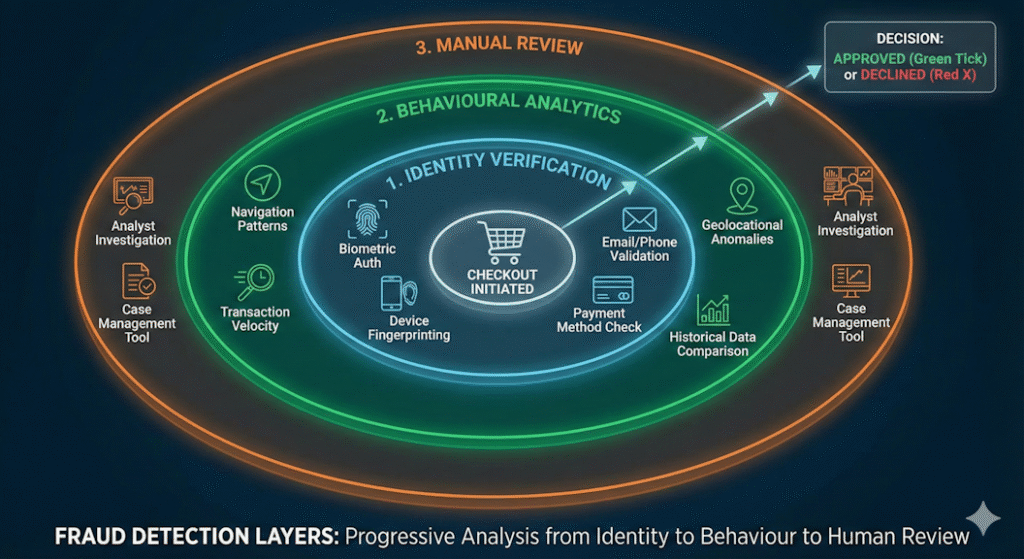
- Device and IP velocity checks (many orders same session/device).
- Bot/fraud detection on login/checkout using captcha or behavioural signals.
4.Flag high-risk orders for review
- Orders from new account + high SKU value + international shipping.
- Pause fulfilment until manual check for first-timer high risk.
Week 2 – Build Defensible Systems
1. Deploy risk-scoring for transactions
- Build simple rule-engine: assign risk score based on account age, device, order value, shipping address, promo usage.
- Set thresholds for auto-approve, manual review, auto-decline.
- Monitor for: rapid order spikes, same shipping address across multiple accounts, multiple card tests.
- Consider a tool or plug-in if you lack internal analytics.
3. Strengthen return policy with verification
- For high-value returns: require photos or condition checks.
- Tag suspect return patterns (e.g., many returns from same account).
4. Combine with identity verification where feasible
- For expensive items, require additional ID verification before dispatch.
- Synthetic identity fraud is growing: fake names + real addresses. ([GeeTest][3])
5. Educate your team & monitor fraud trends
- Weekly review of flagged orders, outcomes, patterns.
- Maintain a “fraud log” for trends and tune your rules accordingly.
At Cerebral Ops we help SMBs build fraud-resilient commerce systems, not just reactive checklists. That means:
- Funnel and acquisition design: Understand which channels bring high-risk traffic (e.g., first-time discount hunters) and build acquisition flows accordingly.
- CRO + operations alignment: Ensure fraud controls don’t kill conversion—rules must be sharp but lean.
- Analytics & tooling: We build dashboards tracking fraud metrics, alerts when risk spikes, and modelling of cost of fraud vs prevention investment.
- Lifecycle strategy: Fraud affects retention. We help integrate fraud monitoring into customer lifecycle flows (repeat buyer signals, loyalty programs) so you don’t reward high-risk profiles inadvertently.
Examples / Use Cases
- Mid-sized apparel DTC brand: After audit, they discovered 7% of orders were flagged for chargebacks from first-time large order + international shipping. They implemented a “manual hold for new accounts >$300” rule. Result: 15% drop in fraud-related losses within 60 days.
- Marketplace seller of electronics: Identified that “triangulation fraud” (fraudster purchases with stolen card, item shipped to mule, real customer complaining) was causing inventory and shipping loss. They added device fingerprinting + shipping-address cross-check; losses dropped by ~40% in first month.
- Subscription box service: Found “friendly fraud” (customer claimed non-delivery) in 12% of all disputes. They tightened tracking, required signature confirmation above threshold, and improved customer-visibility of tracking. Chargebacks dropped 30% in next quarter.
Metrics That Matter
- Fraud loss rate – % of revenue lost to fraud/orders cancelled/refunded.
- Chargeback rate – aim <1% of total transactions (varies by industry).
- Fraud detection ratio – % of flagged orders that were actually fraudulent.
- Manual review volume & cost – time and cost per reviewed order, aim to decrease.
- Conversion friction rate – % of legitimate orders delayed by fraud controls; aim to minimise.
- Repeat-customer trust score – % of orders from returning buyers without fraud flags.
Risks & Constraints
- Friction vs conversion trade-off: Over-zealous rules kill good orders—balance is key.
- Tooling cost: Some advanced fraud tools require budget and integration; SMBs must prioritise.
- False positives: Flagging too many legitimate orders creates service issues and harms experience.
- Data privacy/regulation: Using behavioural and identity data means you must comply with GDPR/CCPA/Indian privacy rules, depending on your geography.
- Evolving attacker tactics: Fraudsters adapt fast; this is ongoing, not “set & forget.”
How we can help you
If you’re running an online store and want a fraud-resilience audit — covering acquisition channels, order patterns, manual review bottlenecks and cost of fraud metrics — let’s map a 4-week plan for you.
We will give you a plan to do it – or we can also do it for you if you are short of time or manpower! Just reach out to us at https://cerebralops.in/contact.html .
Sources
- Help Net Security “The fraud trends shaping 2025: Pressure builds on online retailers.” https://www.helpnetsecurity.com/2025/07/23/biggest-fraud-trends-2025/
- ClickPost “Ecommerce fraud statistics: Key Trends & Insights for 2025.” https://www.clickpost.ai/blog/ecommerce-fraud-statistics
- Justt Blog “Ecommerce Fraud Detection & Prevention.” https://justt.ai/blog/ecommerce-fraud-prevention/
- Geetest “Smart e-commerce fraud prevention tactics for 2025.” https://www.geetest.com/en/article/ecommerce-fraud-protection