
The Fractional Executive Model: When and How to Use It
You need a COO. You can’t afford a $300K salary + equity. What now?
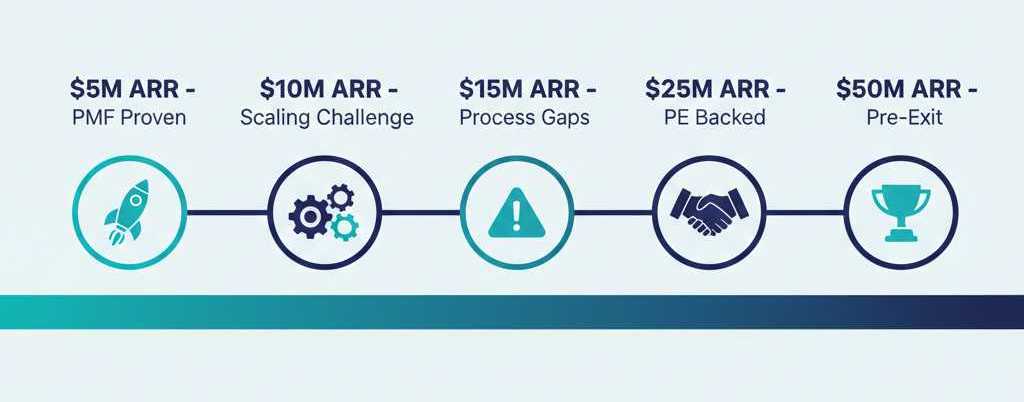
If you’re a B2B SaaS founder staring at your org chart wondering how you’ll scale past $10M ARR without a seasoned operator at the helm, you’re not alone. The math doesn’t work. A full-time COO costs $250K-$400K plus 1-2% equity. Your CFO just vetoed it. Your board wants profitability, not bloated overhead.
Welcome to the fractional executive model—the solution that’s helping hundreds of SaaS companies bridge the gap between bootstrapped chaos and properly funded enterprise operations.
Let me walk you through exactly when this model works, when it doesn’t, and how to extract maximum value without the full-time price tag.
The Growth Inflection Points Where Fractional Leadership Makes Perfect Sense
Here’s the brutal truth: most SaaS companies hire executives too late or too early. Both mistakes cost you millions.
The $5M-$15M ARR Sweet Spot
You’ve proven product-market fit. Revenue is climbing. But your founder-led operations are starting to crack. Customer churn is creeping up. Your engineering team is drowning in technical debt. Sales and product can’t agree on roadmap priorities. You’re spending 60% of your time firefighting instead of selling or building.
This is prime fractional territory. You need executive-level thinking without executive-level overhead. A fractional COO can audit your operations, implement proper processes, and get you to $20M ARR—all for 20-30% of a full-time salary.
The Post-Series A Scaling Challenge
You just closed a Series A. Your investors want you to triple revenue in 18 months. You need to build repeatable systems for customer onboarding, implement proper financial controls, and establish a data-driven culture. But you’re still burning through cash faster than you’d like.
A fractional CTO or COO can architect these systems, hire the right full-time team members, and establish operational rigor—then hand off to a full-time executive when you hit $25M ARR and the economics make sense.
The PE-Backed Turnaround
Your company got acquired by a private equity firm. They want operational excellence, margin improvement, and integration with portfolio companies. The pressure is intense. You need someone who speaks PE board language and can deliver results in 90-day sprints.
Fractional operators thrive in this environment. We’ve seen dozens of PE deals, know what boards expect, and can implement operational transformations without the 6-month ramp-up time of a new full-time hire.
The Technical Debt Crisis
Your CTO left. Or worse, your founding developer is still CTO but shouldn’t be. Your platform is held together with duct tape and prayers. Customer complaints are mounting. Your engineering team is demoralized.
A fractional CTO can assess the damage, create a technical roadmap, stabilize the platform, and either rebuild the team or mentor your existing CTO into the role. This typically costs $10K-$20K per month versus $300K+ for a full-time hire who might take six months to understand your codebase.
The Pre-Exit Preparation
You’re 12-24 months from a potential acquisition or IPO. Buyers will scrutinize your operations, financials, and technical infrastructure. Any weakness tanks your valuation by millions.
A fractional executive can prepare you for due diligence, clean up operational messes, implement proper documentation, and make your company acquisition-ready. The ROI here is massive—cleaning up operations can add 20-40% to your exit valuation.
What Fractional Can (and Can’t) Do Compared to Full-Time Leadership
Let’s cut through the marketing fluff. Fractional executives aren’t magical unicorns who solve every problem. Understanding the limitations is just as important as understanding the benefits.
What Fractional Executives Excel At:
Strategic Architecture and System Design We build the playbooks, frameworks, and processes that scale. A fractional COO doesn’t manage your daily standups—they design the meeting cadence, establish KPIs, and create accountability systems that run without them. Think architect, not general contractor.
A client came to us at $8M ARR with zero documented processes. Their customer onboarding took 90 days and required founder involvement. We built a complete onboarding playbook, implemented project management systems, and reduced onboarding to 30 days—all in three months. The founder got 20 hours per week back.
Crisis Management and Firefighting When your platform goes down at 2 AM or your biggest customer threatens to churn, you need someone who’s seen it before. Fractional executives bring pattern recognition from dozens of companies. We know which fires to fight and which to let burn.
Executive Hiring and Team Building One of the biggest mistakes founders make is hiring the wrong full-time executives. A fractional leader can write the job description, run the interview process, and ensure you hire someone who fits your stage and culture. We’ve saved clients from $500K hiring mistakes more times than I can count.
Objective Analysis Without Politics Full-time executives get attached to their decisions and teams. Fractional leaders can tell you that your VP of Sales isn’t working out or that your product roadmap is misaligned with market needs. We don’t have equity or ego in the game—just results.
Rapid Implementation of Best Practices Your fractional executive has implemented OKR systems at 20 companies. Built financial models for 30 SaaS businesses. Managed technical migrations at 40 startups. You get compressed learning curves without the trial and error.
What Fractional Executives Can’t Replace:
Daily Operational Management If you need someone in the office 50 hours per week managing people, reviewing every decision, and attending every meeting, hire full-time. Fractional works at 10-20 hours per week, focused on high-leverage activities.
Deep Cultural Leadership Building company culture requires daily presence. A fractional executive can establish values and frameworks, but your full-time team drives culture day-to-day.
Investor Relations and External Representation Most investors and customers expect to see full-time executives at the table. A fractional COO can attend board meetings and support fundraising, but they’re not the face of your company.
Long-Term Institutional Knowledge Fractional engagements typically last 6-18 months. If you need someone who’ll be with you for five years and knows every nuance of your business, plan for a full-time hire eventually.
Unlimited Availability Your fractional executive has other clients. They’re available for scheduled time, emergencies, and async communication, but you can’t monopolize their calendar. If you need someone on-call 24/7, that’s a full-time role.
The Embedded Partner Model: Operational Transformation That Actually Sticks
Standard consulting engagements fail because consultants analyze, recommend, and leave. Nothing changes. The embedded partner model is different—we implement, train, and transfer knowledge until the transformation is permanent.
Problem #1: The Strategy Shelf
You’ve hired consultants before. They delivered a beautiful 50-page PowerPoint deck full of insights and recommendations. It sits on a virtual shelf gathering digital dust. Your team went back to doing things the old way within two weeks.
The Embedded Partner Solution: We don’t just recommend—we implement alongside your team. A fractional COO doesn’t write a process document and disappear. They train your ops manager, run the first 10 implementations, review results, and iterate until it’s working. By the time we transition out, your team owns the process.
We worked with a $12M ARR SaaS company that had hired three different consulting firms to fix their customer success operations. Each time, they got reports. Nothing improved. We embedded a fractional COO three days per week for four months. They worked directly with the CS team, rebuilt workflows, implemented Gainsight, and trained two CS managers to own it. Churn dropped from 18% to 11% annually. The ROI was over 10x in year one.
Problem #2: The Skill Gap in Your Team
Your team is talented but inexperienced at your current scale. Your ops manager has never built an organization beyond 50 people. Your engineering lead has never architected a multi-tenant SaaS platform. They’re making expensive mistakes you can’t afford.
The Embedded Partner Solution: Fractional executives mentor your team while delivering results. It’s executive coaching plus operational delivery. Your ops manager learns how to build scalable processes by working alongside someone who’s done it 30 times. Your engineering lead gains architecture skills while building your new platform.
This approach costs less than hiring senior talent full-time and pays double dividends—you get both the deliverable and a more capable team.
Problem #3: The Organizational Resistance
Your company has tried to implement changes before. Your team has change fatigue. They’ve seen initiatives announced and abandoned so many times they don’t take new projects seriously. You lack the credibility or authority to force change.
The Embedded Partner Solution: An external executive brings fresh authority and perspective. Teams listen differently when someone with 30 years of experience says, “Here’s how this works.” There’s no baggage, no internal politics, just expertise and results.
We brought a fractional CTO into a 50-person engineering team that had rejected three attempts to modernize their CI/CD pipeline. The team was skeptical. Within two weeks, the fractional CTO had identified the real blockers (it wasn’t technical—it was fear of breaking production), created a safe rollout plan, and got buy-in from the most resistant senior engineers. The pipeline was modernized in eight weeks.
Problem #4: The Knowledge Transfer Gap
You bring in experts to fix problems, but when they leave, you’re back where you started. The knowledge walks out the door. You become dependent on consultants instead of building internal capability.
The Embedded Partner Solution: Structured knowledge transfer is built into every engagement. We document everything, train your team, and create runbooks so the operations continue after we transition out. The goal is to make ourselves obsolete.
A proper embedded partner engagement includes:
- Weekly working sessions with your team (not just status updates)
- Documented processes and playbooks in your tools (Notion, Confluence, wherever)
- Recorded training sessions for future team members
- Shadowing periods where we watch your team run the process
- Defined success metrics and transition milestones
Problem #5: The Misaligned Incentives
Traditional consultants get paid by the hour or the project. Their incentive is to extend engagements, not finish them. Your interests aren’t aligned.
The Embedded Partner Solution: Fractional executives on retainer have incentives aligned with outcomes. We want quick wins, smooth transitions, and glowing references. Our business model depends on clients succeeding and referring others, not on billing maximum hours.
Many fractional engagements include success-based components. If we don’t hit agreed metrics (revenue growth, churn reduction, margin improvement), we reduce fees or extend the engagement. Skin in the game changes everything.
The ROI Framework: When Does Fractional Actually Pay for Itself?
Let’s talk money. Here’s how to calculate whether fractional makes financial sense for your situation.
The Cost Comparison
Full-time COO: $250K-$400K salary + 1-2% equity + benefits + recruiting fees = $350K-$500K all-in first year, plus opportunity cost of equity dilution.
Fractional COO: $8K-$20K per month for 10-20 hours per week = $96K-$240K annually, zero equity, cancel anytime.
The upfront savings are obvious. But the real ROI comes from what you get:
Direct Revenue Impact
A fractional COO fixing your customer success operations can reduce churn by 3-5 percentage points. On $10M ARR with 15% annual churn, reducing it to 10% means you retain an extra $500K in revenue annually. Your fractional engagement costs $150K. ROI: 3.3x in year one, compounding over time.
A fractional CTO eliminating technical debt that’s slowing your engineering team by 30% effectively adds 30% more engineering capacity. If you have 10 engineers at $150K average salary, that’s $450K in equivalent value. Your fractional engagement costs $180K. ROI: 2.5x.
Avoided Costs
Hiring the wrong full-time executive costs $500K-$1M when you factor in salary, severance, lost time, and team disruption. A fractional executive de-risks this by either solving the problem without a full-time hire or helping you hire the right person.
We’ve seen companies waste $300K hiring a VP of Engineering who couldn’t scale systems, then another $200K replacing them. A fractional CTO for $120K would have either solved the problem or ensured the right hire the first time.
Speed to Value
A full-time executive takes 3-6 months to ramp up, learn your business, and start delivering results. A fractional executive with pattern recognition can deliver value in weeks. At $10M ARR growing 50% annually, six months of delayed improvements costs you real money.
The 3X Rule
Here’s a simple framework: If a fractional executive can deliver 3x their cost in measurable value (revenue growth, cost savings, avoided mistakes) within 12 months, it’s a good investment.
Examples that meet the 3X rule:
- Fractional COO at $150K/year reduces churn enough to retain $450K+ in revenue
- Fractional CTO at $180K/year eliminates $540K+ in redundant tools and inefficient processes
- Fractional CMO at $120K/year implements marketing ops that generate $360K+ in pipeline
When Fractional Doesn’t Pay for Itself
Be honest about these situations:
You don’t have problems worth $150K+ to solve. If you’re at $3M ARR and operationally stable, you probably don’t need a fractional COO. Use that budget for product development or sales.
You won’t implement recommendations. If you’re looking for validation of what you’re already doing rather than real change, save your money. Fractional only works if you’re committed to action.
You need someone full-time in the trenches. If your operational gaps require daily hands-on management, hire full-time at a lower level (operations manager, engineering manager) rather than fractional at an executive level.
You’re not coachable. If you’re a founder who won’t listen to someone with more experience, keep doing it yourself. Fractional executives bring value through expertise and perspective. If you already know everything, you don’t need us.
How to Extract Maximum Value from Your Fractional Executive
You’re paying $10K-$20K per month. Here’s how to make sure you get your money’s worth.
Define Clear Outcomes, Not Inputs
Bad engagement scope: “We need a fractional COO to attend meetings and advise us.”
Good engagement scope: “We need to reduce customer onboarding time from 60 days to 30 days, implement a customer health score system, and reduce churn from 15% to under 10% within six months.”
Measure outputs and outcomes, not hours worked or meetings attended.
Front-Load Strategic Work
The first 30 days should be heavy on analysis and planning. Your fractional executive should audit current state, identify gaps, prioritize initiatives, and create a roadmap. This sets up the entire engagement for success.
Don’t rush to implementation. A week of strategic thinking can save months of wasted execution.
Empower Them to Make Decisions
If your fractional COO has to get approval for every process change or tool purchase under $5K, you’re wasting their time and yours. Delegate authority clearly. Let them make operational decisions within agreed parameters.
The best fractional engagements include a “get stuff done” budget of $10K-$25K for tools, contractors, or small expenses needed to move fast.
Leverage Asynchronous Communication
You’re paying for 15 hours per week of focused work, not constant Slack availability. Use async communication (Loom videos, detailed written updates, shared docs) to maximize their productive time.
Save synchronous meetings for strategic decisions, roadblocks, and complex discussions that benefit from real-time dialogue.
Build in Knowledge Transfer from Day One
Every deliverable should include documentation. Every process implemented should include training. Every system built should include a transition plan.
Ask: “If you got hit by a bus tomorrow, could my team continue running this without you?”
Measure Relentlessly
Establish baseline metrics before the engagement starts. Track progress weekly. Review against targets monthly.
If you’re not measuring, you can’t tell if it’s working. And if you can’t tell if it’s working, you can’t course-correct or scale what’s successful.
Red Flags: When to Walk Away from a Fractional Engagement
Not all fractional executives are created equal. Here’s how to spot the ones who’ll waste your money.
They promise everything. Real operators know their limits. If someone claims they can fix your entire company in three months, run. Sustainable transformation takes time.
They talk in buzzwords without substance. Ask specific questions about their approach. “How would you reduce our churn?” should get a detailed, structured answer, not vague platitudes about “customer-centricity.”
They won’t commit to metrics. Any fractional executive worth hiring will agree to measurable outcomes. If they hedge on setting targets, they’re planning to hide behind activity instead of results.
They don’t ask about your team. Fractional work requires collaboration with your existing team. If they don’t ask about who’ll work with them and who’ll own the processes after transition, they don’t understand the embedded partner model.
They don’t have relevant pattern recognition. B2B SaaS operations differ from e-commerce, which differs from marketplaces. You want someone who’s solved similar problems in similar businesses at similar scales.
Their references are vague. Talk to at least three past clients. Ask specific questions: “What did they actually deliver? How did they work with your team? What happened after they left?”
Making the Fractional Model Work for You
The fractional executive model isn’t right for every company at every stage. But when the fit is right, it’s transformative.
You get executive-level strategic thinking without executive-level fixed costs. You get pattern recognition from dozens of companies applied to your specific challenges. You get implementation, not just recommendations. And you build internal capability instead of creating consultant dependency.
The key is knowing when you need it, setting clear expectations, and treating your fractional executive as a true partner embedded in your business—not an external advisor lobbing suggestions from the sidelines.
If you’re between $5M-$50M ARR, facing operational scaling challenges, and wondering whether to hire full-time executive talent you can’t quite afford yet, the fractional model deserves serious consideration.
How We Help B2B SaaS Companies Scale Operations Without Breaking the Bank
At Cerebral Ops, we’ve spent 30 years in the trenches building, scaling, and fixing B2B SaaS operations. We’ve seen what works and what wastes money. We’ve helped dozens of companies navigate the messy middle between startup chaos and enterprise operations.
We don’t do cookie-cutter consulting. We embed ourselves in your business as fractional COO, CTO, CPO, or CMO—working alongside your team to implement systems that scale, solve problems that are costing you revenue, and build capability that lasts after we transition out.
Whether you’re a founder drowning in operational firefighting, a PE-backed CEO under pressure to deliver margin improvements, or a board member watching a portfolio company struggle with execution, we can help.
We work with B2B SaaS companies doing $5M-$50M in revenue across the US, UK, EU, ANZ, and India. We speak PE board language. We understand SaaS metrics. And we deliver measurable results, not PowerPoint decks.
Curious whether fractional leadership fits your stage? Let’s discuss what’s really broken and whether we’re the right fit to fix it.
Contact us to explore whether fractional executive support makes sense for your business
About the Author
Deepkumar Janardhanan is the founder of Cerebral Ops, where he serves as Fractional CTO/COO/CPO/CMO for B2B SaaS companies in the $5M-$50M revenue range. With 30 years of experience in technology, startup operations, and marketing, Deep specializes in operational transformation, delivery rescue, and embedded partner roles that help SaaS founders scale without the overhead of full-time executive salaries.
About Cerebral Ops
Cerebral Ops partners with B2B SaaS founders, operating partners, and PE investors to solve operational scaling challenges. We provide fractional executive leadership (CTO/COO/CPO/CMO), delivery rescue for troubled projects, and embedded partner support for operational transformation. Working with clients across the US, UK, EU, ANZ, and India through local offices, we bring 30 years of pattern recognition to help your company scale profitably.
Ready to scale your operations without breaking your budget? Schedule a consultation