
SaaS Implementation Delays: Why They Happen and How to Prevent Them
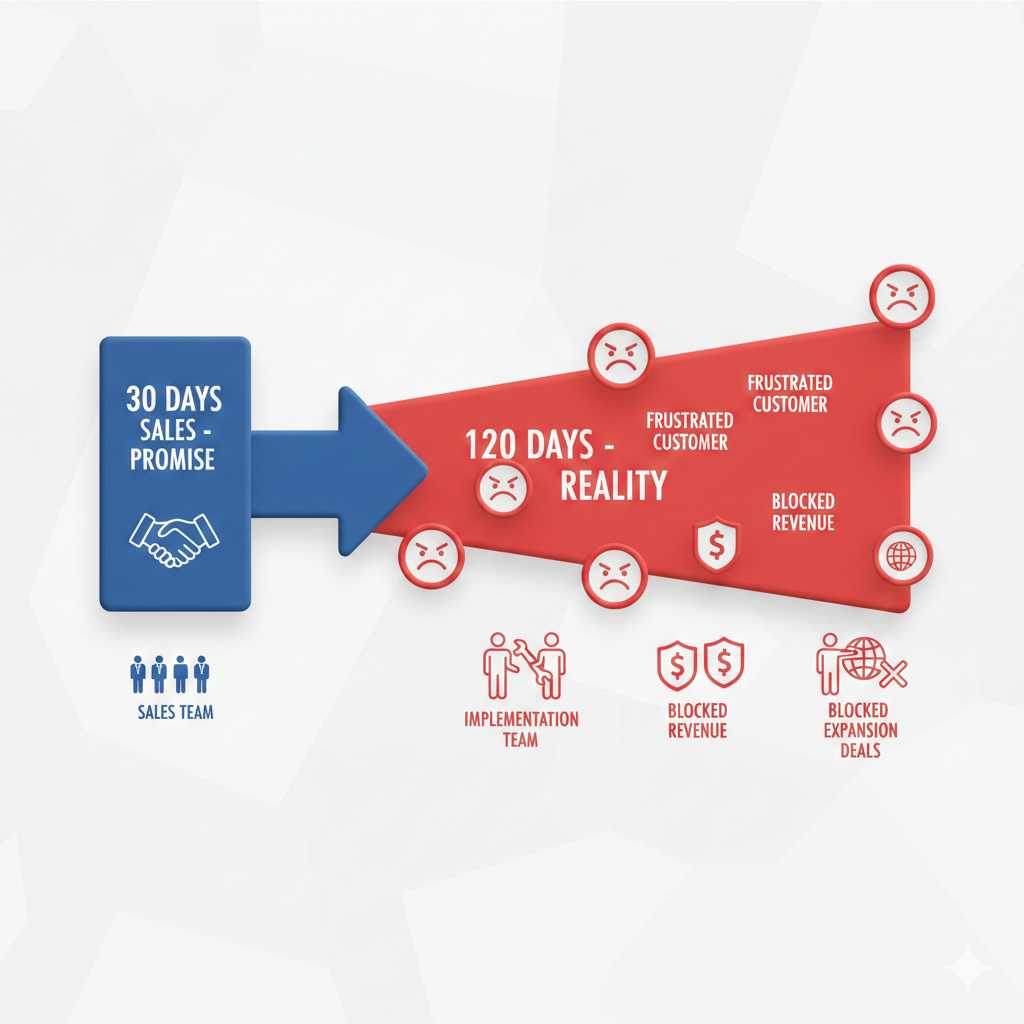
Your sales team promised 30 days to go-live. It’s been 120. Your customer is furious, your Board is asking questions, and your expansion revenue pipeline just froze. Sound familiar?
If you’re a B2B SaaS founder or a PE Operating Partner staring at another blown implementation deadline, you’re not alone. Implementation delays kill more expansion deals, damage more customer relationships, and destroy more ARR than almost any other operational failure in our industry.
I’ve spent 30 years in the trenches—building, rescuing, and scaling B2B SaaS companies from $5M to $50M ARR. And I can tell you this: implementation delays aren’t random acts of chaos. They’re predictable, preventable, and fixable. But first, you need to understand what’s really causing them.
The Real Cost of Implementation Delays
Before we dig into causes and solutions, let’s talk about what these delays actually cost you.
When implementations drag on, customers stop believing your promises. They question the purchase decision. They talk to their networks. And they definitely don’t expand their contracts or refer you to peers.
Your Net Revenue Retention (NRR) tanks. Your sales team starts discounting to overcome reputation damage. Your Customer Success team burns out fighting fires. And your Board starts asking uncomfortable questions about operational maturity.
I’ve watched companies lose seven-figure expansion deals because a six-month implementation turned into 18 months. The customer was so frustrated by the onboarding experience that they wouldn’t even take a meeting about expanding usage.
That’s the brutal reality. Implementation delays don’t just push revenue out a quarter or two—they kill it permanently.
The 7 Hidden Causes of Implementation Delays
Most founders and operators think implementation delays come from “difficult customers” or “complex integrations.” That’s lazy thinking. After three decades of diagnosing these problems, I’ve identified seven root causes that account for nearly every delay I’ve seen.
1. The Sales-to-Delivery Handoff Black Hole
Here’s how it usually goes: Sales closes the deal on Friday afternoon. They celebrate the win, update the CRM, and move on to the next opportunity. The implementation team finds out about the new customer on Monday morning through an automated email notification.
Nobody from Sales has talked to them. There’s no context about the customer’s technical environment, their internal politics, their timeline pressures, or the specific promises made during the sales cycle. The implementation team is flying blind.
Then the customer kickoff happens, and the first 20 minutes are spent re-explaining things the customer already told Sales. The customer realizes immediately that your company’s right hand doesn’t know what the left hand is doing. Trust evaporates before you’ve even started.
Why this kills implementations: Customers judge your operational maturity in the first 72 hours. If they see disconnected teams and poor information flow, they assume the entire implementation will be chaotic. They start hedging, withholding resources, and preparing for failure.
The fix: Build a structured handoff protocol. Sales must brief the implementation team before the customer kickoff. Not an email—an actual conversation. The implementation lead should be introduced to the customer before contract signature, not after.
Document the customer’s technical environment, business drivers, key stakeholders, internal politics, and any custom promises made during sales. Create a handoff checklist and enforce it. No exceptions.
When to DIY vs. hire an expert: If you’re doing fewer than 10 implementations per quarter, you can probably build this yourself. Create the checklist, run a few test handoffs, iterate based on feedback. Budget 40-60 hours to get it right.
If you’re scaling past 10 implementations per quarter, bring in someone who’s built this at scale. The cost of hiring an experienced Fractional COO for 3-4 months ($25K-$40K) is nothing compared to the revenue you’ll lose from botched handoffs. They’ll build you a repeatable system and train your team to run it.
2. Scope Creep Masquerading as “Flexibility”
Every implementation professional knows this dance. The customer asks for “just one small change” to the implementation plan. Your team, eager to please and terrified of looking inflexible, says yes.
Then another change. And another. Three months in, you’re implementing a solution that looks nothing like what was sold, your team is underwater, and the customer is frustrated because you keep missing deadlines.
Why this kills implementations: Each scope change triggers a cascade of downstream effects—technical dependencies, resource reallocation, timeline adjustments, testing requirements. When you say “yes” to scope creep without formal change control, you’re lying to your customer about when they’ll go live. The delay is baked in the moment you accept the change.
The fix: Implement a change control process from day one. Every deviation from the Statement of Work (SOW) goes through a formal review. Document the impact on timeline and cost. Get written approval before proceeding.
This doesn’t make you inflexible—it makes you honest. Customers respect transparency. What they hate is agreeing to a 30-day timeline, then discovering on day 25 that all those “small changes” pushed go-live to day 90.
Create three categories: in-scope (no approval needed), minor deviation (implementation lead can approve), major change (requires stakeholder sign-off and SOW amendment). Define these clearly upfront.
When to DIY vs. hire an expert: Small teams (under 5 implementation specialists) can build this internally. Create the change control template, train the team, enforce it religiously. Budget 20-30 hours plus 2-3 iterations.
For larger operations or if you’re seeing chronic scope creep problems, bring in a Fractional COO with implementation experience. They’ll diagnose the root cause (usually it’s sales over-promising or weak SOWs), fix your upstream processes, and implement governance that sticks. Worth every penny of the 2-3 month engagement.
3. Resource Contention Nobody Wants to Talk About
Your best implementation engineer is working on six customer projects simultaneously. Your Solutions Architect is covering three verticals. Your technical writer is supporting implementations while also managing product documentation.
Everyone knows the team is underwater. Nobody wants to be the one to tell the Board you need to hire. So you keep stacking projects, and every single implementation starts slipping.
Why this kills implementations: Multitasking kills productivity. When your implementation specialists are context-switching between six customers, they’re spending more time ramping up and down than actually implementing. Work that should take 4 hours takes 12 hours because of the switching cost.
Customers feel it immediately. Responses slow down. Meetings get rescheduled. Momentum dies. And once momentum dies in an implementation, it’s nearly impossible to resurrect.
The fix: Track implementation capacity like you track sales pipeline. You need three metrics: number of active implementations, average hours per implementation stage, and available specialist hours per week.
When you hit 80% utilization, you’re in the danger zone. Start hiring. When you hit 90%, you’re already experiencing delays—you just don’t see them in the data yet because projects are still in early stages.
Build a resource model that accounts for different implementation types. Enterprise implementations consume more hours than mid-market. New verticals consume more hours than established verticals. Factor this into your capacity planning.
When to DIY vs. hire an expert: If you’re operationally mature and have clean data, build the model yourself. Shouldn’t take more than 40 hours to create the tracking framework and dashboard.
If your data is messy, your processes are ad hoc, or you’ve never done capacity planning at scale, bring in a Fractional COO. They’ll build the model, clean up your processes, and train your team to maintain it. Three-month engagement will save you 12 months of trial and error.
4. The Technical Debt Time Bomb
Your product was built fast. Your early engineers prioritized features over architecture. You’ve got technical debt that makes integrations take 3x longer than they should.
But Sales keeps selling, and nobody wants to slow down to fix the foundation. So every implementation hits the same integration roadblocks, and every customer experiences the same delays.
Why this kills implementations: Technical debt compounds. Each quarter you don’t address it, integrations get harder, not easier. Your best engineers spend their time working around architectural problems instead of solving customer problems. Implementation timelines creep up from 30 days to 45 days to 60 days, and you can’t explain to customers why it takes so long.
The fix: Create a technical debt register. Categorize debt by implementation impact (high, medium, low). Allocate 20-30% of engineering capacity to debt reduction, prioritizing items that directly impact implementation speed.
This requires partnership between your CTO and your Head of Customer Success. They need to agree on priorities and protect the debt reduction time from feature pressure.
Build business cases for major debt reduction initiatives. If fixing your API architecture will reduce integration time by 40%, that’s a concrete ROI you can take to the Board.
When to DIY vs. hire an expert: If you have a strong CTO who understands the business impact of technical debt, they can probably drive this internally. They’ll need political cover from the CEO and Board, but the technical work can be done in-house.
If your CTO is focused purely on product features, or if there’s organizational tension between Engineering and Customer Success, bring in a Fractional CTO. They can objectively assess the technical debt, build the business case, and broker the cross-functional agreement needed to fix it. Four to six-month engagement typically, with clear deliverables.
5. Customer Readiness Theater
You’re in the kickoff meeting. The customer nods enthusiastically. They agree to the timeline. They commit their team. Everyone leaves feeling great.
Two weeks later, you’re chasing the customer for data access. Three weeks in, you still haven’t met their technical team. Four weeks in, you discover they don’t actually have the internal resources they said they had.
The implementation stalls. Your team is blocked. The customer blames you for the delay. You blame the customer. The relationship deteriorates.
Why this kills implementations: Sales optimizes for closing deals, not for customer readiness. Customers say “yes” to timelines they can’t meet because they want the solution. Then reality hits, and everyone is surprised when the customer can’t deliver their side of the implementation equation.
The fix: Build a customer readiness assessment into your sales process. Before contract signature, verify that the customer has the technical resources, data access, internal alignment, and executive sponsorship needed for a successful implementation.
Create a readiness scorecard. Red flag accounts that score low. Make the go-live timeline contingent on readiness milestones, not just calendar dates.
This is uncomfortable. Some deals will slow down. Some customers will push back. But you’ll avoid the disasters—the implementations that drag on for 6-9 months because the customer was never ready in the first place.
When to DIY vs. hire an expert: Sales leaders can build basic readiness checks internally. Start with a simple checklist, test it on 5-10 deals, refine based on outcomes. Budget 30-40 hours.
If you’re seeing systematic customer readiness problems, bring in a Fractional COO who understands both sales and implementation. They’ll redesign your sales-to-implementation handoff, build the readiness framework, and train both teams on how to use it. Worth a 3-month engagement to get it right.
6. The Missing Early Warning System
You’re three months into a four-month implementation. The project status report shows everything green. Then the customer calls and says they’re furious—the implementation is a disaster, nothing works, and they want to escalate to your CEO.
You investigate and discover the project has been in trouble for six weeks. Your team knew. They just didn’t escalate because they thought they could fix it without management involvement.
Why this kills implementations: By the time problems surface to management, the damage is done. The customer has lost confidence, the timeline is shot, and you’re in damage control mode instead of problem-solving mode.
The fix: Build leading indicators that catch problems at day 15, not day 90. Track customer engagement (meeting attendance, response times, resource availability), technical progress (integration milestones, testing completion), and team health (hours per week, escalation frequency).
Create escalation triggers. If the customer misses two consecutive meetings, that’s a flag. If a technical milestone slips by more than three days, that’s a flag. If your implementation lead logs more than 50 hours on a project in a single week, that’s a flag.
Implement weekly implementation reviews. Don’t just look at projects that are red—look at projects that are trending toward red. Intervene early, when you still have options.
When to DIY vs. hire an expert: Small teams can build basic early warning systems using existing project management tools. Create the metrics dashboard, define escalation criteria, enforce weekly reviews. Budget 40-60 hours plus tool setup.
For larger operations or complex products, bring in a Fractional COO with implementation experience. They’ll design the full early warning infrastructure, train your team on how to use it, and establish the discipline to actually act on the signals. Three to four-month engagement, well worth it.
7. The Missing Implementation Playbook
Every implementation is different because every implementation specialist runs projects their own way. Best practices live in people’s heads, not in documentation. New hires take six months to ramp because there’s no standard methodology to teach them.
Your implementation times vary wildly—30 days for one customer, 120 days for a similar customer, and nobody can explain why.
Why this kills implementations: Without a standard playbook, you can’t scale. Every implementation is a custom project. You can’t predict timelines. You can’t forecast resource needs. You can’t train new team members efficiently.
Worse, your best implementation practices aren’t captured and propagated. Each specialist reinvents the wheel, and customers get wildly inconsistent experiences.
The fix: Build an implementation playbook. Document your methodology: discovery process, technical setup procedures, integration patterns, testing protocols, training frameworks, and go-live checklists.
Create implementation templates for different customer segments. Enterprise customers need one playbook, mid-market customers need a different one. Vertical-specific variations should be documented.
Make the playbook a living document. Every implementation should generate lessons learned that update the playbook. Create a regular cadence (monthly or quarterly) to review and update.
When to DIY vs. hire an expert: If you have a strong Head of Implementation or Customer Success, they can probably build the first version internally. Allocate 80-120 hours plus 3-6 months of iteration time. Expect version 1.0 to be imperfect—that’s fine. Version 3.0 will be great.
If you don’t have seasoned implementation leadership, bring in a Fractional COO with deep implementation expertise. They’ll build the playbook based on proven patterns, train your team on how to use it, and establish the discipline to keep it updated. Four to six-month engagement delivers a production-ready playbook and trained team.
Sales Commitments vs. Delivery Reality: Fixing the Disconnect
Let’s talk about the elephant in the room. Sales is compensated on bookings. Implementations are measured on time-to-value. These incentives are fundamentally misaligned.
Sales wants to close deals. They’ll promise aggressive timelines because that’s what customers want to hear. They’ll agree to custom implementations because that’s what closes the deal. They’ll oversell your team’s capacity because they’re not the ones who have to deliver.
Implementation teams inherit these promises and quietly resent Sales for making their lives harder. Customers get caught in the middle, frustrated that reality doesn’t match what was sold.
This is organizational dysfunction, and it’s surprisingly common. Here’s how to fix it.
Align Incentives
Change Sales compensation to include implementation success metrics. Don’t make it the whole comp plan—keep bookings as the primary driver—but add a 10-20% component tied to successful go-live within the committed timeline.
Watch how fast Sales becomes more conservative about implementation promises when their commission is at stake.
Build Transparent Timelines
Create a timeline calculator that Sales can use during the sales cycle. Input the customer’s requirements, technical environment, and internal resources, and the calculator outputs a realistic implementation timeline.
This takes the negotiation out of it. The timeline isn’t arbitrary—it’s based on actual implementation data and capacity constraints.
Require Implementation Review Before Contract Signature
For deals above a certain ACV threshold (you define this based on your business), require the implementation team to review and approve the SOW before the contract is signed.
This catches impossible commitments before they become contractual obligations. Yes, some deals will slow down. But you’ll avoid the disasters.
Create a Joint Accountability Framework
Sales and Implementation should have joint OKRs around customer time-to-value. Both teams succeed together or fail together. This creates the forcing function for collaboration.
Hold joint retrospectives after each implementation. What went well? What went wrong? What can we learn? Build continuous improvement into the process.
The Project Kickoff Framework That Prevents 80% of Delays
A great kickoff meeting can prevent most implementation delays. A bad one guarantees them. Here’s the framework that works.
Pre-Kickoff Preparation (Happens Before the Meeting)
Sales-to-Implementation Handoff: Detailed briefing covering customer environment, business drivers, key stakeholders, political dynamics, and specific commitments made during sales.
Technical Discovery: Basic assessment of the customer’s technical environment. What systems need to integrate? What data needs to migrate? What security requirements exist?
Stakeholder Mapping: Identify all the people who matter. Who has budget authority? Who has technical veto power? Who will be the day-to-day project lead? Who is the executive sponsor?
Resource Validation: Confirm the customer actually has the resources they committed. Technical people identified by name, time allocation confirmed, access approvals in progress.
The Kickoff Meeting (90 Minutes, No More)
Part 1: Alignment (30 minutes)
Review business objectives. Why did you buy this solution? What does success look like? How will you measure it?
Confirm scope. Walk through the SOW line by line. Identify anything that’s unclear or missing. Get explicit agreement on what’s in scope and what’s not.
Establish decision-making authority. Who can approve changes? Who can answer technical questions? Who has final sign-off on go-live?
Part 2: The Plan (40 minutes)
Present the implementation timeline with key milestones. Make it visual—customers remember pictures, not spreadsheets.
Review dependencies. What do you need from the customer? When do you need it? What happens if it’s late?
Explain the change control process. Set expectations upfront: additional requests will trigger timeline and cost discussions.
Assign specific responsibilities. Create a RACI matrix (Responsible, Accountable, Consulted, Informed) for every major task.
Part 3: Communication & Governance (20 minutes)
Establish meeting cadence. Weekly status calls minimum, daily stand-ups for critical phases.
Define escalation paths. When should issues go to the project leads? When do they go to executives?
Set communication preferences. Email vs. Slack vs. phone. Response time expectations. After-hours protocols.
Review the early warning signals. Explain what metrics you’ll track and what triggers intervention.
Post-Kickoff Actions (Within 24 Hours)
Send detailed meeting notes. Include decisions made, commitments from both sides, and next steps.
Create the project workspace. Shared folder, project management tool, communication channel—whatever you’re using, set it up and give everyone access.
Schedule all the recurring meetings. Get them on calendars now, while momentum is high.
Send the first status update. Even if nothing has happened yet, send an update. Establish the rhythm immediately.
Early Warning Systems That Catch Problems at Day 15, Not Day 90
The best implementation teams don’t just react to problems—they predict them. Here are the leading indicators that matter.
Customer Engagement Signals
Meeting Attendance: Track who shows up to weekly calls. If the executive sponsor stops attending, that’s a problem. If the technical lead misses two consecutive meetings, that’s a problem.
Response Time: Measure how long it takes customers to respond to requests. If average response time goes from 4 hours to 4 days, the project is in trouble.
Resource Availability: Track whether the customer’s team is actually spending the time they committed. If they committed 10 hours per week and they’re delivering 2 hours per week, the timeline is fantasy.
Technical Progress Indicators
Milestone Completion Rate: Are technical milestones hitting on schedule? If you’re consistently missing by 10-20%, the timeline is wrong.
Integration Velocity: How long are integrations taking vs. your estimates? If every integration is taking 2x longer than expected, you have a technical debt problem or an estimation problem.
Defect Trends: Are you finding more bugs or fewer bugs as the implementation progresses? Increasing defect rates late in the project indicate quality problems.
Team Health Metrics
Utilization Rates: If your implementation specialists are consistently over 50 hours per week, they’re going to burn out. Catch this before they quit.
Escalation Frequency: How often are issues getting escalated to management? Increasing escalations indicate the project is struggling.
Team Confidence: Ask your team directly: “On a scale of 1-10, how confident are you we’ll hit the go-live date?” If the answer is consistently below 7, dig deeper.
The Weekly Implementation Review
Every Monday morning, review all active implementations against these metrics. Create a simple dashboard: green (on track), yellow (at risk), red (in trouble).
For yellow projects, assign an action plan. What’s the risk? What’s being done to mitigate it? Who owns it? Check back next week.
For red projects, immediate intervention. Pull in senior leadership. Have the hard conversations with the customer. Reset expectations if needed.
The goal isn’t to avoid all problems—that’s impossible. The goal is to catch problems early, when they’re still small and fixable.
When to Bring In Outside Help
Look, I get it. Admitting you need help feels like failure, especially to operators who’ve always figured things out themselves.
But here’s the reality: fixing implementation delays while running the business is like performing surgery on yourself. Theoretically possible, but probably not a great idea.
I’ve seen brilliant founders spend 18 months trying to fix implementation problems that an experienced operator could have diagnosed and solved in 90 days. The cost of that delay—in lost customers, damaged reputation, and missed expansion revenue—dwarfs the cost of getting expert help.
Here’s when it makes sense to bring in a Fractional COO or an Embedded Partner:
You’re seeing the same problems repeatedly. If implementations keep failing for the same reasons, you have a systemic issue. An outside expert can diagnose root causes you’re too close to see.
You don’t have the internal expertise. If nobody on your team has built scalable implementation processes before, learning on the job is expensive. Bring in someone who’s done it 20 times.
You’re facing Board pressure. If your investors are asking pointed questions about operational maturity, that’s a signal you need to upgrade your execution. A Fractional COO gives you instant credibility and expertise.
You’re scaling fast. If you’re adding 10-20 customers per quarter and implementations are starting to slip, catch it now before it becomes a crisis. Build the systems while you still have time.
You’re doing a delivery rescue. If implementations are already a disaster and you need to fix them fast, bring in someone who specializes in turnarounds. They’ve seen worse, and they know how to fix it.
The math is straightforward. A Fractional COO engagement runs $25K-$50K per month for 3-6 months. Let’s say $150K total investment.
How much ARR are you losing to implementation delays? How much expansion revenue is stuck in your pipeline because customers won’t expand until they go live? How much is your Customer Acquisition Cost increasing because you can’t get referrals from frustrated customers?
For most B2B SaaS companies in the $5M-$50M range, the annual cost of implementation problems runs into seven figures. The ROI on fixing them is obvious.
How I Help B2B SaaS Companies Fix Implementation Delays
I’m Deep, and I’ve spent 30 years building and fixing B2B SaaS operations across the US, UK, EU, ANZ, and India. My specialty is taking companies from $5M to $50M ARR without breaking things along the way.
When I work with B2B SaaS founders and PE Operating Partners on implementation delays, here’s my approach:
Rapid Diagnostic (First 30 Days): I embed with your team and run a full operational audit. I review implementations end-to-end, interview stakeholders, analyze data, and identify the root causes of your delays. You get a detailed diagnostic with specific, prioritized fixes.
Quick Wins (Days 30-60): We implement high-impact, low-effort changes that show immediate results. Usually, this means fixing your handoff process, implementing basic early warning systems, and establishing accountability frameworks. You start seeing improvements in customer satisfaction and implementation velocity.
Systemic Fixes (Days 60-180): We build the structural changes needed for long-term success. Implementation playbooks, capacity planning models, technical debt reduction roadmaps, incentive alignment—whatever your business needs. By the end, you have sustainable processes that work without me.
Knowledge Transfer (Throughout): I don’t just fix things and disappear. I train your team so they can maintain and improve the systems we build. You get the expertise, not a dependency.
I work as a Fractional COO, CTO, CPO, or CMO depending on where the gaps are. Sometimes I embed as a partner for 6-12 months to manage complex turnarounds. The engagement model depends on your needs and timeline.
What I don’t do: I don’t write reports that sit on shelves. I don’t run workshop sessions that produce nothing. I don’t create elaborate PowerPoints for Board meetings. I roll up my sleeves and fix things.
Take Action Now
Implementation delays won’t fix themselves. Left unchecked, they’ll compound until they threaten your business.
If you’re a B2B SaaS founder watching your implementations slip, or a PE Operating Partner dealing with portfolio companies that can’t execute, let’s talk.
I can diagnose your implementation problems in 30 days and have you seeing results within 60. No lengthy consulting engagements, no theoretical frameworks—just practical fixes that work.
Contact Cerebral Ops to fix your implementation delays →
About the Author
Deepkumar Janardhanan is the founder of Cerebral Ops, providing Fractional CTO/COO/CPO/CMO services, Delivery Rescue, and Embedded Partner roles for B2B SaaS companies in the USD 5-50M range. With 30 years of experience in Technology, Startup Operations, and Marketing across the US, UK, EU, ANZ, and India, Deep specializes in fixing operational problems that block growth. Cerebral Ops works with B2B SaaS founders, Operating Partners, Board Members, and PE Investors to build scalable operations that don’t break as companies grow. Based in Thiruvananthapuram, Kerala, with offices serving clients in the US and EU.