LinkedIn Organic vs. LinkedIn Ads for B2B SaaS in 2025: The Real Math
You’re burning through $5,000 a month on LinkedIn ads, watching your cost per lead hover around $310, and your VP of Sales is breathing down your neck about pipeline quality. Meanwhile, your competitor’s founder is posting three times a week, closing deals from DMs, and building an audience that actually gives a damn.
Sound familiar?
Here’s what nobody tells you: the LinkedIn organic vs paid debate isn’t actually a debate. It’s a timing question. And if you’re asking which one to choose, you’ve already missed the point.
I’ve watched hundreds of B2B SaaS founders make the same mistake—they either blow their entire budget on ads before they have product-market fit, or they grind away at organic content for 18 months without ever testing if their message actually converts.
Both approaches fail for the same reason: you’re treating symptoms, not solving the underlying problem.
Let me show you the real math behind LinkedIn organic vs paid in 2025, why the economics have fundamentally shifted, and exactly how to deploy both strategically based on where you are in your growth journey.
The 2025 LinkedIn Landscape: What Actually Changed
LinkedIn’s organic reach peaked in late 2023. If you were riding that wave, congratulations—you caught lightning in a bottle. But here’s what happened next:
LinkedIn’s algorithm shifted hard toward creator-first content. The platform expanded video inventory by 74% year-over-year, and video ads now constitute 28% of all impressions (up from 17% in 2024). Translation? More competition for eyeballs, and the old playbook of posting generic company updates died a quiet death.
On the paid side, CPMs surged 8% year-over-year. The average B2B SaaS company now pays between $33-$65 CPM for targeted campaigns. Cost per lead routinely exceeds $100, with some industries seeing CPLs of $310 or higher for LinkedIn ads.
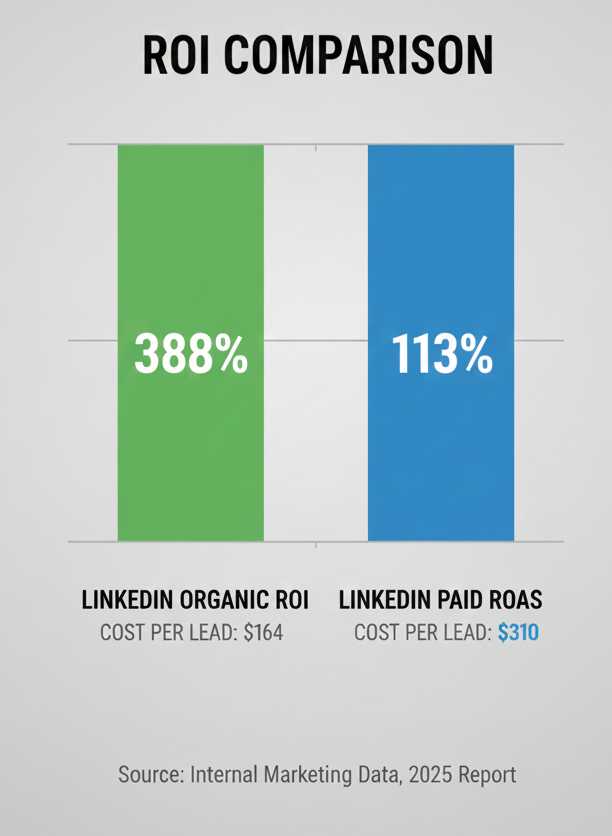
But here’s the plot twist: despite the higher costs, LinkedIn advertising ROAS is outperforming other channels. B2B SaaS companies are seeing 113% ROAS on LinkedIn versus 98% on Google and 104% on Meta.
So what does this mean for you? The platform is getting more expensive but more effective—if you know how to use it.
LinkedIn Organic: The 12-18 Month Authority Play
Let’s talk about organic first, because this is where most founders either waste time or build empires.
The real cost per lead for organic LinkedIn sits around $164—47% cheaper than paid ads. But here’s the catch: that number assumes you’re doing it right, and “right” takes 12-18 months to materialize.
Here’s what organic actually costs you:
- Time: 3-4 hours per week minimum (content creation, engagement, DMs)
- Expertise: Either yours or someone who can authentically channel your voice
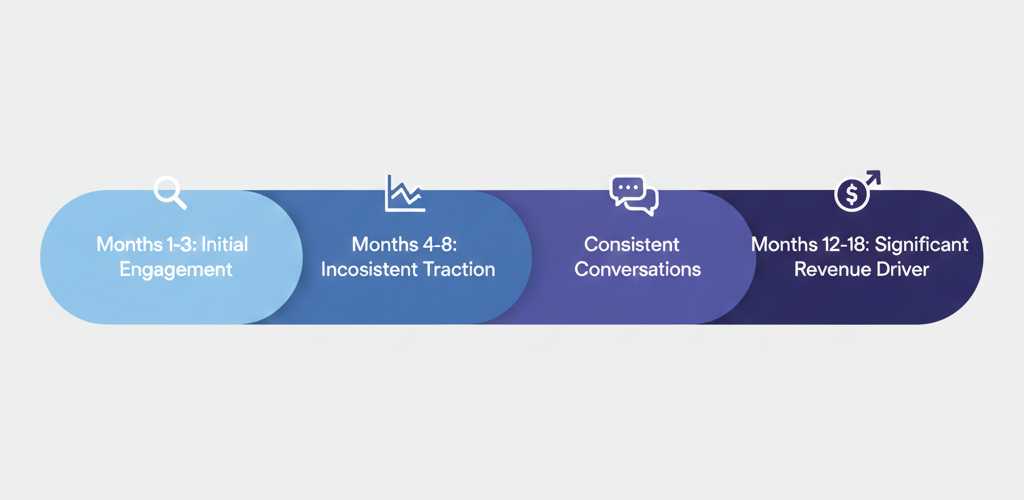
- Patience: Zero results for months 1-3, inconsistent traction months 4-8, compounding returns months 9-18
The ROI curve looks like this: organic LinkedIn marketing delivers approximately 388% ROI once it gains traction. For B2B SaaS specifically, companies investing in founder-led content see leads that convert 2-3x better than paid ad leads because they’re pre-warmed and pre-qualified.
Why organic works (when it works):
People buy from people, not logos. When your founder shows up consistently with insights, war stories, and actual expertise, you’re not just generating leads—you’re building a moat. Your organic content becomes a 24/7 sales asset that works while you sleep.
Look at what happened with Adam Robinson at RB2B. He generated 21 million LinkedIn views in 2024, growing his company to $4M ARR largely through founder-led organic content. That’s not luck—that’s strategic authority building.
The organic playbook that actually works:
- Commit to 90 days minimum before you evaluate results. Anything less is theater.
- Post 3-4 times per week consistently. Not 7x one week and 0x the next. The algorithm rewards consistency.
- Mix content formats: Text posts with selfies (yes, selfies work), carousel posts for frameworks, video for storytelling. Companies using 3+ formats see 2.7x more profile visits.
- Engage religiously: Spend 30 minutes daily commenting on posts from your ICP. This is prospecting disguised as networking.
- Track vanity metrics, optimize for business metrics: Likes are nice, but DM conversations and booked calls are what matter.
The founder-led approach works because it’s authentic, scalable through team amplification, and creates compounding returns. Your content library becomes an asset that generates inbound for years.
But here’s where people screw up: they confuse posting with strategy. Random thoughts don’t build authority. You need pillar topics, a documented perspective, and a clear path from “interesting post” to “let’s talk.”
LinkedIn Ads: The Pipeline Accelerator (If You Have Offer-Market Fit)
Now let’s talk about paid. Because if organic is the marathon, paid is the sprint—and you better know where you’re sprinting to.
LinkedIn ads work exceptionally well when:
- Your ACV is $10,000+ annually
- You have clear ICP definition (not “anyone in B2B”)
- Your offer-message fit is validated
- You need pipeline now, not in 12 months
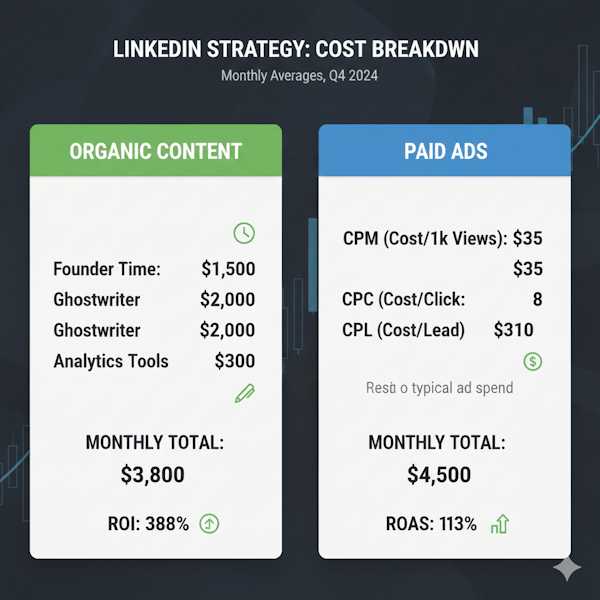
The economics are straightforward: You’re paying $33-65 CPM, $5-10 CPC, and $100-310+ per lead depending on your targeting precision. For a $50K ACV product with a 20% close rate, you need 5 leads to close one deal. At $200 CPL, that’s $1,000 to acquire a $50K customer. The math works.
But here’s what makes LinkedIn ads expensive fast:
Narrow targeting drives CPMs through the roof. When you’re targeting “VP of Engineering at Series B SaaS companies with 50-200 employees in San Francisco using AWS infrastructure,” you’re competing with every other vendor who discovered that same precise filter. Your CPMs can spike to $100+.
Most companies fail at LinkedIn ads because they treat it like Facebook. It’s not. LinkedIn is an intent platform masquerading as a social network. Your ads need to speak to business problems, not aspirations.
The paid playbook that actually converts:
- Start with Lead Gen Forms, not landing pages: Native forms cut CPL by 20-30% because they reduce friction. Use landing pages only for high-intent offers where you need qualification questions.
- Test with $1,000-2,000 monthly before scaling. You need 100-200 leads to reach statistical significance for optimization.
- Use ABM targeting for enterprise deals: Thought Leader Ads (TLAs) that amplify founder content to specific account lists deliver 4x higher engagement than standard sponsored content.
- Layer retargeting on organic engagement: The real power move? Run ads to people who’ve engaged with your organic content. They’re pre-warmed and convert at 2-3x higher rates.
- Track beyond platform metrics: LinkedIn’s attribution is garbage for long sales cycles. Use multi-touch attribution to understand true impact.
The mistake most companies make? They run ads without offer clarity. You’re essentially paying $300 per lead to discover your messaging doesn’t resonate. That’s expensive market research.
The Strategic Framework: When to Use What
Here’s the framework I use with clients:
Early Stage (< $1M ARR):
- 70% organic, 20% experimental paid, 10% partnerships
- Your founder’s time is your most leveraged asset
- Use organic to find your voice, test messages, build initial audience
- Run small paid tests ($500-1000/month) to validate messaging only
- Goal: Establish thought leadership, generate first 50 customers organically
Growth Stage ($1M-10M ARR):
- 50% organic, 40% paid, 10% customer marketing
- Founder-led content is established, now amplify with team
- Scale paid campaigns with validated messaging
- Use ads for targeted account penetration and event promotion
- Goal: Build predictable pipeline machine with both engines running
Scale Stage ($10M+ ARR):
- 30% organic, 50% paid, 20% ABM + customer expansion
- Organic becomes employee advocacy at scale
- Paid dominates demand gen with sophisticated multi-touch campaigns
- ABM for enterprise accounts with $50K+ ACV
- Goal: Market domination through coordinated brand + demand
The inflection point? When your organic content consistently generates qualified conversations (5+ per month), that’s your signal to layer paid amplification. Before that, you’re burning money.
The Hybrid Strategy: How Winners Actually Deploy Both
Here’s the truth: the best performers don’t choose. They orchestrate.
The compounding content loop:
- Founder posts organic thought leadership 3-4x per week
- Best-performing posts get boosted with $500-1000 in Thought Leader Ads to lookalike audiences
- Engagement from ads feeds back into organic algorithm, increasing free reach
- Retargeting campaigns hit engaged audiences with conversion offers
- Closed deals become case study content, feeding back into organic
- Rinse and repeat
This is how you get $164 organic CPL and 113% paid ROAS. They’re not competing—they’re multiplicative.
Case study math:
Let’s say you invest 15 hours/month in organic content (founder + ghostwriter). That’s roughly $5,000 in loaded costs. You generate 10 qualified conversations per month, closing 2 deals at $30K ACV = $60K revenue.
Simultaneously, you spend $5,000 on ads amplifying your best organic content. This generates 25 additional leads at $200 CPL, with 5% converting to closed deals (industry average). That’s 1.25 deals = $37.5K additional revenue.
Total investment: $10,000/month Total revenue: $97.5K/month ROI: 875%
That’s the power of the hybrid approach. Organic builds the brand moat. Paid accelerates penetration. Together, they’re unstoppable.
The Real Cost: What People Miss About “Free” Organic
Let’s address the elephant in the room: organic isn’t free.
Yes, you’re not paying LinkedIn for distribution. But you’re paying in:
- Opportunity cost: Your founder’s time is worth $500-1000/hour. That 4 hours per week is $2,000-4,000 monthly.
- Consistency tax: The moment you stop, your momentum dies. This is a forever commitment.
- Skill gap: Most founders suck at content. You’ll either grind through months of bad posts or pay someone $3,000-10,000/month to do it right.
Meanwhile, paid ads are expensive but predictable. You can turn them on Monday and have leads by Friday. Try that with organic.
The question isn’t cost—it’s ROI per dollar and speed to results.
For enterprise SaaS with 12-month sales cycles, organic’s 18-month ramp perfectly aligns with deal velocity. Your content nurtures accounts throughout their buying journey.
For transactional SaaS with 30-day sales cycles, you need leads yesterday. Paid wins.
Why You Need Expert Help (And Why DIY Usually Fails)
Here’s the uncomfortable truth: Most companies waste 6-12 months and $50,000+ figuring this out themselves.
They hire a junior marketer who “knows LinkedIn,” burn through budget with terrible ad targeting, post sporadically on organic, and wonder why nothing’s working.
Or they follow some guru’s “post like me” playbook without understanding their guru has 50K followers, a different ICP, and a completely different business model.
What expert help actually gives you:
- Strategic diagnosis: Are you even ready for paid? Is your organic message actually resonating?
- Execution precision: Proper campaign structure, targeting, creative testing, attribution setup—the stuff that separates $100 CPL from $300 CPL.
- Integrated orchestration: Connecting organic momentum to paid amplification to pipeline generation.
- Accountability: Someone making sure you’re actually posting consistently, not just “when you have time.”
The ROI math is simple: A LinkedIn growth expert costs $3,000-8,000/month. If they improve your CPL from $300 to $150, you’ve 2x’d your lead volume for the same spend. That pays for itself in week one.
At Cerebral Ops, we’ve helped dozens of B2B SaaS companies navigate exactly this challenge—building founder-led LinkedIn engines that generate pipeline while optimizing paid campaigns that actually convert. We don’t do cookie-cutter playbooks. We diagnose your specific stage, ICP, and resources, then build a custom strategy that compounds.
Your Action Plan: What to Do Monday Morning
Stop theorizing. Here’s your playbook:
If you’re pre-$1M ARR:
- Commit to 90 days of consistent founder-led organic posting (3-4x per week)
- Document your posting process and pillar topics this week
- Allocate $1,000 for paid testing next month to validate messaging
- Track conversations generated, not vanity metrics
If you’re $1M-10M ARR:
- Audit your current organic performance—are you getting 5+ qualified conversations per month?
- If yes, allocate $5,000-10,000 to amplify top-performing content with TLAs
- If no, fix your organic message before scaling paid
- Set up proper multi-touch attribution to track full customer journey
If you’re $10M+ ARR:
- Implement employee advocacy program to scale organic beyond founder
- Deploy sophisticated ABM campaigns targeting tier-1 accounts
- Run continuous paid campaigns with $30,000+ monthly budgets
- Build content machine that feeds both channels systematically
The companies winning on LinkedIn in 2025 aren’t choosing between organic and paid. They’re orchestrating both based on their stage, resources, and timeline.
They’re using organic to build authority and trust over 12-18 months while deploying paid strategically to accelerate pipeline when they have validated offers.
And most importantly, they’re not doing this alone. They’re working with people who’ve run this playbook hundreds of times and know exactly where the landmines are.
Ready to Build Your LinkedIn Growth Engine?
The math is clear: LinkedIn remains the highest-ROI channel for B2B SaaS when deployed strategically. But “strategically” is doing a lot of heavy lifting in that sentence.
If you’re tired of guessing, burning budget on campaigns that don’t convert, or watching competitors build authority while you spin your wheels—let’s talk.
At Cerebral Ops, we specialize in building integrated LinkedIn growth programs that combine founder-led organic content with precision paid campaigns. We handle the strategy, execution, and optimization so you can focus on closing deals, not posting schedules.
Book a free LinkedIn growth audit where we’ll:
- Analyze your current organic performance and identify quick wins
- Review your paid campaign structure (if running) and find optimization opportunities
- Build a custom 90-day roadmap based on your stage, ICP, and resources
- Show you exactly what pipeline growth looks like when you do this right
No cookie-cutter templates. No “post more” advice. Just the strategic diagnosis and execution support you need to make LinkedIn your #1 revenue channel.
Schedule Your Free LinkedIn Growth Audit →
The bottom line: LinkedIn organic builds authority over 12-18 months with 388% ROI and $164 CPL. LinkedIn ads drive pipeline now with 113% ROAS but $310 CPL. Winners use both strategically based on their stage. Losers waste 6-12 months figuring this out through expensive trial and error.
Stop guessing. Start growing.
Frequently Asked Questions
Q: How long does it take to see results from LinkedIn organic content?
Most B2B SaaS companies see initial engagement within 30-60 days, qualified conversations starting around month 3-4, and consistent pipeline generation by month 9-12. The 12-18 month timeline refers to when organic becomes a significant revenue driver generating multiple deals monthly. The key is consistent posting 3-4x per week with strategic engagement. Companies that post sporadically or generically often see zero results even after 12 months.
Q: What’s a realistic LinkedIn ads budget for B2B SaaS?
Start with $1,000-2,000 monthly for testing if you’re early stage. You need 100-200 leads to reach statistical significance for optimization. Once messaging is validated, scale to $5,000-10,000 monthly for growth stage companies, and $30,000+ for scale stage. The critical factor isn’t budget size—it’s whether you have offer-market fit validated before scaling spend. Spending $10K/month with unclear messaging is just expensive market research.
Q: Should I hire someone to manage LinkedIn or do it myself?
For organic content, founder involvement is non-negotiable early on. People buy from people, and your authentic voice is your biggest asset. You can hire ghostwriters to refine your ideas, but the insights need to come from you. For paid ads, expert help pays for itself immediately through better targeting, creative testing, and optimization. Most companies waste $20,000-50,000 learning what experts already know. Consider fractional CMO or agency support for integrated strategy and execution.
Q: How do I measure LinkedIn ROI with long B2B sales cycles?
Use multi-touch attribution that tracks the entire customer journey, not just last-click. Tag your LinkedIn traffic with UTM parameters, track LinkedIn-sourced opportunities in your CRM, and calculate influenced pipeline (deals where LinkedIn touchpoints occurred anywhere in the journey) versus sourced pipeline (deals where LinkedIn was first touch). For organic, track conversation quality and progression to sales calls. For paid, track cost per opportunity and cost per closed deal, not just cost per lead. Most companies need 6-12 months of data to accurately measure LinkedIn ROI with long sales cycles.
Want help building a LinkedIn growth engine that actually generates pipeline? Cerebral Ops specializes in integrated LinkedIn strategies for B2B SaaS companies at every stage. Book your free growth audit today.