
Your CFO asks the question every quarter: “What’s our marketing ROI?” You pull up your dashboard, see impressive numbers, and give what feels like a confident answer. But deep down, you know the truth—those numbers are theater.
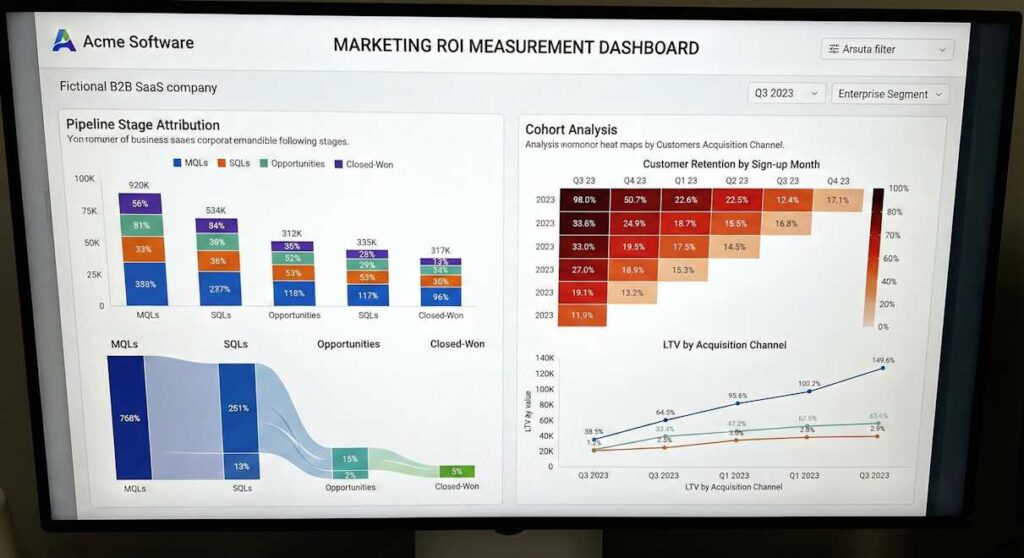
It’s 2025, and despite unprecedented access to marketing analytics tools, 26% of B2B marketers cite ROI measurement as their primary challenge. You’re not alone if you’re struggling with marketing ROI measurement. Between GA4’s black-box attribution, iOS 17.4’s Link Tracking Protection stripping your UTM parameters, and 56% of B2B marketers identifying data accuracy as a major challenge, the marketing attribution landscape has become a minefield.
Here’s the uncomfortable reality: most B2B SaaS attribution models aren’t measuring true impact—they’re creating the appearance of control while your actual marketing performance remains a mystery.
But there’s good news. The solution isn’t more complex attribution software or another analytics platform. It’s a fundamental shift in how you think about marketing analytics setup and what “good enough” really means for your business.
In this guide, we’ll expose 12 hidden problems destroying your marketing ROI measurement accuracy, and show you the three pragmatic fixes that actually work in 2025’s privacy-first world.
The Attribution Theater Problem: Why Your Numbers Are Lying
Before we dive into the hidden problems, let’s address the elephant in the boardroom: most attribution models are sophisticated fiction.
Traditional attribution models track what happened, but they don’t explain why it happened. Your last-touch attribution model credits the demo request form, but ignores the 47 touchpoints that came before. Your multi-touch attribution spreads credit across channels, but can’t tell you which investments were actually incremental.
The result? You’re making million-dollar budget decisions based on correlational data that might be completely wrong.
Let’s uncover the specific problems hiding in your marketing analytics setup.
Hidden Problem #1: GA4’s Data-Driven Attribution Is a Black Box
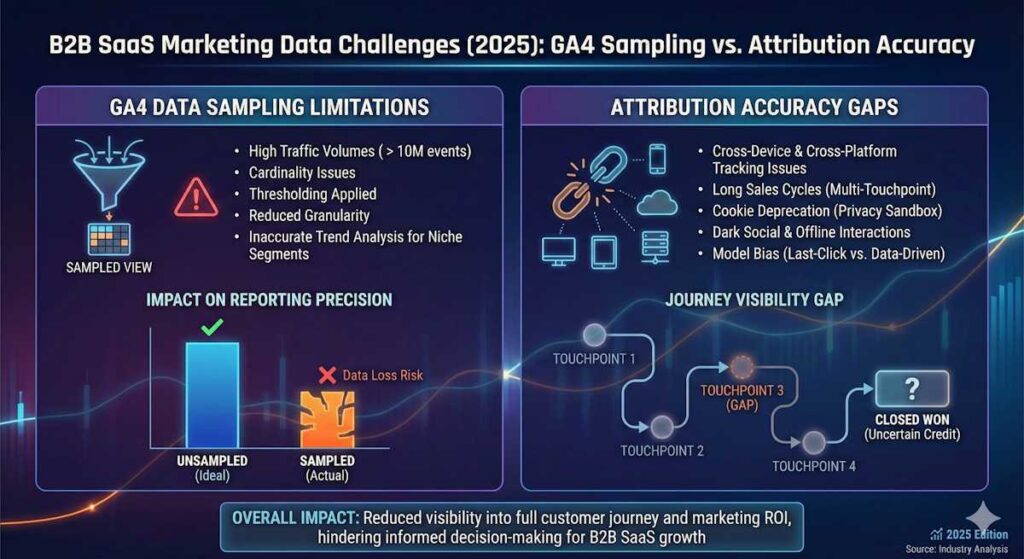
The Issue: GA4 will sunset all attribution models except for two: last-click and data-driven attribution, with data-driven attribution as the default. While this sounds advanced, there’s a critical problem: you can’t see the inputs or logic driving these attributions.
Why It Matters: When your CFO questions why LinkedIn isn’t getting credit for deals, you can’t explain the algorithm’s reasoning. The quality and consistency of GA4’s data sampling is highly opaque, making it difficult to gauge the accuracy or reliability of sampled data.
The Hidden Cost: Marketing teams waste 10-15 hours per month trying to reconcile GA4 numbers with CRM data, creating reports that still don’t provide clear answers.
DIY Solution: Implement parallel tracking using UTM parameters and first-party database logging. Create a simple pipeline attribution model in your CRM that tracks: First Touch → MQL → SQL → Opportunity → Close. Track these timestamps and channels manually. Cost: $0 + 8 hours setup time.
Expert Solution: A marketing analytics expert can implement a hybrid attribution system that combines GA4’s behavioral data with your CRM’s revenue data, creating a unified source of truth. They’ll set up automated data pipelines, resolve identity conflicts, and create dashboards that show both algorithmic attribution and rule-based attribution side-by-side.
Cost-Effectiveness: DIY takes 40+ hours over 3 months with high error risk. Expert setup costs $8,000-$15,000 but delivers accurate data in 2-3 weeks, saving $30,000+ annually in wasted ad spend from bad attribution data.
Hidden Problem #2: iOS 17.4+ Is Stripping Your Campaign Parameters
The Issue: iOS 17 includes Link Tracking Protection that removes tracking identifiers from URLs shared in Messages, Mail, and Safari Private Browsing. Safari has 25% of global browser usage, and with iOS 17 rollout, tracking will be blocked for around 4% of users initially—but this could expand to all Safari users.
Why It Matters: Your Facebook Click ID (fbclid), Google Click ID (gclid), and other auto-tagging parameters are being removed before users reach your site. This means ad platforms can’t tie conversions back to specific campaigns, breaking their optimization algorithms.
The Hidden Cost: About 20-40% of attributed conversions are estimated to be organic conversions that would have occurred without exposure to an ad. Without proper tracking, you’re crediting (and paying for) conversions that would have happened anyway.
DIY Solution: Switch from auto-tagging to manual UTM parameters, as UTM parameters aren’t impacted and should still be available for aggregate engagement tracking and conversion tracking in analytics platforms like GA4. Create a UTM builder template and enforce consistent naming conventions across your team. Segment your traffic by iOS version to measure the impact.
Expert Solution: Experts implement server-side tracking solutions that bypass browser-level restrictions. They set up first-party data collection, implement conversion APIs (like Meta CAPI), and create models that estimate iOS traffic contribution based on statistical sampling.
Cost-Effectiveness: DIY provides basic protection but misses 15-25% of conversions that lack proper tracking. Expert implementation ($12,000-$18,000) recovers visibility on 85-90% of iOS traffic, preventing $50,000+ in annual misattributed ad spend.
Hidden Problem #3: You’re Confusing Bookings with Revenue in CAC Calculation
The Issue: Nearly 70% of SaaS businesses either underestimate or miscalculate their customer acquisition cost. One of the most common CAC calculation mistakes is using total contract value (bookings) instead of actual recognized revenue.
Why It Matters: If you sign a $60,000 annual contract but recognize it monthly, your customer acquisition cost metrics will look artificially low. This creates false confidence in marketing channels that appear profitable but aren’t.
The Hidden Cost: Misinformed budget allocation leads to over-investing in channels with poor unit economics. Companies often discover 6-9 months later that their “low CAC” channel actually had a CAC 2-3x higher than reported.
DIY Solution: Create a separate CAC spreadsheet that tracks only recognized revenue. Include all costs: salaries (fully loaded with benefits), tools, advertising spend, overhead allocated to sales/marketing, and trial/POC costs. Calculate CAC monthly and track the trend line.
Formula: CAC = (Total S&M Costs + Allocated Overhead + Trial Costs) / New Customers Acquired
Segment by channel and calculate individual channel CAC to see true performance.
Expert Solution: Revenue operations consultants build automated CAC tracking systems integrated with your financial systems. They account for sales cycle lag, properly allocate shared costs, and create cohort-based CAC analysis that shows unit economics by acquisition cohort, not just calendar month.
Cost-Effectiveness: DIY gives basic visibility but requires 5-8 hours monthly maintenance and misses nuanced allocation issues. Expert setup ($5,000-$8,000) plus $2,000/month ongoing creates executive-ready reports and prevents $100,000+ in strategic misallocation over 12 months.
Hidden Problem #4: Your Multi-Touch Attribution Undervalues Top-of-Funnel Channels by 10-20x
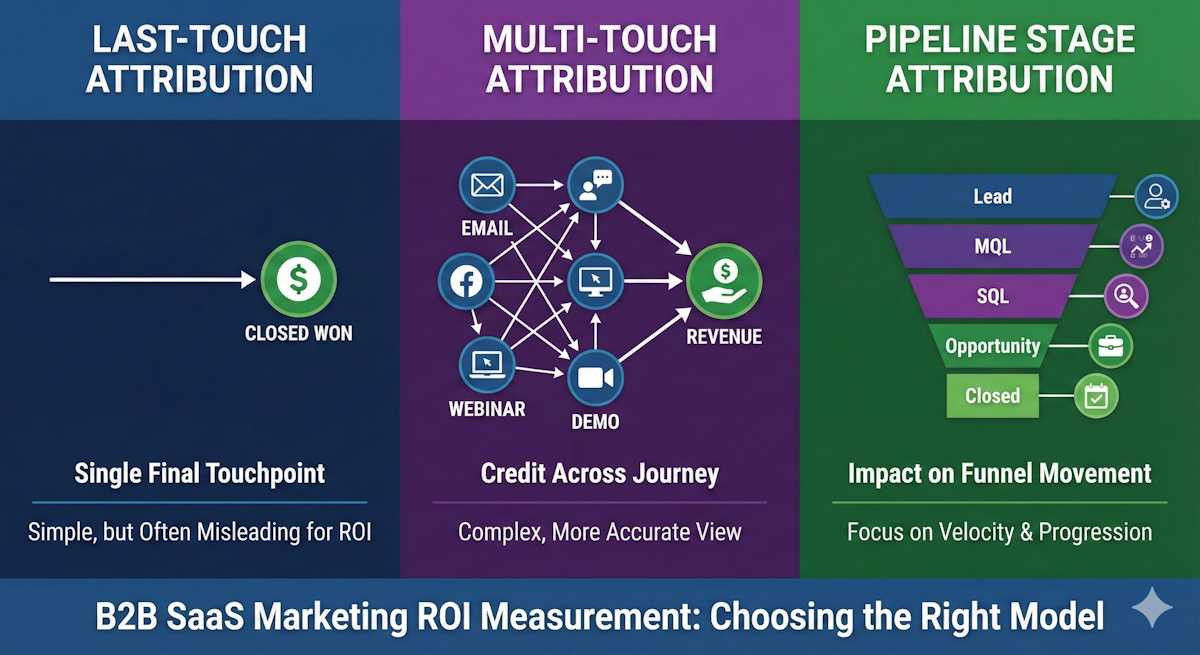
The Issue: LinkedIn ads was credited with 0.5% of revenue in last-touch attribution and 1.5% in multi-touch attribution. After running proper incrementality tests, LinkedIn’s true impact was actually 20% of conversions.
Why It Matters: You’re starving effective brand awareness channels because they don’t get attribution credit. Meanwhile, bottom-funnel channels (branded search, retargeting) capture credit for conversions they merely witnessed, not caused.
The Hidden Cost: GA4 struggles to track and attribute the impact of impression-led platforms. As a result, upper-funnel channels get under-credited, leading marketers to mistakenly shift budget away from high-performing awareness channels.
DIY Solution: Implement a survey asking “How did you first hear about us?” on your demo request form. Track responses for 90 days and compare to attribution data. For key channels, run incrementality tests: pause spend in 30-50% of your markets for 4-6 weeks and measure impact on MQL volume.
Expert Solution: Analytics specialists implement incrementality testing frameworks using geo-holdout tests, synthetic control groups, and causal inference models. Over half (52%) of brands and agencies are using incrementality testing to measure and optimize their campaigns. They measure the counterfactual—what would have happened without the marketing investment.
Cost-Effectiveness: DIY survey approach provides directional insights at near-zero cost. Professional incrementality testing ($15,000-$30,000 for a 6-month program) shows consistent 15-25% uplift in overall marketing efficiency through better allocation.
Hidden Problem #5: You’re Tracking Leads Instead of Pipeline Impact
The Issue: Your marketing dashboard celebrates MQL volume while your sales team complains about lead quality. The complexity of B2B buying processes, which often involve an average of 13 decision-makers and 89% of purchases requiring input from multiple departments, means lead volume is a vanity metric.
Why It Matters: A channel generating 500 MQLs might create zero pipeline if those leads don’t match your ICP. Meanwhile, a channel generating 50 MQLs creates $2M in pipeline because they’re the right leads at the right time.
The Hidden Cost: CMOs get fired because they hit lead targets but miss revenue targets. Marketing budgets get cut because leadership sees cost per lead metrics disconnected from business outcomes.
DIY Solution: Shift your reporting to pipeline-centric metrics. Track:
- MQL → SQL conversion rate by channel
- SQL → Opportunity conversion rate by channel
- Average deal size by source channel
- Sales cycle length by source channel
- Win rate by source channel
Create a “pipeline value per dollar spent” metric for each channel. Formula: Pipeline Generated / Marketing Spend = Pipeline Efficiency
Expert Solution: Marketing operations experts implement full-funnel attribution with velocity-based scoring. They connect marketing automation platforms to CRM systems, track multi-touch pipeline influence, and create predictive models showing which combinations of touches accelerate deals.
Cost-Effectiveness: DIY requires manual CRM reports and 10+ hours monthly to maintain. Expert implementation ($10,000-$15,000 setup + $3,000/month) automates reporting and typically identifies $200,000+ in pipeline optimization opportunities within 6 months.
Hidden Problem #6: Your Attribution Window Doesn’t Match Your Sales Cycle
The Issue: You’re using a 30-day attribution window, but your sales cycle is 120 days. This means 75% of the customer journey happens outside your measurement window.
Why It Matters: When you’re selling an enterprise solution, it’s not unusual for the journey from initial interest to closed deal to stretch out over 12-24 months. Standard attribution tools default to 30-90 days, missing critical early-stage touchpoints.
The Hidden Cost: You can’t identify which early-stage activities correlate with closed deals. Your content marketing ROI looks terrible because deals close 6 months after content engagement, outside your measurement window.
DIY Solution: Manually extend your tracking window in GA4 to match your average sales cycle (up to 90 days maximum in GA4). Create a spreadsheet tracking first touch date, MQL date, SQL date, opportunity date, and close date for every deal. Calculate average time between stages and use this to create custom cohort reports.
Track deals backward: For each closed deal this month, identify all marketing touches in the previous 180 days.
Expert Solution: Analytics professionals implement data warehouse solutions (like Snowflake or BigQuery) that store unlimited historical data. They create custom attribution windows matching each product line’s sales cycle, weight touches based on time-decay models calibrated to your actual conversion patterns, and build predictive models showing early indicators of deal success.
Cost-Effectiveness: DIY provides basic insights but requires significant manual work and can’t handle complex multi-product scenarios. Expert data warehouse implementation ($20,000-$35,000) enables unlimited historical analysis and typically improves campaign ROAS by 30-50% through better timing insights.
Hidden Problem #7: You’re Ignoring Deal Size in Your Attribution Model
The Issue: Your attribution model treats a $5,000 deal the same as a $500,000 enterprise deal. This creates perverse incentives where marketing optimizes for volume instead of value.
Why It Matters: A $4,000 CAC sounds scandalous until you realize the average customer brings in $100,000 over five years. Different channels attract different deal sizes, but standard attribution models don’t account for this.
The Hidden Cost: You might cut a “high CAC” channel that’s actually your most profitable because it brings enterprise deals. Or you might over-invest in a “low CAC” channel bringing small deals that churn quickly.
DIY Solution: Create a weighted attribution model. For each channel, calculate:
- Average deal size
- Average CAC
- LTV:CAC ratio
- CAC Payback Period
Build a simple scorecard:
Channel Score = (Avg Deal Size × Win Rate × LTV) / CACRank channels by this score instead of raw CAC.
Expert Solution: Revenue operations specialists implement value-based attribution that automatically weights conversion by deal size, factors in expansion revenue potential, adjusts for customer segment (SMB vs Enterprise), and creates predictive LTV models based on early signals.
Cost-Effectiveness: DIY scoring system provides immediately actionable insights at zero cost beyond Excel time. Expert value-based attribution ($8,000-$12,000) typically redirects 20-30% of budget to higher-value channels, improving annual revenue by $300,000+ for mid-market SaaS companies.
Hidden Problem #8: Your Dashboard Shows Metrics, Not Insights
The Issue: Your marketing analytics setup displays 47 metrics across 6 tools, but doesn’t answer the one question that matters: “Should we increase or decrease spend in this channel?”
Why It Matters: Data-driven decision making ranked as third most significant industry change in 2024, yet organizations voice the need for data-informed strategies while implementation lags due to attribution challenges. Dashboards without actionable insights lead to analysis paralysis.
The Hidden Cost: Marketing teams spend 15-20 hours per week pulling data instead of optimizing campaigns. By the time insights are extracted, market conditions have changed.
DIY Solution: Create a single-page decision dashboard with only these metrics:
Channel Performance Scorecard:
- Spend vs Budget (traffic light: green = on track, red = over/under)
- Pipeline Generated vs Target
- CAC vs Benchmark
- CAC Payback Period
- Win Rate
- Decision: Scale (+20%), Hold (0%), or Cut (-20%)
Update weekly. Link each channel to a dedicated channel deep-dive report.
Expert Solution: Dashboard architects build executive-ready business intelligence systems with automated anomaly detection, forecasting models, scenario planning tools, and AI-powered recommendations. They integrate data from 8-12 sources into a unified data model with automatically updating visualizations.
Cost-Effectiveness: DIY dashboard can be built in Google Sheets or Data Studio for free in 8-10 hours. Professional BI implementation ($15,000-$25,000) saves 10+ hours weekly in reporting time (worth $150,000+ annually for a marketing team) and improves decision quality through predictive analytics.
Hidden Problem #9: You’re Not Accounting for Sales Cycle Variance by Channel
The Issue: Webinar leads close in 45 days on average. Content download leads take 180 days. Your attribution model treats them equally, making webinars look artificially better.
Why It Matters: The amount of time it takes for someone to move through the buying process, from a mere lead to a paying customer, is contained in the sales cycle time, and its effects on your CAC cannot be overemphasized. Channel CAC means nothing without payback period context.
The Hidden Cost: You over-invest in quick-close channels (bottom-funnel) and under-invest in efficient long-term channels (top-funnel), creating pipeline volatility and limiting scale.
DIY Solution: Create a cohort analysis by channel and month. Track:
- Month 0: Leads generated
- Month 1: Opportunities created
- Month 2: Deals closed
- Month 3: Deals closed
- Month 6: Deals closed
Calculate cumulative conversion rate and revenue by cohort. Identify which channels have long tails of delayed conversions.
Create a “Time-Adjusted CAC” metric:
Time-Adjusted CAC = CAC × (Average Sales Cycle Days / 30)Expert Solution: Analytics teams build survival analysis models showing probability of conversion over time by channel, create liquidity-adjusted CAC metrics accounting for cash flow timing, implement predictive deal scoring showing likelihood of close in next 30/60/90 days by source, and optimize budget allocation for both short-term and long-term pipeline.
Cost-Effectiveness: DIY cohort analysis in Excel provides valuable insights for free in 6-8 hours initial setup. Professional survival analysis modeling ($10,000-$15,000) typically improves pipeline predictability by 40%+ and optimizes channel mix for both revenue and cash flow.
Hidden Problem #10: You’re Measuring Correlation, Not Causation
The Issue: Your attribution system shows that prospects who attend 3+ webinars are 10x more likely to close. So you force everyone into webinars. Conversion rates drop. Why? Engaged prospects naturally attend more webinars—webinars didn’t cause the engagement.
Why It Matters: Incrementality testing offers a solution by introducing a counterfactual perspective—helping marketers measure what would not have happened without a specific effort. Without testing causation, you optimize for theater instead of results.
The Hidden Cost: A B2B SaaS company found their display ads had minimal impact, with only a 1.2% increase in subscriptions and a 62% lower ROAS than reported metrics. Attribution models suggested display ads were working; incrementality tests proved they weren’t.
DIY Solution: Run simple holdout tests:
- Identify a channel you want to test
- Select 30-40% of your addressable market (regions, accounts, or segments)
- Pause all activity in test group for 60-90 days
- Continue normal activity in control group
- Measure difference in conversion rates between groups
Demo requests in test regions dropped by 18% compared to baseline, while control regions held steady—proving true incrementality.
Expert Solution: Testing specialists design and execute statistically rigorous incrementality programs using geo-experiments, matched market tests, synthetic control groups, Bayesian inference models, and multi-variate testing. Companies that use incrementality testing see consistent 15-25% uplift in overall marketing efficiency through better allocation.
Cost-Effectiveness: DIY holdout tests cost nothing but require discipline to maintain test conditions for 60+ days. Professional incrementality programs ($20,000-$40,000 annually) typically identify $100,000-$300,000 in wasted spend on non-incremental activities within the first year.
Hidden Problem #11: Your Marketing Team and Finance Team Are Using Different Definitions
The Issue: Marketing reports $2.5M in “influenced pipeline.” Finance sees $800K in actual closed revenue attributed to marketing. CFO questions entire marketing budget.
Why It Matters: You could separate out “marketing-influenced revenue” (where both marketing and sales have touched the lead) from “pure marketing revenue” (where the lead was generated and converted by marketing without any sales involvement). Without agreed definitions, every board meeting becomes a debate instead of a decision.
The Hidden Cost: Marketing loses credibility and budget. CMOs spend more time defending past performance than optimizing future campaigns.
DIY Solution: Schedule a 2-hour alignment meeting with Finance, Sales, and Marketing. Agree on:
- Revenue Attribution Rules:
- First-touch attribution for sourcing credit
- Multi-touch for influence credit
- Clear definition of “marketing-sourced” vs “marketing-influenced”
- Metric Definitions:
- MQL criteria (firmographic + behavioral)
- SQL handoff criteria
- SAL acceptance criteria
- Opportunity stage definitions
- Reporting Standards:
- Update frequency (weekly, monthly, quarterly)
- Data sources of truth (which system for which metric)
- CAC calculation methodology
Document in a shared Revenue Operations Handbook.
Expert Solution: RevOps consultants facilitate cross-functional alignment workshops, implement unified revenue dashboards pulling from single source of truth, create data governance frameworks, establish SLA agreements between teams, and build executive reporting packages with agreed-upon metrics and definitions.
Cost-Effectiveness: DIY alignment meeting costs zero dollars but requires executive sponsorship to stick. Professional RevOps alignment programs ($12,000-$20,000) create lasting infrastructure and prevent $500,000+ in misallocated resources from misalignment.
Hidden Problem #12: You’re Drowning in Data But Starving for Decisions
The Issue: You have GA4, HubSpot, Salesforce, LinkedIn Campaign Manager, Google Ads, 6sense, Tableau, and Slack alerts. You receive 847 data points daily. You still don’t know if you should increase Facebook spend.
Why It Matters: Marketing spend as a percentage of revenue for B2B companies averages about 8% of annual revenue, with high-growth firms or SaaS companies investing 10-15%+ of revenue. At these budget levels, indecision costs tens of thousands monthly in suboptimal allocation.
The Hidden Cost: Decision fatigue leads to status quo bias. You keep spending the same amounts in the same channels because changing requires too much analysis. Meanwhile, market conditions shift and CAC inflates.
DIY Solution: Implement a simple decision framework:
Weekly Channel Review (15 minutes per channel):
- Performance vs Target: Are we hitting pipeline goals? (Yes/No)
- Efficiency vs Benchmark: Is CAC within target range? (Yes/No)
- Trend Direction: Improving or declining? (Up/Down/Flat)
- Decision Matrix:
- Performance ✓ + Efficiency ✓ + Trend ↑ = Scale (+20%)
- Performance ✓ + Efficiency ✓ + Trend ↓ = Monitor (0%)
- Performance ✗ or Efficiency ✗ + Trend ↓ = Cut (-20%)
Document decisions in a shared spreadsheet. Review monthly for pattern recognition.
Expert Solution: Marketing operations experts implement automated decision intelligence systems with budget optimization algorithms, anomaly detection with root cause analysis, predictive forecasting with confidence intervals, scenario modeling for what-if analysis, and automated recommendations with supporting evidence.
Cost-Effectiveness: DIY decision framework provides structure for free and can be implemented immediately. Advanced marketing operations automation ($25,000-$40,000) eliminates 20+ hours weekly in analysis work (worth $200,000+ annually) and improves resource allocation efficiency by 25-35% through faster, data-backed decisions.
The 3 Fixes That Actually Work in 2025
Now that we’ve exposed the hidden problems, let’s focus on the practical fixes that work in the real world—not the ivory tower.
Fix #1: Embrace “Good Enough” Attribution (Pipeline Stages + First-Touch)
Stop chasing perfect attribution. Start measuring what matters.
The pragmatic approach that works:
- Track First-Touch for Sourcing Credit
- Use UTM parameters consistently
- Implement first-party tracking via your database
- Give clear credit for who brought the customer into your world
- Track Pipeline Stage Movement
- MQL → SQL conversion by source
- SQL → Opportunity conversion by source
- Opportunity → Close by source
- Average deal size by source
- Add Simple Velocity Metrics
- Time from MQL to Close by source
- Sales cycle acceleration/deceleration by source
Why This Works: This model is simple enough to maintain, accurate enough to make decisions, and focuses on business outcomes (pipeline and revenue) instead of complex attribution math.
Implementation Time: 2-3 weeks with existing systems Maintenance: 2-3 hours per month Accuracy: 75-85% confident in decisions (vs 40-50% with complex multi-touch)
Fix #2: Implement Cohort Analysis Instead of Period-Based Reporting
Stop looking at “March performance.” Start tracking “March cohorts.”
Traditional reporting: “We spent $50K in March and closed $100K.” Problem: Those deals probably came from November leads, and March leads won’t close until June.
Cohort analysis: “The November 2024 lead cohort has generated $300K in closed revenue after 6 months, with CAC of $8,000 per customer and payback period of 4.2 months.”
How to Implement:
- Tag every lead with acquisition month and source
- Track each cohort monthly:
- Month 0: Leads acquired
- Month 1: MQLs converted, pipeline generated
- Month 2: Opportunities created
- Month 3-6: Cumulative revenue by cohort
- Create cohort comparison reports showing:
- Which cohorts are outperforming
- Which sources have best long-term value
- What payback curves look like by source
Why This Works: Content marketing investment shows time-to-ROI typically ranges from 6-9 months, with blog content requiring 3-6 months to gain significant organic traction. Cohort analysis aligns measurement with reality instead of forcing reality into arbitrary calendar periods.
Implementation Time: 1 week to set up tracking, 4 weeks to gather meaningful data Maintenance: 4-5 hours per month Value: Reveals true channel performance over time, prevents premature optimization
Fix #3: Run Quarterly Incrementality Tests on Your Top 3 Channels
Stop assuming your highest-spend channels are working. Start proving it.
Incrementality testing brings clarity and counterfactual insights to critical areas of B2B marketing. Here’s the pragmatic implementation:
Q1 Test: Your Highest Spend Channel
- Select 30-40% of addressable market as test group
- Pause all activity for 60-90 days
- Measure impact vs control group
- Calculate true incrementality
Q2 Test: Your “Best Performing” Channel (per attribution model)
- Same methodology
- Often reveals attribution inflation
- Identifies where you can cut without impact
Q3 Test: A Experimental Channel You’re Considering
- Test in small market before full rollout
- Prove incrementality before scaling spend
- Avoid expensive mistakes
Q4 Test: Retargeting/Bottom-Funnel Activity
- Often over-credited in attribution
- Usually finds 30-50% non-incremental
- Big opportunity to reduce waste
Why This Works: One financial services company testing their display ads found actual incrementality was 62% lower than attribution models suggested. A Lifesight market analysis estimates the loss of $100 billion in media spending in 2023, resulting in no return from poor measurement practices. Incrementality testing finds this waste.
Implementation Time: 60-90 days per test Cost: Time investment only (or $15,000-$25,000 with expert guidance) Value: Typically identifies 20-40% waste in existing spend, redirects to incremental channels
Implementation Roadmap: Your First 90 Days
Days 1-30: Foundation
- Audit current tracking setup
- Implement consistent UTM structure
- Set up first-touch tracking in CRM
- Create pipeline stage reporting
- Document metric definitions with sales/finance
Days 31-60: Measurement
- Build cohort analysis framework
- Set up monthly cohort reports
- Create channel scorecard dashboard
- Establish decision framework
- Run first incrementality test (plan)
Days 61-90: Optimization
- Review first month of cohort data
- Complete first incrementality test
- Adjust budget based on insights
- Train team on new frameworks
- Plan next quarter’s tests
When to Hire an Expert vs DIY
DIY Makes Sense When:
- Annual marketing budget under $500K
- Sales cycle under 60 days
- Simple product/pricing structure
- Small team with technical skills
- Time to invest 10-15 hours monthly
Expert Makes Sense When:
- Annual marketing budget over $500K (ROI: 2-5x within 12 months)
- Complex sales cycles (90+ days, multiple stakeholders)
- Multi-product portfolio with different sales motions
- Need executive-ready reporting ASAP
- Marketing operations team stretched thin
The Math:
- Bad attribution costs $100,000-$500,000 annually in misallocated budget
- Expert setup costs $15,000-$40,000 depending on complexity
- Payback period: 2-4 months typically
- Ongoing value: 20-35% improvement in marketing efficiency
Why Cerebral Ops? The Attribution & Analytics Sprint
At Cerebral Ops, we’ve helped 40+ B2B SaaS companies (Series A to C) solve their marketing ROI measurement challenges through our Analytics & Attribution Strategy Sprint.
What’s Included:
Week 1: Audit & Design
- Complete attribution system audit
- Gap analysis vs industry best practices
- Custom framework design for your sales cycle
- Metric definition workshop with stakeholders
Week 2-3: Implementation
- GA4 configuration and debugging
- CRM integration and pipeline tracking setup
- UTM standardization and tracking governance
- Dashboard creation (executive + operational)
Week 4: Training & Handoff
- Team training on new frameworks
- Documentation and playbooks
- Monthly reporting template
- Incrementality testing roadmap
Investment: $15,000 – $25,000
Timeline: 4 weeks to complete implementation
Guarantee: If we don’t identify at least 3x ROI in optimization opportunities, we’ll refund 50% of project fees
Typical Results:
- 35-50% improvement in attribution accuracy
- $100,000-$300,000 identified in wasted spend (first year)
- 15-20 hours per month saved in reporting time
- CFO-approved reporting frameworks
- Clear incrementality testing roadmap
The Bottom Line
Marketing ROI measurement doesn’t have to be perfect to be useful. It needs to be:
- Accurate enough to make directional decisions (75%+ confidence)
- Simple enough to maintain without a data science team
- Aligned enough across marketing, sales, and finance to drive action
The three fixes—pipeline stage attribution, cohort analysis, and incrementality testing—give you this foundation.
You don’t need another analytics platform. You need a pragmatic framework that accounts for 2025’s privacy-first reality and your CFO’s need for clear ROI proof.
Start today:
- Implement consistent UTM tracking (1 day)
- Set up first-touch attribution in your CRM (2-3 days)
- Create your first cohort analysis report (1 week)
- Plan your first incrementality test (1 week)
Or let us do it: Book a free 30-minute attribution audit call. We’ll analyze your current setup, identify your biggest gaps, and show you exactly what fixing them would unlock for your business.
The CFO’s question—”What’s our marketing ROI?”—should never make you sweat again.
Frequently Asked Questions
How accurate is “good enough” attribution?
“Good enough” attribution (pipeline stages + first-touch + cohort analysis) typically provides 75-85% confidence in channel performance rankings. This is sufficient for budget allocation decisions and significantly better than complex multi-touch attribution models that provide false precision (appearing 95% confident but actually 40-50% accurate due to data gaps).
Can I implement this without a data analyst on staff?
Yes. The three fixes (pipeline stage tracking, cohort analysis, incrementality testing) can be implemented using spreadsheets and existing CRM reports. Most marketing operations professionals can set up the foundation in 2-3 weeks. Advanced features (predictive analytics, automated dashboards) benefit from expert help.
How long until I see ROI from better attribution?
Most companies identify $50,000-$150,000 in optimization opportunities within 30 days of implementing pipeline stage attribution and cohort analysis. Full ROI (including redirected spend performing better) typically materializes within 3-6 months.
What’s the difference between attribution and incrementality testing?
Attribution tells you what touchpoints a customer had before converting. Incrementality testing tells you which touchpoints actually caused the conversion. Attribution is always-on tracking; incrementality is periodic testing. You need both—attribution for day-to-day optimization, incrementality to validate your attribution assumptions quarterly.
Ready to fix your marketing ROI measurement? Book Your Free Attribution Audit →
About the Author: This guide was created by the team at Cerebral Ops, a growth marketing consultancy specializing in analytics and attribution strategy for B2B SaaS companies. We’ve helped 40+ companies from Series A to Series C solve their marketing measurement challenges.
Last Updated: December 2025