
Print & Direct Mail Marketing: 20 Strategies That Still Convert (When Digital Fails You)
You’ve spent another $2,000 on Facebook ads this month. Your email open rates have plummeted to 12%. Your Instagram posts are getting buried in algorithmic quicksand. And your latest Google Ads campaign? Let’s not even go there.
Here’s the uncomfortable truth most digital marketing “gurus” won’t tell you: digital marketing is becoming a pay-to-lose game for small businesses.
Meanwhile, something fascinating is happening in the physical world. While everyone else is fighting for digital scraps, savvy business owners are crushing it with print and direct mail marketing—and watching their competitors scratch their heads wondering how they’re booking 30% more clients.
I’m not suggesting you abandon digital. That would be stupid. But I am telling you this: if you’re not integrating print and direct mail into your marketing mix in 2024-2025, you’re leaving serious money on the table.
Let me show you exactly how to fix that.
Why Print Marketing Is Crushing Digital Right Now (The Data Doesn’t Lie)
Before we dive into the tactics, let’s destroy a myth: “Print is dead.”
Bull. Here are the numbers that’ll make you rethink everything:
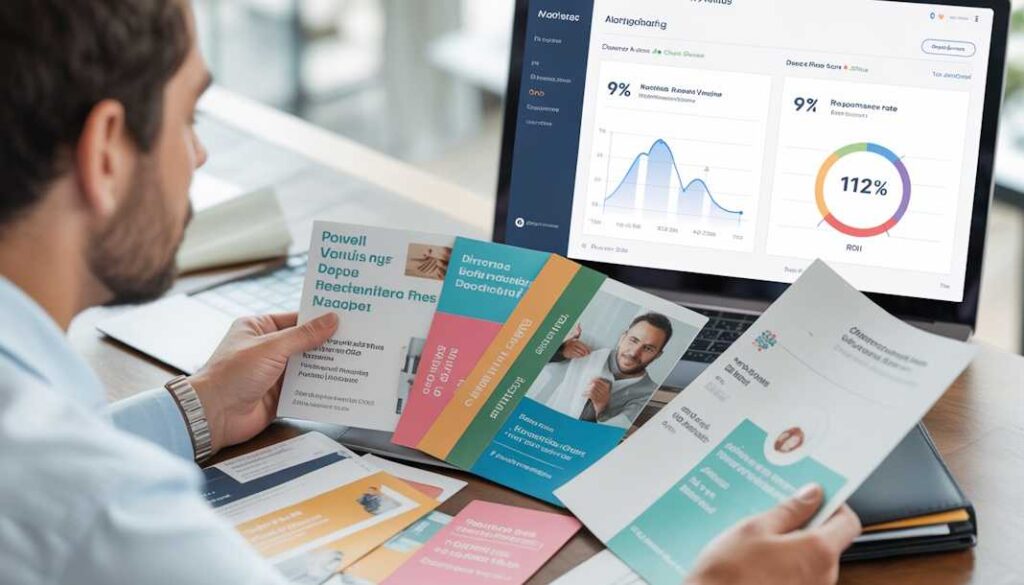
- Direct mail has a 9% response rate compared to email’s pathetic 0.12% (Association of National Advertisers, 2024)
- 84% of marketers say direct mail delivers their highest ROI of any channel they use
- Direct mail ROI averages 112%—crushing email (93%), paid search (88%), and social media ads (81%)
- 72% of consumers regularly engage with mail each week, with Gen X leading at 78%
- The average person sees 4,000-10,000 digital ads per day. How many door hangers do they see? Usually just yours.
You’re not competing with 47 other ads in someone’s mailbox. You’re not fighting an algorithm that prioritizes whoever has the deepest pockets. You’re sitting on their kitchen counter, staring them in the face.
That’s power.
The 5 Hidden Problems Killing Your Print Marketing (And How to Fix Them)
Most small businesses that “try” print marketing fail spectacularly. Not because print doesn’t work—but because they make these five catastrophic mistakes:
Hidden Problem #1: They Treat Print as an Afterthought
The mistake: They whip up a flyer on Canva in 15 minutes, print 500 copies at FedEx, and wonder why their phone doesn’t ring.
The reality: Print requires the same strategic thinking as your best digital campaigns. You need to know your customer avatar, craft a compelling offer, and create a seamless path to conversion.
The fix (DIY): Before you design anything, answer these questions:
- Who exactly am I targeting? (Be specific—”homeowners within 5 miles making $75K+” not “people who need my service”)
- What’s their biggest pain point right now?
- What’s my irresistible offer?
- What’s the ONE action I want them to take?
Map your print to your marketing funnel just like you would a landing page.
The fix (Expert): This is where growth marketing experts like us at Cerebral Ops come in. We don’t just design pretty postcards—we engineer conversion systems. We analyze your customer journey, identify where print creates maximum leverage, and build campaigns that actually drive revenue. Cost-effective? When a $600 mail drop generates $15,000 in new business, you’re damn right it is.
Hidden Problem #2: They Can’t Track What’s Working
The mistake: They send out 2,000 postcards with just a phone number and their website. When customers call or visit, there’s no way to know if they came from the mailer.
The reality: What you can’t measure, you can’t improve. And what you can’t prove, you can’t justify to your skeptical business partner or spouse.
The fix (DIY): Use unique tracking mechanisms:
- Create a dedicated landing page (yoursite.com/special-offer) only on your mailers
- Use a unique QR code that links to your offer page with UTM parameters
- Set up a dedicated phone number through Google Voice or similar
- Include a unique promo code they must mention to redeem the offer
QR codes are experiencing a renaissance—global scans quadrupled in 2024, hitting 26.95 million. People know how to use them now, and they bridge your offline and online worlds beautifully.
The fix (Expert): We implement sophisticated attribution systems that track every touchpoint. You’ll know exactly which neighborhoods respond best, what offers convert highest, and your true cost per acquisition. We integrate your print campaigns with your CRM and analytics platforms, so you can make data-driven decisions instead of guessing. When you’re spending thousands on print, this level of insight isn’t optional—it’s essential.
Hidden Problem #3: Their Design Screams “Amateur Hour”
The mistake: Cluttered layouts with 47 different fonts, stock photos from 2003, and enough text to fill a novella. Or the opposite—so minimal it says nothing.
The reality: You have 2-3 seconds to grab attention. Professional design isn’t about being pretty—it’s about guiding the eye, building trust, and driving action.
The fix (DIY):
- Use high-resolution images (300 DPI minimum for print)
- Stick to 2-3 fonts maximum (one for headlines, one for body)
- Create visual hierarchy (headline → benefit → offer → CTA)
- Use white space strategically—cluttered = unprofessional
- Make your CTA impossible to miss (big, bold, clear)
- Ensure brand consistency across all materials
Tools like Canva Pro have print templates with proper bleed settings. Use them. And for the love of all things holy, proofread three times. Spelling mistakes destroy credibility instantly.
The fix (Expert): Professional designers understand print specs, paper stock psychology, and conversion-focused layouts. We’ve tested thousands of variations and know what works in your industry. Plus, we handle the technical stuff—CMYK color profiles, bleed settings, dieline specifications—so your materials look professional, not printed on a home inkjet. The ROI difference between amateur and professional design in print? Often 3-5x in response rates.
Hidden Problem #4: They Have No Follow-Up System
The mistake: They run one campaign, get mediocre results, and declare “print doesn’t work for us.”
The reality: Marketing is a conversation, not a transaction. One touchpoint rarely converts. The money is in the follow-up sequence.
The fix (DIY): Build a simple multi-touch system:
- Initial mail piece introduces your service + irresistible offer
- Follow-up postcard 7-10 days later (“Did you miss our offer?”)
- Leave-behind materials after every service (referral cards with incentive)
- Seasonal campaign mailers to past customers
- Digital retargeting to those who scanned your QR code but didn’t convert
You can get 49% better response rates when you send a follow-up email within a week of your direct mail piece landing.
The fix (Expert): We build omnichannel sequences that coordinate print, email, SMS, and retargeting ads. When someone scans your QR code but doesn’t book, they get added to a nurture sequence. When they visit your website from your postcard, they see relevant ads on Facebook and Google. This level of orchestration requires marketing automation expertise and proper integration setup—but it’s what separates businesses that “dabble” in print from those that dominate their market with it.
Hidden Problem #5: They Choose the Wrong Tactics for Their Business
The mistake: A B2B consultant tries door hangers. A local cleaner invests in magazine ads. A restaurant runs EDDM to rural routes.
The reality: Not all print tactics work for all businesses. Match the tactic to your business model, customer location density, and average transaction value.
The fix (DIY): Use this decision framework:
- High transaction value + concentrated target area → Personalized direct mail with follow-up
- Low transaction value + need volume → EDDM or door hangers in dense neighborhoods
- Service-based + neighborhood coverage → Door hangers + leave-behind referral cards
- Professional services + trust-building → Handwritten notes to high-value prospects
- Retail + foot traffic → Business card blitzes + partnership menu inserts
The fix (Expert): This is where strategy makes or breaks your budget. We analyze your unit economics, customer geography, competitive landscape, and business model to recommend the optimal print mix. We’ve seen businesses waste $10,000+ on the wrong tactics when $2,000 in the right tactics would have crushed it. Strategic clarity saves money and accelerates results.
The 20 Print & Direct Mail Tactics That Actually Work (Sorted by Business Type)
Now let’s get tactical. Here are 20 proven print and direct mail marketing strategies, organized by what works best for different business types. I’ll tell you which ones you can DIY and which ones are worth hiring expertise for.
For Home Services (Cleaners, Landscapers, HVAC, Plumbers)
1. Simple Door Hanger Drop
How it works: Place door hangers on targeted doors in specific neighborhoods to introduce your service and drive immediate calls or bookings.
Best for: House cleaners, landscapers, lawn care, home repair, pest control
Budget: $50-$200 per 500-1,000 drops (design + printing + your time)
DIY viable? Yes, if you can design well and have time to distribute
The numbers: Average response rate of 1-3%, with well-designed campaigns hitting 4%. At $0.15 per hanger, that’s $7.50 cost per lead with a 2% response.
Pro tip: Target neighborhoods within 10 minutes of your current clients—they’re already pre-qualified by income and property type. Include a tear-off business card section so they don’t have to keep the whole hanger.
Compliance note: Follow local solicitation rules and “no trespassing” ordinances. Most places allow non-interactive door hangers, but always check local regulations.
2. USPS EDDM Carrier Route Blast
How it works: Use USPS Every Door Direct Mail to blanket specific carrier routes with your message—no address list required.
Best for: House cleaners, tutoring, fitness studios, home services
Budget: $500-$2,000 per drop (printing + postage + design)
DIY viable? Hybrid—design yourself, but use the USPS online tool for route selection
The advantage: Costs only $0.247 per piece for postage, and you can filter by demographics using U.S. Census data (age, income, household size).
Pro tip: Don’t blast every route in your zip code. Use the USPS mapping tool to target routes with demographics that match your ideal customer profile. A focused 1,000-piece drop to the right neighborhood beats a 5,000-piece shotgun blast.
3. Referral Insert Leave-Behind
How it works: Leave a printed referral offer card at every job completion, encouraging customers to share your service.
Best for: All home services, auto detailing, pet services
Budget: $50-$150 for 500-1,000 cards
DIY viable? Absolutely
The psychology: Asking for referrals in person feels awkward. A physical card with a clear incentive (“Give this to a friend and you both get 15% off”) makes it easy and removes the uncomfortable conversation.
Pro tip: Make it a tear-apart card or perforate it so they can keep one half and give one half. Include your business card info on both sections.
4. Service Menu Flyer
How it works: Distribute a simple flyer listing your services with transparent pricing ranges to reduce friction and prompt inquiries.
Best for: Salons, repair shops, auto services, fitness studios
Budget: $50-$200 for 500 flyers
DIY viable? Yes
The psychology: Price uncertainty kills conversions. When people don’t know if they can afford you, they don’t reach out. Transparent pricing ranges (“Basic cleaning: $120-$180 depending on size”) pre-qualify leads and increase confidence.
Pro tip: List your most popular package at the top and make it easy to compare options. Include a “Not sure what you need? Text us a photo and we’ll recommend the right service” CTA.
For Retail & Professional Services
5. Neighborhood Intro Postcard
How it works: Mail a postcard with a compelling local offer to nearby homes to build awareness and drive first-time trials.
Best for: Salons, pet services, fitness studios, restaurants
Budget: $200-$600 per 500-1,000 piece drop
DIY viable? Yes, using services like VistaPrint or PostcardMania
The opener: New businesses have a built-in advantage—people love supporting local and trying new things. Lead with “New in [neighborhood]!” and make your first-timer offer irresistible.
Pro tip: Mail 2-3 weeks before your grand opening, then follow up with door hangers the week of. Multi-touch significantly increases response rates.
6. Thank-You Card with Upsell
How it works: Include a printed thank-you card with an incentive for the next service after every transaction.
Best for: Salons, wellness services, pet grooming, restaurants
Budget: $50-$150 for 500 cards
DIY viable? Yes
The psychology: Thank-you cards build loyalty and make customers feel valued. Adding a time-limited offer for their next visit (“20% off if you book within 14 days”) converts goodwill into revenue.
Pro tip: Handwrite the person’s name on the card—it takes 3 seconds and increases the impact significantly. People don’t expect businesses to do this anymore, so when you do, you stand out.
7. Local Bulletin Board Posting
How it works: Post tear-off flyers on approved community boards in coffee shops, libraries, and community centers.
Best for: Tutoring, fitness trainers, pet services, coaches
Budget: $0-$50 for printing
DIY viable? Absolutely
The advantage: Zero distribution cost, and you’re reaching people who are actively engaged in your community.
Pro tip: Make tear-off strips with your phone number or QR code. Check back weekly to replace flyers and restock tear-offs—this also tells you which locations are generating the most interest.
8. Business Card Blitz
How it works: Strategically hand out or leave business cards after every interaction, service, or networking opportunity.
Best for: All service businesses
Budget: $20-$100 for 500-1,000 cards
DIY viable? Yes
The reality: Business cards work, but only if you actually hand them out. Most business owners print 500 cards and still have 485 of them in a drawer two years later.
Pro tip: Make it a daily goal to give out 5 cards. Leave them with tips at restaurants. Hand them to people who compliment your work. Drop them at complementary businesses (“I’m a web designer—do you mind if I leave a few cards for clients who might need a new website?”). Consistency compounds.
For High-Value & Personal Services
9. Handwritten Note Campaign
How it works: Send short, personal handwritten notes to high-value prospects or VIP customers to build relationships.
Best for: All service businesses, especially professional services and premium offerings
Budget: $20-$100 (cards + stamps + your time)
DIY viable? Absolutely—in fact, this works BECAUSE it’s genuinely handwritten by you
The impact: In an age of automation, receiving a genuine handwritten note is remarkable. It signals care, attention, and that you value the relationship beyond the transaction.
Pro tip: Keep it short and specific. “Sarah, I noticed you mentioned wanting to expand your online presence during our conversation. I’ve helped several businesses in your industry do exactly that. Let’s grab coffee and I’ll share some ideas—no obligation. – Mike”
10. Annual Print Presence Package
How it works: Commit to multiple print placements throughout the year (monthly magazine ads, quarterly newsletters, etc.) for consistent local visibility.
Best for: Established local services, professional services, wellness providers
Budget: $1,000-$3,000/year depending on publications
DIY viable? Hybrid—you can design ads yourself but need to work with publications for placement
The advantage: Frequency builds familiarity. One-off ads get lost. Consistent presence creates “Oh, I’ve seen them everywhere” recognition that converts when people finally need your service.
Pro tip: Negotiate an annual package upfront—publications typically offer 20-40% discounts for year-long commitments. Track each placement with unique QR codes or promo codes so you know which publications deliver results.
For Volume & Local Dominance
11. Coupon Mailer Co-Ops
How it works: Join shared coupon packs (like ValPak or Money Mailer) to reach large local audiences at lower cost per household.
Best for: Salons, house cleaners, auto services, restaurants
Budget: $300-$1,000 per drop (shared cost)
DIY viable? Hybrid—you design the coupon, they handle printing and distribution
The advantage: You’re splitting distribution costs with other local businesses, dramatically reducing your per-piece cost. The shared envelope format also means recipients are actively looking for deals.
Pro tip: Your offer needs to stand out in the pack. Don’t just offer “10% off”—everyone does that. Offer something specific and valuable: “Entire home deep clean for $99 (normally $180)—new customers only.”
12. Seasonal Promo Mailers
How it works: Time direct mail campaigns around seasonal needs and events to increase relevance and response.
Best for: HVAC, house cleaners, landscapers, pet services, pool services
Budget: $200-$800 per 500-1,000 piece drop
DIY viable? Yes
The timing advantage: Mail your HVAC tune-up offer in March (before summer) not July (when they’re already sweating). Mail your pool opening service in March, not May. Get ahead of the need.
Pro tip: Create an annual marketing calendar with seasonal campaigns mapped out 3 months in advance. This ensures you’re proactive, not reactive, and you can batch design work to save time and money.
13. Service Area Door Map
How it works: Print maps showing neighborhoods you serve to clarify coverage and speed decision-making.
Best for: Home services, house cleaners, delivery services
Budget: $50-$150 for 500 maps
DIY viable? Yes, using free tools like Canva + Google Maps screenshots
The conversion boost: “Do you serve my area?” is one of the most common objections. A clear map eliminates that question before it’s even asked.
Pro tip: Include response times or service days by zone if relevant. “Monday & Thursday service in Green Valley” helps customers know what to expect.
For Brand Building & Partnerships
14. Menu Insert Partnerships
How it works: Partner with complementary local businesses to include your flyer in their bags, packages, or receipts.
Best for: House cleaners (partner with realtors), fitness studios (partner with health food stores), pet services (partner with veterinarians)
Budget: $50-$200 for printing, possible small fee to partner
DIY viable? Yes
The genius: You’re reaching people who are already customers of a complementary business—they’re pre-qualified and already spending money locally.
Pro tip: Make it a win-win. Offer to promote their business to your customers in return. Create a “Trusted Local Partners” program and cross-promote each other regularly.
15. Local Magazine Quarter-Page Ad
How it works: Run small but consistent ads in community magazines for steady brand presence.
Best for: Beauty, wellness, home services, professional services
Budget: $300-$1,000/month depending on circulation
DIY viable? Hybrid—design yourself, place with publication
The long game: Magazine ads are about consistent presence, not immediate conversions. But when someone is ready to buy, they remember the business they’ve seen month after month.
Pro tip: Test 3 months minimum before judging effectiveness. One-off ads almost never work. Consistency creates familiarity, and familiarity breeds trust.
16. Local Map Ad Placement
How it works: Advertise on printed local maps distributed by visitor centers, hotels, or real estate offices.
Best for: Restaurants, auto services, pet boarding, attractions
Budget: $200-$600 for annual placement
DIY viable? Hybrid
The opportunity: Tourists and new residents actively use these maps and are highly receptive to recommendations.
Pro tip: If you’re near a hotel or tourist area, this is gold. Visitors don’t know where to go—being on their map makes you the default choice.
17. Neighborhood Newsletter Inserts
How it works: Insert flyers into HOA or neighborhood newsletters to reach clustered households.
Best for: House cleaners, landscapers, home services
Budget: $100-$400 depending on neighborhood size
DIY viable? Yes
The advantage: HOA newsletters have high open rates because they contain community information residents actually want. Your insert rides that engagement.
Pro tip: Offer an exclusive “neighborhood discount” to create urgency and community connection. “Special rate for Oak Hills residents—mention this ad for $20 off.”
Advanced & Measurement-Driven Tactics
18. QR-to-Digital Bridge
How it works: Use QR codes on all print materials to seamlessly drive recipients to booking pages, offers, or videos.
Best for: All retail service businesses
Budget: Free (QR code generation is free)
DIY viable? Absolutely
The measurement advantage: QR codes give you tracking superpowers. You can see exactly how many people scanned, when they scanned, where they were located, and what they did after scanning.
Pro tip: Use dynamic QR codes (through services like Flowcode or Uniqode) so you can change the destination URL without reprinting materials. Set up UTM parameters on your landing pages so you can track conversions in Google Analytics.
19. Menu or Receipt Ads
How it works: Place ads on receipts or menus of complementary local businesses to reach customers at point-of-purchase.
Best for: Salons, fitness studios, pet grooming, wellness services
Budget: $100-$300 for placement + printing
DIY viable? Yes
The timing: You’re catching people when they’re already in “spending mode” and likely in a good mood after a positive experience.
Pro tip: Partner with businesses that serve the same demographic but aren’t competitors. A massage therapist partnering with a yoga studio. A pet groomer partnering with a pet supply store.
20. Local Coupon Book Ads
How it works: Place offers in community coupon books distributed to specific neighborhoods or through schools.
Best for: Salons, house cleaners, restaurants, fitness studios
Budget: $300-$1,000 depending on distribution size
DIY viable? Hybrid
The advantage: These books often sit on refrigerators or counters for months, giving you extended visibility.
Pro tip: Track redemptions carefully. Some coupon books deliver incredible ROI, others are duds. Test small before committing to annual packages.
The Integration Strategy: How Print Supercharges Your Digital
Here’s where it gets really interesting: print doesn’t replace digital—it amplifies it.
When you integrate print and direct mail with your digital campaigns, you create a force multiplier effect. Here’s how:
The 3-Touch Local Domination Sequence
- Touch 1 – Physical: Door hanger or postcard hits their mailbox with a strong offer and QR code
- Touch 2 – Digital: They scan the QR code, don’t book yet, but now they’re in your retargeting audience
- Touch 3 – Digital + Physical: They see your Facebook and Google ads for the next 30 days, plus receive a follow-up “Did you miss this?” postcard in week 2
This sequence gets 3-4x better conversion rates than any single channel alone.
The Print-to-Digital Attribution Loop
Modern marketing automation platforms can track the entire journey:
- QR code scan triggers tag in your CRM
- Landing page visit adds them to email sequence
- If they don’t convert in 48 hours, automated follow-up email triggers
- After 7 days, they receive a follow-up postcard
- After 14 days, they see retargeting ads with a limited-time offer
You’re orchestrating multiple touchpoints across channels, with print serving as the high-attention entry point that digital can’t achieve alone.
The Trust-Building Combo
People research online but trust offline. Running Google Ads while also hitting their mailbox creates powerful pattern interruption: “Wow, I just saw them online AND they mailed me. They must be the real deal.”
This multi-channel presence elevates your perceived authority and market position. You’re not just another digital advertiser—you’re everywhere, which signals success and stability.
What You Need to Get Started (The Quick Action Plan)
If you’re ready to integrate print and direct mail into your marketing mix, here’s your starting roadmap:
Month 1: Test & Learn
- Choose 2-3 tactics from the list above that match your business type
- Design simple but professional materials (use templates if DIY)
- Set up proper tracking (QR codes, unique URLs, dedicated phone numbers)
- Run small tests: 500-1,000 pieces each
- Measure everything: response rate, conversion rate, cost per acquisition
Month 2: Analyze & Optimize
- Review results from each tactic
- Identify your winner(s)
- Double down on what worked
- Cut or modify what didn’t
- Test one new variable (different offer, different design, different neighborhood)
Month 3: Scale & Systematize
- Increase budget on proven tactics
- Build your multi-touch sequence
- Integrate with your digital campaigns
- Create a monthly or quarterly print calendar
- Start tracking lifetime customer value, not just initial acquisition cost
Common Objections (And Why They’re Wrong)
“But print is expensive!”
Compared to what? A $5 CPM on Facebook that generates zero qualified leads? Print has a higher upfront cost but typically delivers better quality leads with higher lifetime value. And EDDM at $0.247 per piece is cheaper than many digital channels when you factor in actual conversion rates.
“Can’t I just use Canva and do it myself?”
You can. But there’s a difference between “doing print” and “doing print that converts.” Professional design, strategic copywriting, and proper print specifications significantly impact response rates. A 2% response rate instead of 0.5% means 4x ROI. That’s the difference between amateur and expert execution.
“Nobody pays attention to mail anymore.”
Actually, 72% of consumers regularly engage with mail each week. That’s higher than email engagement rates. The difference is that their mailbox isn’t flooded like their inbox. Your piece gets noticed.
“How do I know what will work for my business?”
You test. You measure. You optimize. Just like digital. The businesses that succeed with print aren’t lucky—they’re strategic and consistent.
How Cerebral Ops Can 10x Your Print Marketing ROI
Listen, you can absolutely do some of this yourself. If you’re a scrappy startup, I encourage it. Test, learn, iterate.
But here’s what you can’t do yourself (easily):
- Strategic campaign architecture that integrates print, digital, and your sales process seamlessly
- Advanced targeting and data analysis to identify your highest-ROI neighborhoods and customer segments
- Professional creative that actually converts at 3-5x higher rates than template designs
- Marketing automation setup that orchestrates multi-channel sequences automatically
- Proper attribution and analytics so you know exactly what’s working and what’s waste
- Vendor management and quality control across printers, mail houses, and distribution partners
- Continuous optimization based on real data, not guesswork
At Cerebral Ops, we don’t just “do print marketing.” We engineer growth systems that leverage print as a strategic advantage.
We’ve helped startups and small businesses across the US and EU resolve their growth bottlenecks through integrated technology, marketing, and ops solutions. Print and direct mail are often the missing piece in their marketing stack—the piece that cuts through digital noise and drives qualified leads at scale.
Here’s what we typically see when we add strategic print to a client’s marketing mix:
- 30-50% reduction in customer acquisition cost
- 2-3x increase in lead quality and conversion rates
- Significantly higher lifetime customer value due to multi-touch nurturing
- Competitive differentiation in markets where everyone else is digital-only
The businesses winning in 2024-2025 aren’t abandoning digital or print—they’re integrating both strategically.
And that’s exactly what we help you do.
Ready to Stop Losing to Digital-Only Competitors?
You have two options:
Option 1: Spend the next 6-12 months testing print tactics yourself, making expensive mistakes, and slowly figuring out what works through trial and error.
Option 2: Work with people who’ve already made those mistakes, learned those lessons, and developed the systems that consistently deliver results.
If you’re serious about adding print and direct mail to your growth engine, let’s talk.
Get in touch with Cerebral Ops:
We’ll review your current marketing situation, identify your biggest opportunities, and show you exactly how integrated print campaigns can accelerate your growth—typically within 60-90 days of implementation.
Because while your competitors are still dumping money into crowded digital channels with diminishing returns, you’ll be owning your local market with a multi-channel strategy they can’t match.
Let’s build your growth engine.
About Cerebral Ops
Cerebral Ops (https://cerebralops.in) is a growth marketing consultancy that helps startups and small businesses resolve their growth problems through integrated technology, marketing, and operations solutions.
Unlike traditional marketing agencies that specialize in just one channel, we take a holistic approach—identifying the optimal mix of digital, print, automation, and operational improvements that drive sustainable revenue growth.
We work with clients across the US and EU through our local offices, bringing 30+ years of combined experience in:
- Multi-channel marketing strategy and execution
- Marketing attribution and analytics
- Conversion optimization
- Marketing automation and CRM integration
- Growth operations and systems thinking
Our philosophy: growth isn’t about doing more—it’s about doing the right things better.
Ready to grow faster? Contact us at https://cerebralops.in/contact.php or message us directly on WhatsApp at +91-877 995 2916.